
20 basic carbon terms
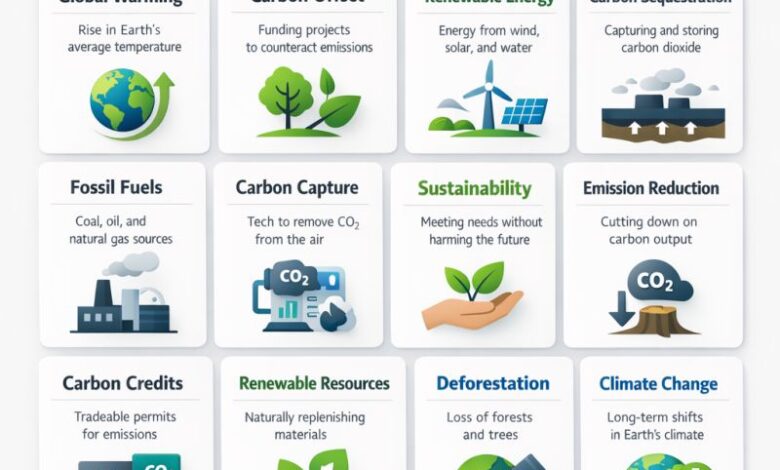
Decarbonization Lexicon: 20 Essential Carbon & Climate Strategy Terms
Achieving carbon literacy is the foundation of effective corporate sustainability, environmental governance, and climate policy. Understanding these core concepts enables decision-makers to evaluate climate risk, navigate ESG compliance, prevent greenwashing, and execute measurable decarbonization strategies.
Here is an authoritative guide to 20 fundamental terms shaping the low-carbon economy, categorized by their operational role.
I. Emissions Accounting & Metrics
1. Carbon Footprint
The total volume of greenhouse gas (GHG) emissions caused directly and indirectly by an individual, event, organization, service, or product. It is expressed as carbon dioxide equivalent CO2e to aggregate the impact of multiple gases.
2. Carbon Dioxide Equivalent (CO2)
A standard unit for measuring and comparing the warming impact of various greenhouse gases relative to carbon dioxide. For example, emitting 1 metric ton of methane equals roughly 28 to 36 metric tons of CO2e over a 100-year timescale.
3. Global Warming Potential (GWP)
An index measuring how much heat a specific greenhouse gas traps in the atmosphere over a designated timeframe (typically 20 or 100 years) compared to carbon dioxide, which has a baseline GWP of 1.
4. Methane (CH4)
A potent greenhouse gas emitted during the production and transport of coal, natural gas, and oil, as well as from livestock practices, organic waste decomposition in landfills, and wastewater treatment. It has over 80 times the warming power of CO2 over a 20-year period.
II. GHG Protocol Operational Scopes
                       [GHG PROTOCOL EMISSIONS SCOPES]
                                      │
         ┌────────────────────────────┼────────────────────────────┐
         ▼                            ▼                            ▼
   [Scope 1: Direct]          [Scope 2: Indirect]          [Scope 3: Value Chain]
 • On-site fuel combustion   • Purchased electricity      • Upstream supply chain
 • Company fleet vehicles    • Purchased heating/cooling  • Downstream product use
 • Process emissions         • Purchased steam            • Business travel & waste
5. Scope 1 Emissions (Direct)
Direct greenhouse gas emissions originating from sources owned or controlled by an organization, such as fuel burned in boilers, furnaces, manufacturing equipment, and company-owned vehicles.
6. Scope 2 Emissions (Indirect – Energy)
Indirect GHG emissions associated with the generation of purchased electricity, steam, heating, or cooling consumed by an organization.
7. Scope 3 Emissions (Indirect – Value Chain)
All other indirect emissions occurring across an organization’s value chain, both upstream (e.g., raw material extraction, supply chain logistics) and downstream (e.g., product distribution, customer usage, and end-of-life disposal). Scope 3 typically comprises over 80% of a company’s total footprint.
III. Climate Targets & Strategic Frameworks
8. Net Zero
A state where an entity’s residual greenhouse gas emissions are balanced by an equivalent volume of permanent carbon removal from the atmosphere. Under international standards (such as the Science Based Targets initiative – SBTi), achieving Net Zero requires deep emissions reductions of 90–95% before relying on carbon removals for residual emissions.
9. Carbon Neutrality
A balance between carbon emissions and carbon absorption. Unlike Net Zero which strictly mandates drastic internal emissions cuts across all scopes and addresses all GHGs carbon neutrality can be claimed primarily through purchasing carbon offsets to balance emissions (often focusing solely on CO2).
10. Science Based Targets (SBTi)
Emissions reduction targets aligned with the scale of reductions required by climate science to limit global warming to 1.5°C above pre-industrial levels, as outlined in the Paris Agreement.
11. Decarbonization
The systematic process of reducing or eliminating greenhouse gas emissions from an organization’s operations, energy supply, supply chain, and broader economic activities.
IV. Carbon Removal, Sequestration & Offsetting
12. Carbon Sequestration
The process of capturing and storing atmospheric carbon dioxide. This occurs naturally through biological sinks (forests, soil, mangroves, oceans) or technologically via artificial storage media.
13. Carbon Capture, Utilization, and Storage (CCUS)
A suite of technologies that capture CO2 emissions directly from point-source industrial facilities (e.g., cement plants, power generation) or ambient air. The captured carbon is either compressed and permanently injected into deep geological formations or utilized as a feedstock in manufacturing.
14. Carbon Credit
A tradable certificate or permit representing the right to emit 1 metric ton of carbon dioxide or an equivalent amount of another GHG (1 CO2e). Carbon credits are generated by verified projects that avoid, reduce, or remove emissions.
15. Carbon Offset
A financial mechanism that allows an individual or organization to compensate for their own emissions by funding verified emission reduction or carbon removal projects elsewhere (e.g., reforestation, renewable energy deployment).
V. Policy, Economics & Energy Systems
16. Carbon Pricing
An economic instrument that places an explicit cost on greenhouse gas emissions to incentivize businesses to lower emissions. Carbon pricing is primarily implemented through Carbon Taxes (a fixed price per ton emitted) or Emissions Trading Systems (ETS) / Cap-and-Trade (a market-determined price based on capped allowance limits).
17. Renewable Energy
Energy generated from natural resources that replenish themselves continuously without depleting Earth’s resources or emitting greenhouse gases during operation such as solar, wind, hydroelectric, geothermal, and ocean energy.
18. Circular Economy
An economic model designed to eliminate waste and pollution, circulate products and materials at their highest value, and regenerate nature. By extending material lifecycles, circularity significantly reduces embodied Scope 3 carbon emissions.
19. Greenwashing
The practice of making misleading, exaggerated, or unsubstantiated claims regarding the environmental benefits or carbon reductions of a company’s products, services, or overall business practices.
20. Embodied Carbon
The total greenhouse gas emissions generated during the extraction, processing, manufacturing, transportation, and assembly of raw materials used to create a physical asset (such as buildings, infrastructure, or consumer goods) prior to its operational phase.
Comparison Matrix: Key Carbon Terms
| Concept | Scope / Coverage | Primary Mechanism | Regulatory Rigor |
| Net Zero | All GHGs across Scopes 1, 2 & 3 | Requires 90–95% direct reductions + permanent removal | High (Governed by SBTi framework) |
| Carbon Neutrality | Primarily CO2 (often Scopes 1 & 2) | Balances footprint using carbon offsets | Variable / Voluntary standards |
| Carbon Offset / Credit | 1 CO2e per unit | Market trade of reduction/removal certificates | Governed by standards like Verra / Gold Standard |
| Embodied Carbon | Upstream raw materials & manufacturing | Lifecycle assessment (LCA) of physical goods | Emerging (Green procurement laws) |
source:
https://www.linkedin.com/feed/update/urn:li:activity:7486331695881707520/


