12 Dimensions of sustainable green buildings
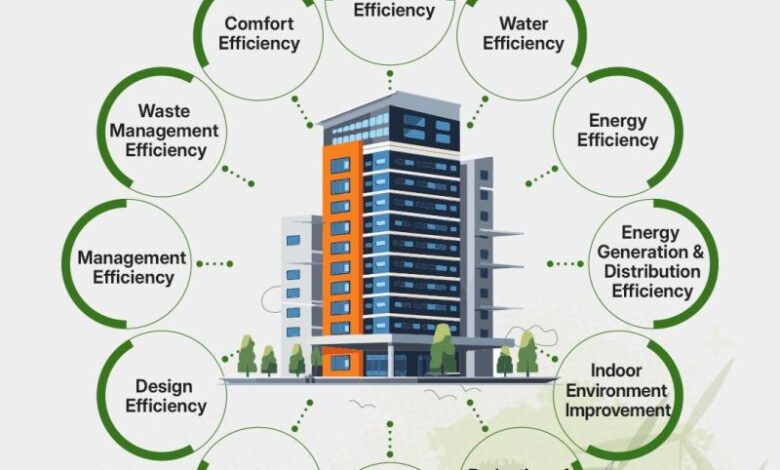
The 12 Dimensions of Regenerative Architecture: A Strategic Framework
A truly “Green” building is a living system. It moves beyond the “do less harm” philosophy toward Regenerative Design where the building actively contributes to the health of its occupants and the restoration of its environment.
Here is the 12-dimensional matrix that defines the next generation of the built environment.
Cluster I: Resource Metabolism (The Input/Output)
This cluster focuses on how the building “consumes” and “digests” natural resources.
- 1. Water Efficiency (Hydrological Balance): Moving toward “Net-Zero Water” through atmospheric water generation, blackwater recycling, and xeriscaping.
- 2. Energy Efficiency (The Passive First Principle): Utilizing high-performance envelopes to minimize demand before applying technology.
- 3. Energy Generation & Distribution (The Prosumer Model): Transforming buildings from energy consumers into “Micro-Grids” that generate, store, and share renewable power with the community.
- 4. Waste Management Efficiency (The Circular Loop): Implementing onsite composting and “cradle-to-cradle” waste streams to ensure zero operational waste reaches landfills.
Cluster II: Structural Integrity & Materiality (The Physical Body)
Sustainability is embedded in the “bones” of the building, focusing on long-term resilience.
- 5. Land Efficiency (Density & Biophilia): Prioritizing brownfield redevelopment and vertical integration to preserve natural carbon sinks and biodiversity.
- 6. Material Efficiency (Embodied Carbon): Selecting materials based on their Life Cycle Assessment (LCA), favoring mass timber, recycled steel, and low-carbon cement.
- 7. Resource Efficiency (Sourcing Ethics): Ensuring every component is ethically sourced, renewable, and harvested within a local radius to minimize transport emissions.
- 8. Design Efficiency (Form Follows Performance): Optimizing building orientation and geometry to leverage natural light and passive heating/cooling.
Cluster III: Human Centricity (The Experience)
A building is only sustainable if it supports the long-term health and productivity of its inhabitants.
- 9. Indoor Environment Quality (IEQ): Advanced HEPA filtration, CO2 monitoring, and the elimination of VOC-emitting materials to create “Air-Positive” spaces.
- 10. Comfort Efficiency (Thermal & Acoustic Harmony): Moving beyond simple HVAC to radiant heating/cooling and acoustic dampening that aligns with human circadian rhythms.
- 11. Management Efficiency (Digital Twins): Using AI-driven Building Management Systems (BMS) to predict maintenance needs and optimize performance in real-time.
Cluster IV: Global Impact (The Legacy)
The final dimension measures the building’s footprint on the planetary scale.
- 12. Greenhouse Gas Reduction (Decarbonization): A holistic accounting of both Embodied Carbon (construction) and Operational Carbon (use) to reach a true Net-Zero or Carbon-Negative status.
Strategic Comparison: The Green Building Evolution
| Metric | Conventional Building | Sustainable Green Building |
| Philosophy | Compliance-based | Performance-based |
| Financial View | Short-term CAPEX focus | Long-term Life Cycle Value (LCV) |
| Occupant Impact | Passive shelter | Health and Productivity catalyst |
| Grid Relation | Parasitic (draws only) | Symbiotic (gives back) |
The 12 dimensions prove that sustainability is an optimization problem, not a sacrifice. By aligning these pillars, developers create assets that are more valuable, cheaper to operate, and fundamentally better for the people inside them.
source: