Understanding six types of carbon
Most professionals know carbon emissions. But did you know that carbon comes in different forms, each with a different role in our climate system❓🤷♂️
Understanding these six types of carbon helps us better understand climate change, carbon storage, and environmental sustainability.
Here’s a practical breakdown:
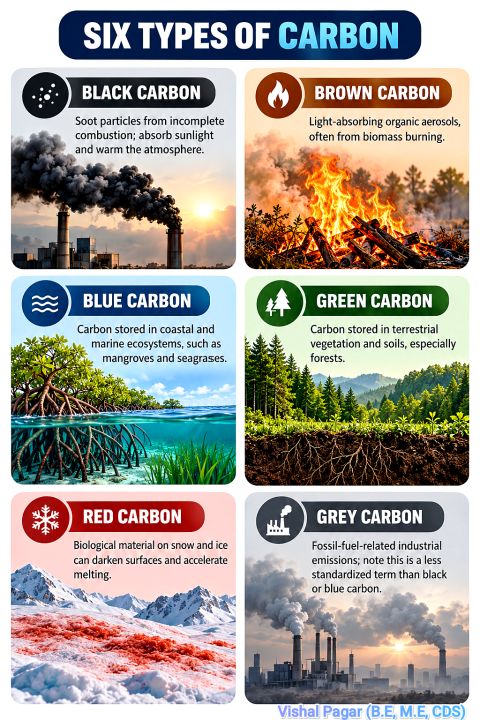
1. Black Carbon
– Produced by incomplete combustion of fossil fuels, biomass, and other materials.
– Absorbs sunlight and contributes to atmospheric warming.
– Common sources include diesel engines, industrial combustion, and soot.
2. Brown Carbon
– A light-absorbing component of organic aerosols.
– Often released during biomass burning, such as forest fires and the burning of wood.
– Can contribute to atmospheric warming, although its effects vary.
3. Blue Carbon
– Carbon captured and stored by coastal and marine ecosystems.
– Major ecosystems include mangroves, seagrasses, and salt marshes.
– Protecting these ecosystems supports climate mitigation and biodiversity.
4. Green Carbon
– Carbon captured and stored in terrestrial vegetation and soils.
– Forests, grasslands, and other land ecosystems play an important role.
– Deforestation and land degradation can release stored carbon.
5. Red Carbon
– Refers to biological material, such as algae and microorganisms, that can accumulate on snow and ice.
– These organisms can darken reflective surfaces, reduce albedo, and accelerate melting.
– This is a less standardized term than blue or green carbon.
6. Grey Carbon
– Sometimes used to describe carbon associated with fossil-fuel-based industrial activities and emissions.
– However, grey carbon is not a universally standardized scientific category.
– In carbon accounting, it is more useful to quantify emissions by source, scope, and life cycle stage.
Why does this matter for sustainability professionals?
Understanding these distinctions helps us:
– Identify different climate forcing mechanisms.
– Recognize the importance of natural carbon sinks.
– Evaluate ecosystem restoration and conservation strategies.
– Improve carbon footprint assessments and climate action planning.
– Avoid confusing carbon storage with carbon emissions.
One important distinction: black and brown carbon are associated with light-absorbing particles, while blue and green carbon focus on carbon captured and stored in ecosystems. Red and grey carbon are less standardized terms and should be used with clear definitions.
For sustainability professionals, the key is not just knowing the terminology. It is understanding the science behind it and applying the right concepts to real-world environmental decisions.