9Rs of circularity
Designing Waste Out of Existence: Strategic Mastery of the 9Rs
Most organizations mistake recycling for a circular strategy. In reality, recycling is a failure of circular design an energy-intensive last resort reserved for materials that can no longer yield value at a higher system level.
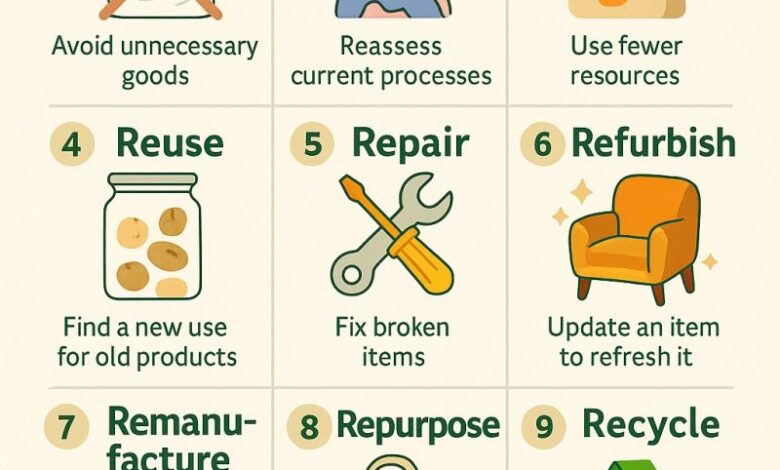
A true circular economy does not optimize waste management; it renders waste obsolete by design. The 9R Framework provides a prioritized hierarchy for value preservation. The higher an intervention sits on the framework, the less energy, capital, and raw material are required to sustain product utility.
The 9R Circularity Hierarchy
Level 1: Smarter Product Use and Manufacture
- 1. Refuse: Make a product redundant by abandoning its function or offering a radically different digital/functional alternative (e.g., shifting from physical media to cloud software, or eliminating single-use packaging entirely).
- 2. Rethink: Intensify product usage through sharing platforms, product-as-a-service (PaaS) business models, and multi-functional design ecosystems.
- 3. Reduce: Increase efficiency in product manufacturing or consumption by consuming fewer natural resources and materials per unit produced.
Level 2: Extending Lifetime of Product and Its Parts
- 4. Reuse: Re-use a redundant, functional product by another user without alteration or physical modifications.
- 5. Repair: Restore a broken or defective product to functional operation so it can be used with its original purpose.
- 6. Refurbish: Overhaul and modernize an old product to update performance standards or aesthetic quality.
- 7. Remanufacture: Disassemble, test, and rebuild end-of-life products using recovered, tested, and high-quality parts to perform like new with equivalent warranties.
- 8. Repurpose: Adapt a discarded product or its components for a completely different function or industry application (e.g., transforming retired EV batteries into stationary grid energy storage).
Level 3: Useful Application of Materials
- 9. Recycle: Process materials to obtain raw material quality equal to (downcycling/upcycling) or lower than the original material, preserving elements only when all higher-value structural options are exhausted.
Executive Breakdown: Value Retention Across the 9Rs
| Circular Level | Rs Included | Material Structural Integrity | Energy Required | Primary Value Driver |
| High Value | Refuse, Rethink, Reduce | 100% Intact (Avoided) | Minimal / Zero | Avoided CapEx, Zero Material Cost |
| Medium Value | Reuse, Repair, Refurbish, Remanufacture, Repurpose | Preserved / Restored | Moderate | Labor & Component Recovery |
| Low Value | Recycle | Destroyed (Chemical/Mechanical) | High | Scrap Material Value Only |
Strategic Imperatives for Business Transformation
Moving up the 9R ladder requires a fundamental pivot across three organizational pillars:
- Design for Disassembly: Engineers must select modular components, standardized fasteners, and non-composite materials to enable frictionless repair, refurbishment, and remanufacturing.
- Business Model Innovation: Companies must transition from transactional sales to Product-as-a-Service (PaaS) or lease structures, internalizing product longevity as a profit driver rather than a revenue risk.
- Reverse Logistics Networks: Supply chains must be re-engineered to facilitate localized take-back mechanisms, component harvesting, and secondary market redistribution efficiently.
In a mature circular system, the measure of success is not how many tons of material enter the recycling stream, but how long high-value goods remain in high-utility loops before recycling is ever required.