Tahukah Anda
Commonly interchanged ESG terms
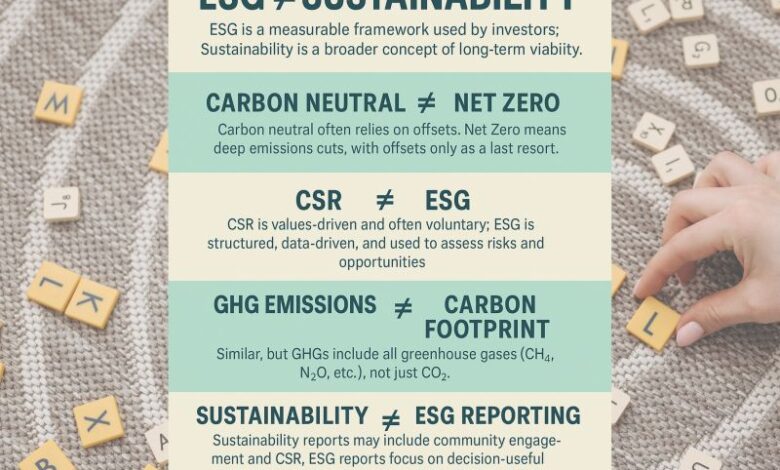
Navigating the ESG Lexicon: Unpacking Key Terms for Clarity and Impact
In the rapidly evolving landscape of sustainability and Environmental, Social, and Governance (ESG), language plays a pivotal role. Yet, the very terms intended to clarify are often subject to misuse or misunderstanding, frequently employed interchangeably despite carrying distinct and significant implications. This guide aims to demystify some of the most commonly confused concepts, providing a sharper understanding for investors, businesses, and stakeholders alike.
Let’s clear the fog:
- ESG ≠ Sustainability While often used in tandem, ESG and Sustainability are not synonymous. ESG (Environmental, Social, Governance) functions as a quantifiable framework primarily utilized by investors to evaluate a company’s performance across specific non-financial metrics. It provides a structured lens through which to assess risks and opportunities related to these criteria. In contrast, Sustainability is a much broader, overarching concept that speaks to the long-term viability of systems—be they ecological, economic, or social. It encompasses the capacity to endure and thrive without depleting resources or causing irreversible damage, aiming for a balance that meets the needs of the present without compromising future generations.
- Carbon Neutral ≠ Net Zero These terms represent different levels of ambition and methodologies in addressing greenhouse gas emissions. Carbon Neutral typically signifies that a company or entity has balanced its carbon dioxide (CO₂) emissions by either reducing them or, more commonly, by purchasing carbon offsets to compensate for remaining emissions. The reliance on offsets can be substantial. Net Zero, however, represents a far more ambitious and scientifically grounded target. It demands deep and significant cuts in all greenhouse gas (GHG) emissions across a company’s value chain, with offsets utilized only as a last resort for truly unavoidable emissions. The emphasis is on absolute reduction first.
- CSR ≠ ESG The distinction between Corporate Social Responsibility (CSR) and ESG lies primarily in their drivers, structure, and application. CSR is largely values-driven, often voluntary, and traditionally focuses on a company’s initiatives to contribute positively to society, such as philanthropy, community engagement, or ethical labor practices. It tends to be qualitative and narrative based. Conversely, ESG is highly structured and data-driven. It serves as an analytical framework for assessing specific, measurable risks and opportunities across environmental, social, and governance dimensions, directly influencing investment decisions and enterprise risk management.
- GHG Emissions ≈ Carbon Footprint These terms are closely related, often used interchangeably, but with a subtle yet important difference. A Carbon Footprint refers specifically to the total amount of greenhouse gases (GHGs) generated by an individual, event, product, or organization, expressed as carbon dioxide equivalent (CO₂e). GHG Emissions is the more encompassing term, referring to the release of all greenhouse gases including not only carbon dioxide (CO₂) but also methane (CH₄), nitrous oxide (N₂O), fluorinated gases, and others into the atmosphere. While a carbon footprint quantifies these emissions, GHG emissions refers to the broader category of gases themselves.
- Sustainability Reporting ≠ ESG Reporting While both involve disclosure, their scope and focus differ. Sustainability Reports tend to be more expansive, often including a wider array of information such as community engagement initiatives, philanthropic activities, and broader CSR efforts that highlight a company’s overall commitment to sustainable development. ESG Reports, on the other hand, are typically more focused on providing decision-useful data that aligns with recognized reporting standards. These standards include the Global Reporting Initiative (GRI), the International Sustainability Standards Board (ISSB), or the Task Force on Climate-related Financial Disclosures (TCFD), emphasizing quantitative metrics relevant to investors’ assessments of risks and opportunities.
- Impact Investing ≠ Sustainable Investing These are distinct approaches within responsible investment. Sustainable Investing generally refers to an investment strategy that considers ESG factors to avoid harm, mitigate risks (e.g., screening out industries with high ESG risks), or align with ethical values. The primary goal is often to achieve competitive financial returns while integrating ESG considerations. In contrast, Impact Investing has a dual objective: to generate positive, measurable social and environmental impact alongside a financial return. It actively targets specific, tangible change, seeking to address pressing global challenges through capital allocation.
source: