
Sustainability acronyms you need to knows
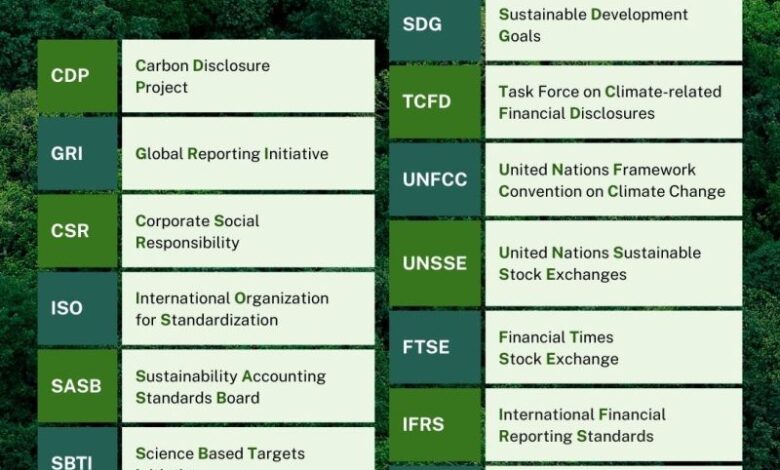
1. The Strategic North Star
These acronyms represent the high-level goals and values that guide organizational strategy.
- SDGs (Sustainable Development Goals): A collection of 17 interlinked global goals designed by the UN to be a “blueprint to achieve a better and more sustainable future for all” by 2030.
- ESG (Environmental, Social, and Governance): A framework used by investors and institutions to measure the sustainability and ethical impact of an investment in a business.
- UNFCCC (United Nations Framework Convention on Climate Change): The international environmental treaty established to combat “dangerous human interference with the climate system,” primarily through the reduction of greenhouse gas concentrations.
2. Reporting & Transparency Frameworks
As the saying goes, “You cannot manage what you do not measure.” ini these acronyms define how companies disclose their impact.
| Acronym | Full Name | Primary Function |
| GRI | Global Reporting Initiative | The most widely used standards for sustainability reporting on an organization’s economic, environmental, and social impacts. |
| TCFD | Task Force on Climate-related Financial Disclosures | Framework for companies to provide information to investors about their climate-related financial risks. |
| CSRD | Corporate Sustainability Reporting Directive | A new EU regulation requiring large companies to publish regular reports on their environmental and social impact activities. |
| IFRS | International Financial Reporting Standards | Specifically the ISSB (International Sustainability Standards Board) under IFRS, which aims to create a global baseline for sustainability disclosures. |
3. Climate Science & Metrics
These terms focus on the technical reality of emissions and the scientific targets required to stay within planetary boundaries.
- GHG (Greenhouse Gas): Gases (like CO2, CH4, and N2O) that trap heat in the atmosphere. Measurement is often standardized as CO2e (Carbon Dioxide Equivalent).
- SBTi (Science Based Targets initiative): A partnership that defines and promotes best practices in emissions reductions and net-zero targets in line with climate science (the Paris Agreement).
- ISO (International Organization for Standardization): Specifically ISO 14001 (Environmental Management) and ISO 50001 (Energy Management), which provide world-class specifications for products, services, and systems.
4. Policy & Market Mechanisms
These acronyms represent the “teeth” of sustainability the laws and economic tools that enforce change.
- CBAM (Carbon Border Adjustment Mechanism): A landmark EU tool that puts a fair price on the carbon emitted during the production of carbon-intensive goods entering the EU, preventing “carbon leakage.”
- EPR (Extended Producer Responsibility): A policy approach where producers are given a significant responsibility financial and/or physical for the treatment or disposal of post-consumer products (e.g., plastic packaging).
Why This Matters
Mastering this lexicon is no longer optional for the modern professional. These aren’t just labels; they are the mechanical parts of a Circular Economy. From the CBAM affecting international trade to SBTi dictating corporate roadmaps, these acronyms provide the data-driven language needed to transition from “greenwashing” to “green acting.”


