
Global warming and climate change
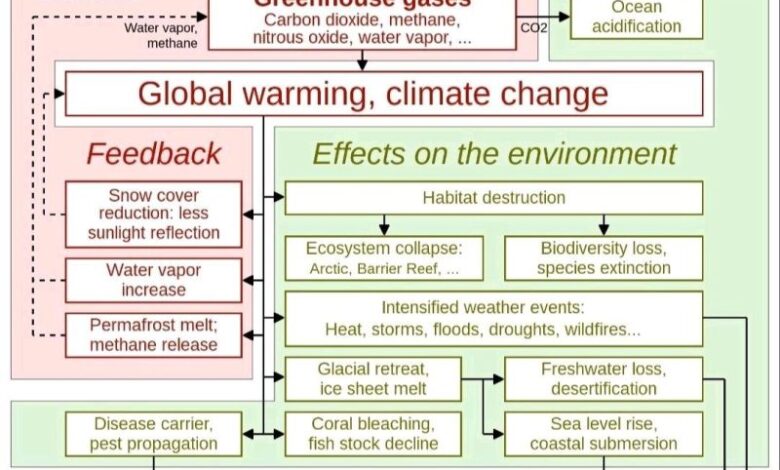
The Great Unraveling: Decoding the Climate Chain Reaction
Climate change is far more than a statistic or a distant forecast it is a high-stakes chain reaction where every human action triggers a global ripple effect. To understand our current crisis is to understand a system in distress, where one collapsing domino inevitably topples the next.
1. The Spark: Atmospheric Overload
The reaction begins at the molecular level. Human activity fueled by our reliance on coal, oil, and industrial agriculture saturates the sky with greenhouse gases.
- The Trap: Carbon dioxide (CO2), methane (CH4), and nitrous oxide (N2O) act as a thermal blanket.
- The Result: Solar energy that once escaped into space is now held captive, forcing the planet’s average temperature to climb at an unprecedented rate.
2. The Feedback Loop: Nature’s Accelerants
The true danger of global warming isn’t just the heat itself; it’s the feedback loops that make the process self-sustaining. As the world warms, the planet’s natural cooling mechanisms transform into heaters:
- The Albedo Effect: As white Arctic ice melts, it reveals dark ocean water. Instead of reflecting sunlight, the dark water absorbs it, melting even more ice.
- The Permafrost “Carbon Bomb”: Thawing frozen ground in the tundra releases ancient stores of methane a gas 80 times more potent than CO2 in the short term creating a cycle that humanity cannot easily switch off.
3. The Collapse: From Ecosystems to Infrastructure
When natural systems break, the consequences move from the wilderness into our backyards. We are no longer witnessing “natural disasters”; we are witnessing the new normal of systemic instability.
| System | Immediate Impact | Long-term Consequence |
| Cryosphere | Melting glaciers and ice sheets. | Global sea-level rise threatening coastal megacities. |
| Biosphere | Habitat loss and shifting seasons. | Mass extinction and the collapse of pollinator networks. |
| Atmosphere | Intensified energy and moisture. | Hyper-frequent “100-year” floods, wildfires, and droughts. |
4. The Human Cost: The End of the Ripple
Ultimately, the chain reaction ends with us. Climate change is a threat multiplier for every existing human vulnerability:
- Food & Water Insecurity: Degraded farmland and erratic rainfall turn breadbaskets into dust bowls.
- Economic Displacement: Rising tides and unlivable heat create a new class of “climate migrants,” forcing millions to leave their ancestral homes.
- Health Crises: Warmer climates expand the territory of disease-carrying insects and increase the lethality of heat-related illnesses.
The connectivity of our planet is our greatest vulnerability, but it is also our greatest hope. Just as one negative action triggers a chain of destruction, one strategic intervention can trigger a chain of recovery.
Transitioning to renewable energy, restoring global forests, and redesigning our cities aren’t just “environmental” goals they are the emergency brakes on a system heading toward a tipping point.
The challenge is clear: Breaking the chain reaction today is an act of courage; attempting to reverse it tomorrow may be an impossibility.


