
Nature based solutions climate resilience
The New Frontier of Strategic Infrastructure
In the face of climate volatility, the traditional reliance on concrete and steel “Gray Infrastructure” is reaching its breaking point. These static systems are expensive to build, prone to failure under extreme stress, and depreciate over time. In contrast, Nature-Based Solutions (NbS) represent a dynamic class of infrastructure that grows in value, adapts to changing conditions, and delivers a compounded return on investment.
1. The Performance Advantage: Beyond “Gray” Constraints
NbS are not merely “green” alternatives; they are high-performance systems designed to manage systemic environmental risks.
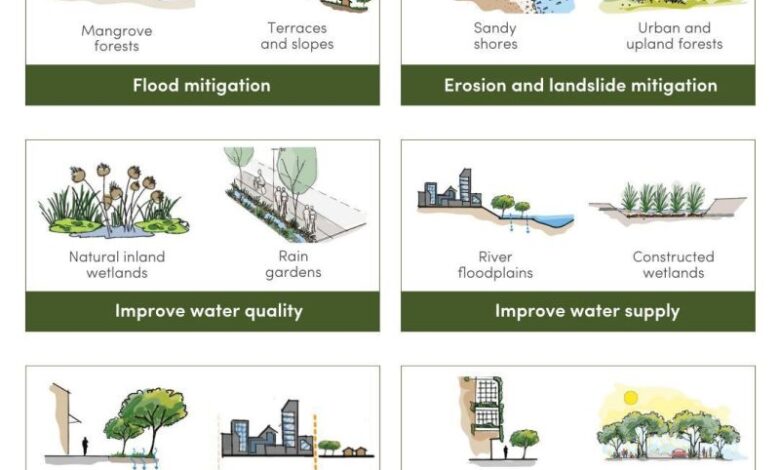
- Coastal Defense (Mangroves vs. Sea Walls): While sea walls are static and vulnerable to erosion, mangrove forests are self-repairing barriers. They attenuate wave energy by up to 66%, sequester carbon, and provide nursery grounds for fisheries creating a multi-sector economic boost that concrete cannot replicate.
- Urban Cooling (Canopies vs. Air Conditioning): Tree canopies actively reduce the “Urban Heat Island” effect, lowering ambient temperatures by up to 8oC. This reduces municipal energy demand and improves public health outcomes, directly impacting city budgets.
2. Economic Multipliers: The “Dividend” of Restoration
Investing in nature-based infrastructure triggers a cascade of economic benefits, often referred to as the “Green Dividend.”
| Function | Nature-Based Solution | Economic Multiplier |
| Water Security | Wetland & Watershed Restoration | Reduced filtration costs; stabilized agricultural supply. |
| Stormwater | Rain Gardens & Bioswales | Avoided “Gray” drainage expansion; reduced flood damage. |
| Slope Stability | Terracing & Reforestation | Lowered wildfire risk; protected transport corridors. |
| Public Health | Urban Green Spaces | Reduced healthcare expenditures related to air quality/heat. |
3. Scalability and the “Blue-Green” Economy
What makes NbS strategically superior is their Fractal Scalability. These solutions can be deployed as hyper-local urban interventions (Rain Gardens) or as massive regional restoration projects (Peatland rewetting).
- Capital Efficiency: NbS often require lower upfront capital expenditures (CAPEX) than gray infrastructure and have significantly lower long-term maintenance costs (OPEX), as the systems are biologically programmed to maintain themselves.
- Inclusion and Livelihoods: Unlike a concrete dam, a restored wetland supports local tourism, sustainable harvesting, and biodiversity, ensuring that climate resilience is inclusive of the communities it serves.
4. The Strategic Pivot: Integrating Ecosystems into Planning
The World Resources Institute and other global leaders are signaling a shift: Infrastructure is no longer just built; it is cultivated. For governments and industries, integrating NbS into master planning is the ultimate hedge against climate uncertainty.
The Strategic Roadmap:
- Valuation: Assigning a monetary value to ecosystem services (e.g., the “replacement cost” of a forest for a water treatment plant).
- Hybridization: Combining Gray and Green infrastructure (e.g., using dunes to protect a coastal highway) to maximize resilience.
- Blended Finance: Leveraging green bonds and carbon credits to fund large-scale restoration projects.
Engineering with the Earth
The future of the global economy does not lie in a struggle against nature, but in the sophisticated integration of it. By moving from a “Command and Control” engineering mindset to one of “Co-evolutionary Design,” we can build cities and supply chains that are not just resilient, but regenerative.
Nature is not a luxury for the green economy it is the engine that will drive its survival. It is time to treat our ecosystems as the essential infrastructure assets they have always been.
source:
https://www.linkedin.com/feed/update/urn:li:activity:7451537687054041089


