How can cities reduce their carbon footprint?
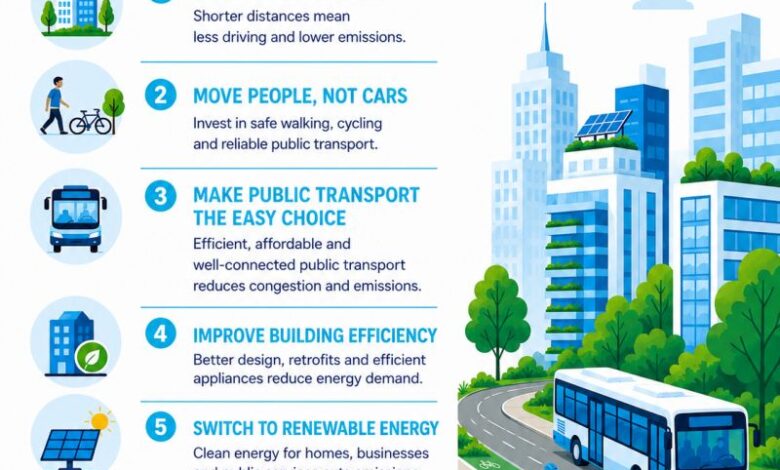
Urban Decarbonization: 7 Structural Strategies for Climate-Resilient Cities
Cities consume over 78% of the world’s energy and produce more than 60% of global greenhouse gas (GHG) emissions despite occupying less than 3% of Earth’s land surface. Because urban environments concentrate infrastructure, economic capital, and human activity, urban design represents the single most impactful lever for systemic climate mitigation.
Achieving net-zero urbanism requires moving beyond incremental municipal tweaks to fundamental structural, technological, and spatial transformations across seven core domains.
1. Compact Urban Layouts & Transit-Oriented Development (TOD)
The physical footprint of a city dictates its baseline energy demand. Sprawling urban layouts force dependence on personal private vehicles and multiply civil infrastructure requirements.
- 15-Minute City Model: Structuring urban zones so that daily necessities—work, retail, healthcare, education, and recreation—are reachable within a 15-minute walk or micro-mobility ride.
- Transit-Oriented Development (TOD): Densifying residential and commercial zones directly around high-capacity public transit hubs (BRT, light rail, and metro networks) to eliminate car dependency at the spatial level.
[Low-Density Urban Sprawl] ──► High Vehicle Miles Traveled (VMT) ──► Elevated Per Capita Emissions
[Transit-Oriented Density]  ──► Active Mobility & Mass Transit   ──► Lower Infrastructure Energy Footprint
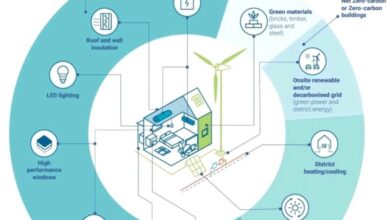
2. Decarbonizing Building Stock & Electrification
Buildings account for roughly 40% of global energy-related carbon emissions—split between operational carbon (heating, cooling, lighting) and embodied carbon (materials and construction).
                      [BUILDING CARBON BREAKDOWN]
                                   │
        ┌──────────────────────────┴──────────────────────────┐
        ▼                                                     ▼
[Operational Carbon Mitigation]               [Embodied Carbon Mitigation]
• Building Envelope Retrofits (Insulation, double glazing) • Low-Carbon Materials (Cross-Laminated Timber [CLT])
• Heat Pump Integration (Replacing fossil-fuel boilers)    • Recycled Aggregate & Green Cement Formulations
• On-Site Solar PV & Smart Energy Management (BMS)         • Circular Construction & Material Passports
3. Active Transportation & Fleet Electrification
Transitioning urban mobility requires a two-pronged strategy: shifting trips from motorized vehicles to active transport, and electrifying all remaining transit systems.
- Protected Micro-Mobility Networks: Separating bike, e-bike, and scooter corridors from vehicular traffic to increase safety and active transport adoption.
- Zero-Emission Municipal Fleets: Mandatory electrification of municipal buses, waste collection vehicles, and emergency fleets, coupled with low-emission zones (LEZ) that restrict high-polluting internal combustion engines (ICE) from dense urban centers.
4. Nature-Based Solutions (NbS) & Urban Forestry
Urban heat islands (UHI)—caused by dark asphalt, dense concrete mass, and waste heat from human activity—substantially increase summer cooling energy demands. Integrating nature into streetscapes mitigates heat while restoring ecological balance.
- Sponge City Infrastructure: Permeable pavements, bioswales, rain gardens, and constructed wetlands reduce urban flooding, filter stormwater, and recharge local aquifers.
- Urban Canopy & Green Roofs: Expanding shade trees and vegetative green roofs reduces surface temperatures through evapotranspiration, reducing air conditioning load in surrounding buildings.
5. Circular Waste Systems & Methane Abatement
Municipal solid waste landfills are major point sources of methane ($\text{CH}_4$), a potent short-lived climate pollutant with over 28 times the global warming potential of $\text{CO}_2$ over a 100-year period.
- Organic Waste Diversion: Mandatory municipal composting and anaerobic digestion to capture biogas for energy while preventing organic waste from degrading in anaerobic landfill environments.
- Waste-to-Energy (PSEL) & Extended Recycling: Integrating modern waste-to-energy facilities equipped with advanced flue-gas scrubbing alongside closed-loop municipal material recovery facilities (MRFs).
6. Decentralized Smart Energy Grids & Local Generation
Traditional centralized power grids lose energy through long-distance transmission and rely heavily on fossil baseloads. Modern cities are transitioning into decentralized energy producers.
- District Energy Systems: Utilizing centralized heat pumps, geothermal loops, or industrial waste heat to heat and cool entire neighborhoods efficiently.
- Microgrids & Virtual Power Plants (VPPs): Pairing distributed rooftop solar arrays with localized battery energy storage systems (BESS) managed by smart grids to balance peak demand dynamically.
7. Green Public Procurement & Eco-Modulated Policy
Urban decarbonization requires strong institutional frameworks that align market incentives with climate goals.
- Sustainable Public Procurement: Mandating carbon footprint thresholds for materials used in municipal infrastructure projects (roads, bridges, public housing).
- Congestion Pricing & Density Bonuses: Internalizing the climate cost of urban driving through congestion fees, while granting zoning density bonuses to developers who exceed minimum green building standards.
Summary Matrix: The 7 Pillars of Urban Decarbonization
| Strategy Pillar | Primary Carbon Mechanism | Core Implementation Lever |
| 1. Compact TOD Layouts | Reduces Vehicle Miles Traveled (VMT) | Zoning reform, mixed-use development |
| 2. Green Building Stock | Abates operational & embodied emissions | Heat pumps, building retrofits, mass timber |
| 3. Electrified Mobility | Eliminates tailpipe emissions | LEZs, protected bike lanes, EV bus fleets |
| 4. Nature-Based Infrastructure | Mitigates Urban Heat Island (UHI) effect | Bioswales, sponge city design, urban canopies |
| 5. Circular Waste Management | Prevents landfill methane generation | Anaerobic digestion, organic waste diversion |
| 6. Smart Energy Grids | Replaces fossil grid baseload | District energy, rooftop solar PV, microgrids |
| 7. Policy & Procurement | Drives systemic market transformation | Congestion pricing, low-carbon municipal purchasing |
source:
https://www.linkedin.com/posts/climatechange-sustainable-share-7487748920450801664-WRRt/