Climate action guide for urban planners: a blueprint for building resilient, sustainable cities
By 2050, a staggering two-thirds of humanity will be city dwellers. This historic urban shift presents immense opportunities but also substantial challenges, as cities face the pressure to accommodate millions while mitigating escalating climate risks. Urban expansion is often accompanied by outward sprawl, converting vast swathes of land to development and amplifying environmental pressures. The built-up area of cities is growing faster than their populations, sprawling into areas vulnerable to extreme weather, flooding, and heat stress.Approximately 80% of global cities now grapple with significant climate risks, while an overwhelming 90% of urban expansion in Global South countries happens near climate-vulnerable areas. Unfortunately, much of this growth comprises informal settlements, which lack robust infrastructure and planning, making millions of residents particularly susceptible to climate hazards. These trends highlight an urgent need for targeted climate action in urban planning—a pivotal strategy to build resilient, low-carbon cities prepared for the future.
A Comprehensive Guide for Urban Planners
The new Climate Action Guide for Urban Planners, available in English, French, Spanish, Portuguese, and Arabic, is designed to empower urban planners worldwide to be climate champions in their communities. Published by C40 Cities in collaboration with Community Jameel and UrbanShift, this guide outlines actionable pathways for integrating climate considerations into city plans, focusing on urban resilience and emissions reduction. Through a blend of innovative policies and real-world examples, it offers urban planners a roadmap to align their work with global climate goals.
Urban Planning as a Core Climate Solution
Urban planning holds transformative potential for climate action. Decisions made by planners impact how cities grow, how people live, and how ecosystems are preserved or degraded. This guide emphasizes the unique position urban planning occupies in shaping low-carbon, climate-resilient cities and improving residents’ quality of life. Key recommendations include:
Promoting Increased Density and Efficient Built Forms: By building compactly, cities can lower emissions from transportation and buildings while enhancing urban vibrancy.
Encouraging Mode-Shift: Reducing reliance on cars through accessible, transit-oriented development can significantly cut transportation emissions and promote healthier lifestyles.
Curbing Urban Sprawl: By limiting development on greenfield sites, cities can conserve natural landscapes, maintaining their essential carbon storage capacities and ecological functions.
Restricting Development on Hazard-Prone Lands: Thoughtful planning can reduce urban exposure to floods, landslides, and other climate hazards, especially critical as extreme weather events become more frequent.
Integrating Nature-Based Solutions: Urban green spaces, wetlands, and forests not only improve residents’ quality of life but also serve as buffers against heatwaves, floods, and other climate-related risks.
A Step-By-Step Guide for Climate-Responsive Urban Planning
The guide is organized around two central frameworks. The first includes ten stages of urban plan preparation, each explained with climate-focused approaches to empower planners to embed resilience and mitigation strategies into their work.
Assessment of Local Climate Risks: Evaluating specific vulnerabilities such as flooding, drought, or heat stress in a city’s geographical context.
Community Engagement: Involving residents in decision-making to create plans that reflect local needs and climate realities.
Vision Development: Crafting an inclusive vision that emphasizes climate resilience, environmental sustainability, and social equity.
Data Gathering: Integrating climate-related data such as emissions inventories, air quality reports, and biodiversity assessments to inform plans.
Scenario Planning: Modeling different urban development scenarios to project climate impacts and weigh options.
Plan Drafting: Designing urban layouts that incorporate green infrastructure, mixed-use zoning, and energy-efficient building codes.
Implementation Frameworks: Setting out concrete steps and assigning responsibilities for plan execution.
Monitoring and Evaluation: Establishing metrics and periodic reviews to assess plan effectiveness over time.
Funding and Resource Allocation: Identifying sources of funding for climate adaptation and mitigation projects.
Policy Adjustment: Adapting policies as new climate data or community needs emerge.
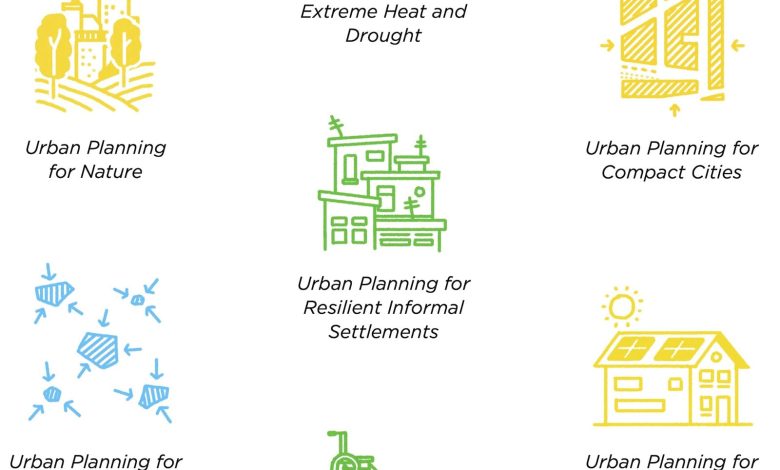
The guide’s second framework presents seven planning policy areas that urban planners can leverage for impactful climate action. Each policy area features case studies from cities worldwide that have pioneered these approaches:
Managing Water and Flooding: Examples from Auckland, Cape Town, and Singapore show how urban planners can use green infrastructure to absorb rainwater and prevent floods.
Adapting to Extreme Heat: London and Singapore illustrate innovative cooling measures, from increasing urban tree cover to designing heat-resistant buildings.
Resilient Informal Settlements: Case studies from Nairobi, Mumbai, and São Paulo highlight approaches for improving informal areas with better infrastructure and services.
Compact City Development: Amman and Portland showcase how densifying cities helps conserve land, lower emissions, and promote community connections.
Polycentric Urban Models: Seoul and Milan demonstrate how multiple urban centers within a city can reduce long commutes and promote sustainable local economies.
Transit-Oriented Development: Delhi and Mexico City offer insights into aligning development with mass transit systems to reduce car dependence and congestion.
Green Building Standards: Shanghai and Medellín set examples with rigorous green building policies, reducing emissions from construction and energy use.
A Call to Action for Climate-Resilient Cities
In an era of unprecedented climate challenges, this guide serves as a call to action for urban planners, urging them to leverage their role to create cities that are not only sustainable but also prepared to withstand the impacts of climate change. By following the guide’s practical recommendations, cities can mitigate their greenhouse gas emissions and strengthen their defenses against climate hazards. This document is more than a guide; it’s a blueprint for building the resilient, inclusive, and low-carbon cities our future demands.
For those interested in transforming urban landscapes into thriving, sustainable environments, this guide provides an invaluable resource, packed with actionable insights and inspiring case studies. As cities continue to grow, this guide reminds us of the critical importance of urban planning in creating equitable and climate-ready cities that serve both people and the planet. Explore this essential resource by downloading the full Climate Action Guide for Urban Planners and join the movement toward resilient, sustainable urban growth.
source :
https://www.c40knowledgehub.org/s/article/Climate-action-guide-for-urban-planners?language=en_US