Demystifying Climate Strategies: Carbon Credit vs. Carbon Neutral vs. Net Zero
Many people use Carbon Credit, Carbon Neutral, and Net Zero interchangeably. They shouldn’t❗🤷♂️
These three terms are closely related, but they represent very different climate strategies.
Understanding the difference can help you avoid one of the most common misconceptions in sustainability.
Here’s a simple breakdown:
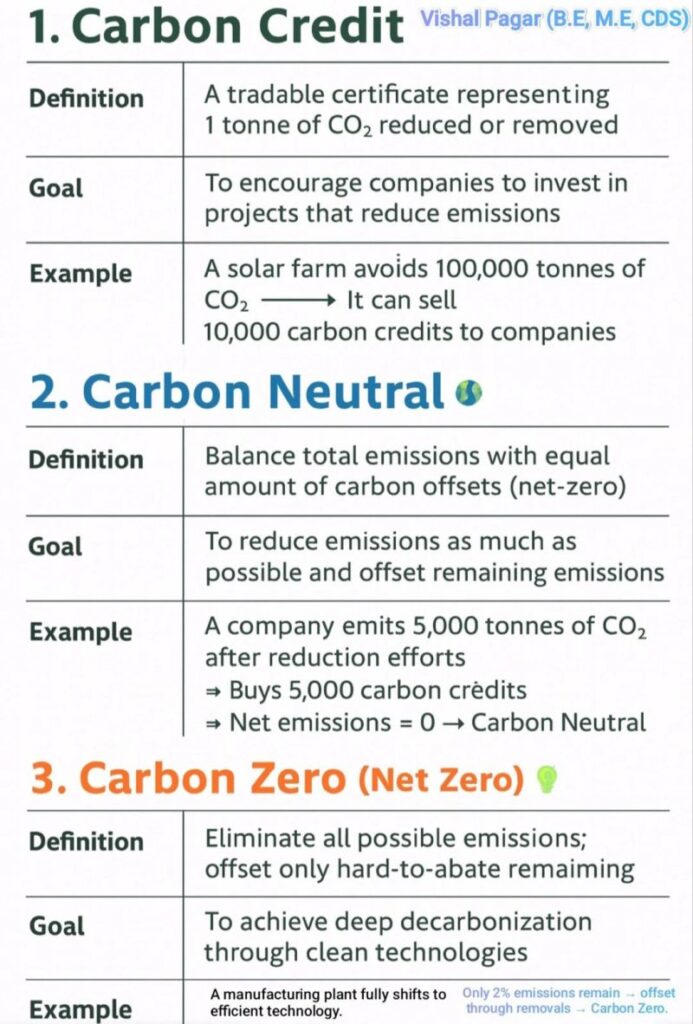
• Carbon Credit – A Climate Finance Tool
✔ A carbon credit represents 1 tonne of CO₂ (or CO₂e) reduced or removed through a verified project.
✔ Organizations can purchase carbon credits to compensate for emissions that are difficult to eliminate.
✔ Carbon credits support projects such as renewable energy, reforestation, methane capture, and carbon removal.
Think of it as: A tradable unit that finances emission reductions or removals.
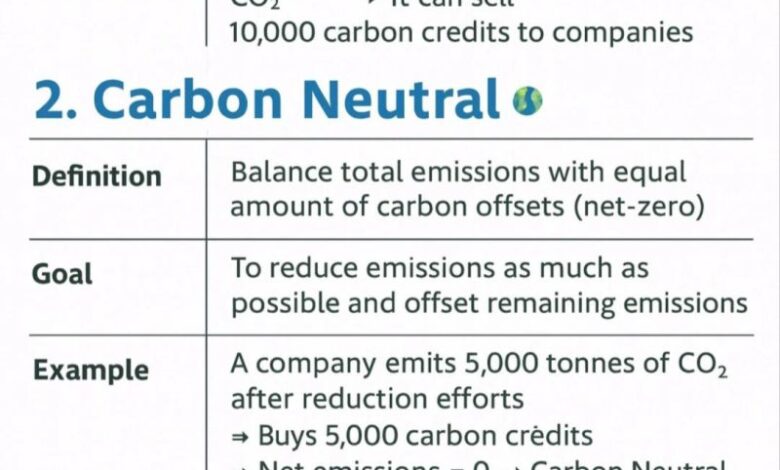
• Carbon Neutral – Balancing Emissions
✔ An organization measures its greenhouse gas emissions.
✔ It reduces emissions where possible.
✔ The remaining emissions are compensated using carbon credits or other eligible offsets.
The objective is to achieve net zero emissions on paper by balancing emissions with equivalent offsets.
Think of it as: Reduce what you can. Offset the rest.
• Net Zero – Deep Decarbonization
✔ Net Zero prioritizes actual emission reductions across Scope 1, Scope 2, and Scope 3.
✔ Carbon removals are used only for residual emissions that cannot currently be eliminated.
✔ The focus is on transforming operations, supply chains, energy systems, and products rather than relying primarily on offsets.
Think of it as: Reduce almost everything first. Remove only the unavoidable remainder.
Here’s the easiest way to remember the difference:
✔ Carbon Credit = A unit representing 1 tonne of CO₂e reduced or removed.
✔ Carbon Neutral = Balance emissions by combining reductions with carbon offsets. ✔ Net Zero = Deeply reduce emissions first, then neutralize only the small amount that remains through durable removals.
Many organizations begin with carbon neutrality as an intermediate milestone while working toward Net Zero.
However, achieving Net Zero requires far more than purchasing offsets. It demands long-term investment in energy efficiency, renewable energy, low-carbon technologies, sustainable supply chains, and continuous emission reductions.
The future of corporate climate action isn’t about buying more carbon credits.
It’s about reducing dependence on them through real decarbonization.
Which concept do you think is most misunderstood today—Carbon Credits, Carbon Neutrality, or Net Zero?
✓ For practical sustainability and ESG, Carbon footprint, and LCA masterclass courses: visit: 365sustainability.com
Rapikan teks berikut dan berikan judul
Judul: Demystifying Climate Strategies: Carbon Credit vs. Carbon Neutral vs. Net Zero
Many people use the terms Carbon Credit, Carbon Neutral, and Net Zero interchangeably, but they represent very different climate strategies. Understanding these distinctions is crucial for avoiding common sustainability misconceptions.
Carbon Credit: A Climate Finance Tool
- Definition: A tradable unit representing 1 tonne of CO₂ (or CO₂e) reduced or removed through a verified project.
- Function: Organizations purchase these to finance emission reductions or removals for emissions that are difficult to eliminate.
- Impact: Supports projects such as renewable energy, reforestation, methane capture, and carbon removal.
Carbon Neutral: Balancing Emissions
- Core Concept: Reduce what you can, offset the rest.
- Process: An organization measures its greenhouse gas emissions, reduces them where possible, and compensates for the remainder using eligible carbon credits.
- Goal: Achieve net-zero emissions on paper by balancing actual emissions with equivalent offsets.
Net Zero: Deep Decarbonization
- Core Concept: Reduce almost everything first, remove only the unavoidable remainder.
- Process: Prioritizes actual emission reductions across Scope 1, Scope 2, and Scope 3. Carbon removals are used strictly for residual emissions that cannot currently be eliminated.
- Goal: Transform operations, supply chains, energy systems, and products rather than relying primarily on offsets.
Quick Reference Summary
- Carbon Credit: A unit representing 1 tonne of CO₂e reduced or removed.
- Carbon Neutral: Balancing emissions by combining reductions with carbon offsets.
- Net Zero: Deeply reducing emissions first, then neutralizing only the small amount that remains through durable removals.
Many organizations begin with carbon neutrality as an intermediate milestone while working toward Net Zero. However, achieving Net Zero requires long-term investment in energy efficiency, renewable energy, low-carbon technologies, and sustainable supply chains. The future of corporate climate action is not about buying more carbon credits—it is about reducing dependence on them through real decarbonization.
For practical sustainability, ESG, Carbon Footprint, and LCA masterclass courses, visit: 365sustainability.com