Dignity in Motion, Dignity at Home: Why Climate Mobility Must Protect People’s Right to Stay and Their Right to Move
Climate change is increasingly reshaping where and how people can live. Rising seas, stronger storms, extreme heat, drought, flooding, coastal erosion, and changing access to water and livelihoods are already affecting communities around the world. But climate mobility is not simply a story about people being forced to leave their homes. It is also about people who want to remain where they are, people who cannot afford to move, and communities trying to preserve their homes, cultures, livelihoods, and identities despite growing climate risks.
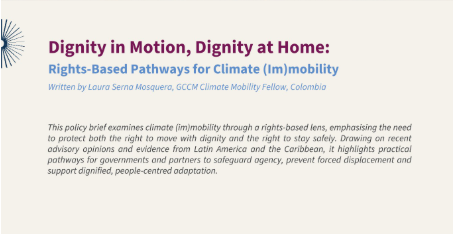
The policy brief “Dignity in Motion, Dignity at Home: Rights-Based Pathways for Climate (Im)mobility” examines this challenge through a human-rights lens. Its central message is that climate mobility should never be treated only as a question of migration management. At its core, it is about dignity, agency, safety, and the freedom of people to make meaningful choices about their own futures.
Climate change can affect some of the most basic conditions required for people to live safely. A family may face repeated flooding that damages its home and destroys its income. A farming community may experience worsening drought that makes agriculture increasingly difficult. Coastal residents may see saltwater intrusion contaminate freshwater sources. In other places, storms and erosion may gradually make settlements unsafe.
In such circumstances, mobility can become an adaptation strategy. Moving temporarily, relocating permanently, migrating for employment, or sending a family member elsewhere may help households survive and rebuild. But movement should not automatically be treated as the only solution.
For many communities, the ability to stay safely at home is just as important as the ability to move.
People may have deep cultural, spiritual, economic, and social ties to their land. Their livelihoods may depend on local ecosystems. Their families may have lived in the same place for generations. Community networks may provide childcare, food, employment, and social support that cannot simply be recreated somewhere else.
This is why the discussion of climate mobility must include both mobility and immobility.
The Right to Move and the Right to Stay
A rights-based approach begins with a simple principle: people should have meaningful choices.
When climate impacts become severe, people should be able to move safely and with dignity if moving is necessary or desired. At the same time, governments should not assume that relocation is automatically the best or only adaptation strategy.
Communities that want to remain should receive sufficient support to make staying possible and safe.
That may mean investing in flood protection, resilient housing, water infrastructure, ecosystem restoration, heat adaptation, livelihood diversification, early-warning systems, healthcare, and social protection.
In many situations, better adaptation can give communities more time and more choices.
Without such support, what appears to be “voluntary migration” may actually be movement driven by desperation.
Climate Mobility Is Fundamentally About Human Rights
Climate-related displacement affects far more than geography.
When people are forced to leave their homes, they may lose access to housing, employment, education, healthcare, land, cultural heritage, and community networks.
Displacement can also create new vulnerabilities.
Families may move into informal settlements with poor services. Migrants may struggle to find secure employment. Indigenous peoples may lose access to ancestral territories. Women, children, older people, people with disabilities, and low-income households may face additional risks.
This means that climate mobility policies cannot focus only on the number of people who move.
They must also ask:
Are people safe?
Do they have access to housing?
Can they continue earning a living?
Can children stay in school?
Can communities maintain their cultural identity?
Do people have a real voice in decisions affecting their future?
These questions are central to a rights-based approach.
Recent Legal Developments Strengthen the Human-Rights Dimension
The policy brief highlights the growing importance of recent judicial opinions, including developments involving the Inter-American Court of Human Rights and the International Court of Justice.
These developments reinforce the idea that climate change is not merely an environmental problem. It can also engage governments’ obligations to protect fundamental rights.
This has important implications for climate mobility.
Governments increasingly need to consider whether climate policies adequately protect people from foreseeable harm, whether adaptation measures reach vulnerable communities, and whether people affected by relocation or displacement are treated fairly.
In other words, climate mobility cannot be managed only through emergency response.
It requires long-term governance grounded in rights.
Preventing Forced Displacement Should Come First
One of the strongest principles in a rights-based climate mobility framework is the importance of preventing avoidable displacement.
People should not be forced to leave simply because adaptation investment arrived too late or never arrived at all.
Better planning can reduce this risk.
Coastal protection, ecosystem restoration, drought-resistant agriculture, stronger buildings, improved drainage, water security, and disaster preparedness can all help communities remain safely where they are.
Social protection also matters.
A household that loses its income after repeated climate disasters may eventually have no option but to migrate. Financial assistance, insurance, livelihood support, and access to credit can sometimes prevent this situation from becoming forced displacement.
The objective is not to prevent all movement.
Movement has always been part of human adaptation.
The objective is to ensure that movement is a choice whenever possible rather than the consequence of institutional failure.
Adaptation Can Protect the Right to Stay
The brief draws attention to experiences in Latin America and the Caribbean, where many communities facing climate risks express a strong desire to remain in their homes.
This is significant.
Climate policy sometimes assumes that highly exposed communities will eventually need to relocate. But communities themselves may see the issue very differently.
Their first preference may be better infrastructure.
Better protection from storms.
Restored mangroves.
Improved access to water.
More resilient housing.
Alternative livelihoods.
Or stronger disaster preparedness.
Supporting these measures can protect what might be described as the right to remain with dignity.
Adaptation therefore becomes more than infrastructure investment. It becomes a way of protecting human agency.
But Staying Must Also Be a Real Choice
There is another side to the issue.
People should not be trapped in dangerous places simply because they lack the money, legal status, information, or transportation needed to move.
This situation is sometimes described as involuntary immobility.
A household may know that flooding is becoming increasingly dangerous but be unable to relocate because property values have collapsed.
A farmer may want to move but lack savings.
Older residents may have no family elsewhere.
Some communities may lack legal documentation or access to formal migration pathways.
In these situations, remaining in place is not necessarily an expression of preference.
It may reflect a lack of alternatives.
That is why a rights-based approach must protect both sides of the equation:
the freedom to stay and the freedom to move.
Planned Relocation Should Be a Last Resort
There will be situations where climate risks become so severe that remaining permanently may no longer be safe.
Sea-level rise, repeated coastal flooding, erosion, extreme water scarcity, or other hazards may eventually make relocation necessary.
But planned relocation is among the most complex forms of climate adaptation.
Moving houses is relatively straightforward compared with moving communities.
Communities carry social networks, livelihoods, history, cultural practices, religious sites, burial grounds, and relationships with landscapes.
A relocation programme that provides new buildings but destroys these social connections may solve one problem while creating many others.
For that reason, relocation should involve meaningful consultation from the earliest stages.
Affected communities should participate in deciding whether relocation occurs, where people move, how livelihoods will be restored, and how cultural and community ties will be maintained.
Safe Mobility Requires Legal Pathways
Climate-related movement will increasingly cross administrative and national borders.
This creates another challenge.
Existing migration systems were not necessarily designed for people moving because of gradual climate impacts.
A person fleeing a sudden disaster may receive temporary protection in some countries, while someone whose livelihood disappears gradually because of drought may have fewer legal options.
Regional cooperation can help address these gaps.
Countries can develop agreements for temporary mobility, labour migration, disaster displacement, residence rights, and social protection.
Well-designed mobility pathways can turn migration into an adaptation strategy rather than an emergency response.
People who can move legally are generally better positioned to find employment, send money home, access public services, and avoid exploitation.
Climate Mobility Policies Must Put People First
Infrastructure and migration statistics are important, but climate mobility ultimately concerns individual lives.
Policies should therefore begin with people rather than administrative categories.
Someone affected by climate change may simultaneously be a farmer, parent, Indigenous community member, worker, homeowner, caregiver, and citizen.
Climate mobility policies should recognize this complexity.
A person should not lose basic rights simply because environmental conditions forced them to move.
Similarly, a community should not be deprived of adaptation investment merely because policymakers assume relocation will eventually be necessary.
National Laws Need to Catch Up with Climate Reality
One practical recommendation emerging from the policy brief is the need to strengthen national legal and policy frameworks.
Climate mobility cuts across many different areas of government.
Disaster management.
Housing.
Land rights.
Migration.
Urban planning.
Social protection.
Labour.
Environmental protection.
Climate adaptation.
When these systems operate separately, vulnerable communities can fall through institutional gaps.
Integrated national frameworks can clarify responsibilities and establish procedures before crises occur.
This is particularly important for planned relocation, where unclear responsibilities can create long delays and uncertainty.
Regional Cooperation Will Become Increasingly Important
Climate impacts do not respect national borders.
Drought can affect several countries simultaneously.
Storms can displace people across regions.
Sea-level rise can affect entire groups of coastal states.
Migration routes frequently cross national boundaries.
Regional cooperation can therefore provide solutions that individual countries cannot easily create alone.
Shared standards for disaster displacement, labour mobility, social protection, documentation, and emergency assistance can provide greater predictability for people affected by climate change.
This is especially important in regions where migration has historically been part of economic and social life.
Partnerships Must Preserve Community Agency
Governments will not manage climate mobility alone.
Civil-society organisations, international institutions, local governments, community groups, development banks, researchers, and the private sector will all have roles.
But partnerships should not remove decision-making power from affected communities.
People facing climate risks possess knowledge about their own environments, histories, livelihoods, and priorities.
That knowledge should shape adaptation strategies.
The objective should therefore be people-centred adaptation, not simply technically efficient adaptation.
Climate Mobility Is Not Only About the Future
Discussions about climate migration are sometimes framed as predictions about how many people might move by 2050 or 2100.
But climate mobility is already happening.
Families are already relocating after repeated disasters.
Workers are already migrating because agriculture has become less reliable.
Coastal communities are already adapting to erosion and saltwater intrusion.
Other communities are fighting to remain where they are.
The policy challenge is therefore not to prepare for a hypothetical future population movement.
It is to improve the systems that already shape people’s choices today.
Dignity Must Remain at the Centre
Perhaps the most important contribution of the policy brief is the way it reframes the debate.
Climate mobility should not be measured simply by whether people move.
The real question is whether they have agency.
Can they remain safely if that is what they want?
Can they move safely if staying becomes impossible?
Are they involved in decisions?
Are their rights protected?
Can they maintain livelihoods, families, communities, and cultural identities?
These questions shift climate mobility away from a narrative of inevitable displacement and toward a framework based on human dignity.
The goal should not be to decide whether people must stay or move. The goal should be to create conditions in which people have genuine, safe, and dignified choices.
That means investing in adaptation so communities can remain where possible, preventing forced displacement wherever possible, creating safe mobility pathways where movement is necessary, and ensuring that relocation is voluntary, participatory, and rights-respecting.
Climate change will undoubtedly reshape patterns of human settlement.
But the way societies respond will determine whether that transformation is defined by displacement and vulnerability or by resilience, agency, and dignity.
Source: Dignity in Motion, Dignity at Home: Rights-Based Pathways for Climate (Im)mobility — written by Laura Serna Mosquera, GCCM Climate Mobility Fellow, Colombia
https://www.linkedin.com/posts/climate-mobility-policy-ugcPost-7512981344755568643-QK11/