Ego to Eco
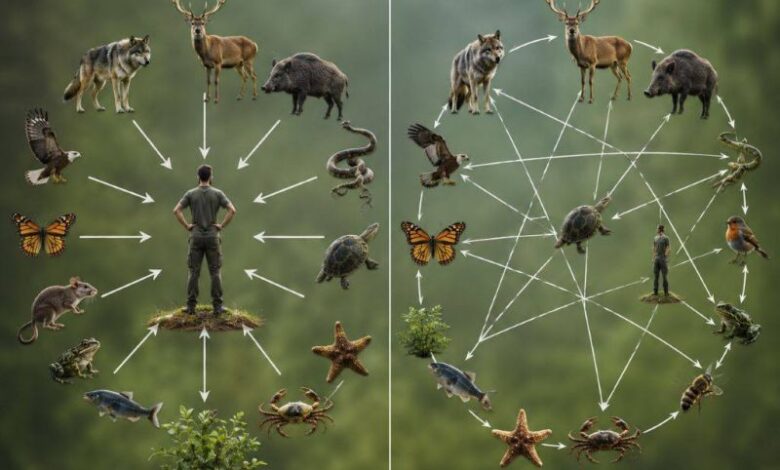
The Philosophical Shift Driving Modern Environmental Governance
The global environmental crisis is frequently framed as an engineering or financial challenge a matter of developing cleaner energy, scaling carbon capture, or pricing carbon. However, environmental economists, systems thinkers, and ecologists increasingly agree that the root cause is paradigm-based: anthropocentrism (the “ego” mindset) versus ecocentrism (the “eco” mindset).
Transitioning from viewing humanity as the manager or owner of nature to viewing humanity as a constituent part of an integrated biosphere represents the single most significant conceptual shift required for long-term sustainability.
1. Paradigm Comparison: Ego vs. Eco
The transition from an extraction-focused worldview to a regenerative one requires shifting core assumptions across economics, urban planning, and governance.
| Dimension | Anthropocentric Mindset (Ego) | Ecocentric Mindset (Eco) |
| Core Assumption | Humans are superior to and separate from nature. | Humans are embedded within complex biological networks. |
| Valuation Model | Instrumental value (nature as a resource or commodity). | Intrinsic value & Ecosystem Services (nature as life-support system). |
| Economic Approach | Linear economy (Take-Make-Waste). | Circular Economy (Reduce-Reuse-Recycle-Regenerate). |
| Design Framework | Technological domination and control. | Biomimicry and Nature-Based Solutions (NbS). |
| Risk Perspective | Short-term resource exhaustion vs. growth. | Systemic ecological tipping points and cascade failure. |
2. Systems Ecology: Trophic Cascades and Interconnectedness
The core justification for the “eco” mindset lies in ecological sciences, particularly in how organisms shape physical landscapes through trophic cascades and ecological feedback loops:
[Keystone Species / Biodiversity Loss]
              │
              ▼
  Disrupts Trophic Dynamics
              │
              ▼
 Altered Soil/Water/Vegetation Regimes
              │
              ▼
  Systemic Vulnerability & Economic Loss
- Keystone Dynamics: The removal or introduction of top predators or foundational organisms drastically alters entire landscapes. For example, reintroducing wolves to degraded forests alters herbivore behavior, allowing riverbank vegetation to recover, which stabilizes river channels and prevents erosion.
- Biological Infrastructure:
- Wetlands & Mangroves: Function as natural storm surge barriers, sediment traps, and water purification filters.
- Fungi & Mycorrhizal Networks: Facilitate soil nutrient cycling and carbon sequestration below ground.
- Pollinators: Underpin wild plant diversity and roughly one-third of global agricultural crop production.
3. Operationalizing “Eco” in Policy and Economy
Translating ecocentrism into practical action requires institutionalizing natural systems into modern society:
A. Nature-Based Solutions (NbS) & Biomimicry
Rather than relying solely on high-carbon grey infrastructure (such as concrete seawalls or chemical filtration plants), cities and governments are deploying green infrastructure:
- Sponge Cities: Utilizing permeable pavements, urban wetlands, and bioswales to absorb stormwater, recharge aquifers, and mitigate urban heat.
- Biomimicry in Engineering: Designing material cycles and structural forms modeled on natural processes that operate at ambient temperatures with zero waste.
B. Natural Capital Accounting & Circular Economy
Traditional GDP calculations treat environmental destruction as economic growth (e.g., oil spill cleanup increases GDP). The ecocentric framework adopts Natural Capital Accounting, pricing ecosystem services into balance sheets and adopting the 10 R’s of Circularity (Refuse, Rethink, Reduce, Reuse, Repair, Refurbish, Remanufacture, Repurpose, Recycle, Recover) to design waste out of industrial supply chains.
4. Strategic Imperative: Planetary Boundaries and Human Resilience
Protecting natural systems is not an act of benevolence; it is a fundamental requirement for human survival and economic stability. Crossing critical Planetary Boundaries such as biosphere integrity, land-system change, and climate change—threatens food security, public health, and global economic supply chains.
Moving from ego to eco ultimately replaces the illusion of dominance with the reality of interdependence: human prosperity is a direct function of ecosystem integrity.
source:
https://www.linkedin.com/feed/update/urn:li:activity:7487789069159034881/