Five minutes, five hundred years.
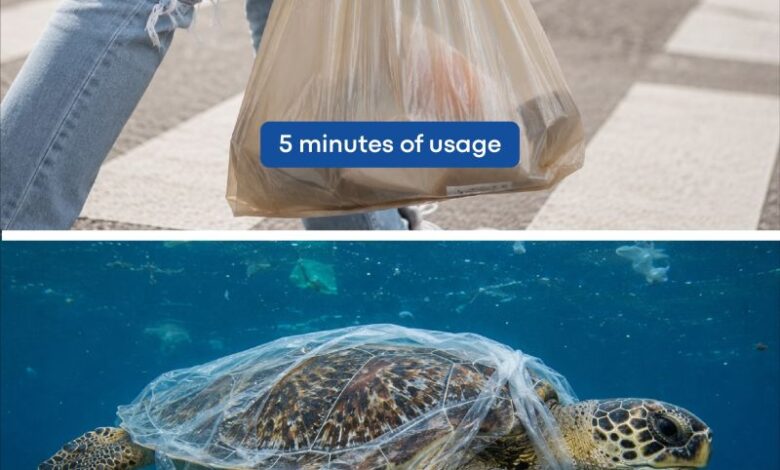
The Life-Cycle Asymmetry of Single-Use Plastics
A standard high-density polyethylene (HDPE) plastic bag is used for an average of 12 minutes to transport consumer goods from retail outlets to homes. However, once discarded into open environments, the polymer chains that make it lightweight, flexible, and waterproof resist natural degradation for 400 to 500 years.
This extreme temporal mismatch engineering a material for centuries of durability only to deploy it for minutes of convenience—underpins the global plastic crisis and highlights the structural failure of linear supply chains (Take-Make-Waste).
1. Material Lifetime Asymmetry: Linear Discard vs. Persistence
The functional utility of single-use plastics is fleeting, yet their environmental persistence spans generations due to their synthetic chemical bonds.
[Linear Polymer Consumption Pathway]
Extraction & Synthesis (Fossil Resins) ──► Production ──► Retail Use (~12 Mins) ──► Landfill / Environmental Leakage (~500 Years)
Unlike organic materials, synthetic polymers do not biodegrade through natural biological processes. Instead, environmental exposure to ultraviolet (UV) radiation, wave action, and thermal oxidation drives photo-degradation:
- Physical Fragmentation: Larger plastic debris fragments into microplastics ($< 5\text{ mm}$) and nanoplastics ($< 1\text{ }\mu\text{m}$).
- Bioaccumulation & Trophic Transfer: Marine fauna, such as sea turtles and seabirds, ingest macro- and microplastics due to visual similarity to prey (e.g., mistaking floating film for jellyfish) or olfactory cues.
- Trophic Cascade & Human Exposure: Microplastics absorb persistent organic pollutants (POPs) and heavy metals from surrounding waters, entering aquatic and terrestrial food webs and eventually contaminating agricultural soil, freshwater supplies, and human dietary sources.
2. Upstream Solutions: Designing Out Waste Across the Value Chain
Relying exclusively on consumer-side recycling bins addresses the symptom rather than the root cause. Achieving structural reduction requires embedding circular economy principles at the product design and business model phase:
| Intervention Tier | Technical Mechanism | Strategic Impact |
| Refill & Reuse Systems | Standardized durable totes and containers designed for high-cycle washing and reuse. | Replaces virgin polymer production and minimizes lifecycle carbon emissions per use. |
| Material Redesign | Deploying bio-based, marine-degradable polymers (e.g., Polyhydroxyalkanoates – PHA) where reuse is unfeasible. | Ensures non-toxic biological degradation in natural aquatic and soil environments. |
| Extended Producer Responsibility (EPR) | Regulatory mandates requiring producers to finance post-consumer collection, processing, and recycling. | Internalizes environmental externalities into product pricing, driving eco-design choices. |
3. The Lifecycle Efficiency of Reusable Alternatives
Evaluating the environmental impact of carryout bags requires a comprehensive Life Cycle Assessment (LCA), which measures raw material extraction, manufacturing energy, transportation, and end-of-life disposal.
                      [LCA BREAKEVEN THRESHOLD]
  Single-Use HDPE Bag ──► 1 Use (Low manufacturing impact, high environmental leakage risk)
  Recycled Paper Bag  ──► ~3–7 Uses (Requires higher energy & water to manufacture)
  Cotton Tote Bag     ──► ~50–150 Uses (High agricultural footprint; requires long-term reuse)
While alternative materials like paper or organic cotton require more water and energy to produce initially, their net environmental impact decreases significantly with each reuse cycle. The most sustainable packaging option is not defined by its material origin, but by how many times it remains in active service.
4. Realigning Policy, Industry, and Consumer Action
Resolving the single-use plastic paradox requires synchronized action across three operational levels:
- Governments & Policy: Enacting targeted bans or eco-taxes on non-essential single-use plastics to level the financial playing field for sustainable alternatives.
- Industry & Corporate Strategy: Transitioning from disposable packaging formats to closed-loop logistics, high-content post-consumer recycled (PCR) resin packaging, and service-based delivery models.
- Consumer Choice & Market Demand: Cultivating high-reuse habits that shift market demand away from single-use convenience toward durable infrastructure.
True sustainability requires aligning product lifespans with their functional utility ensuring that moments of convenience no longer leave centuries of environmental debt.
source:
https://www.linkedin.com/feed/update/urn:li:activity:7487405397029310464/