
How does ESG Actually work in practice?
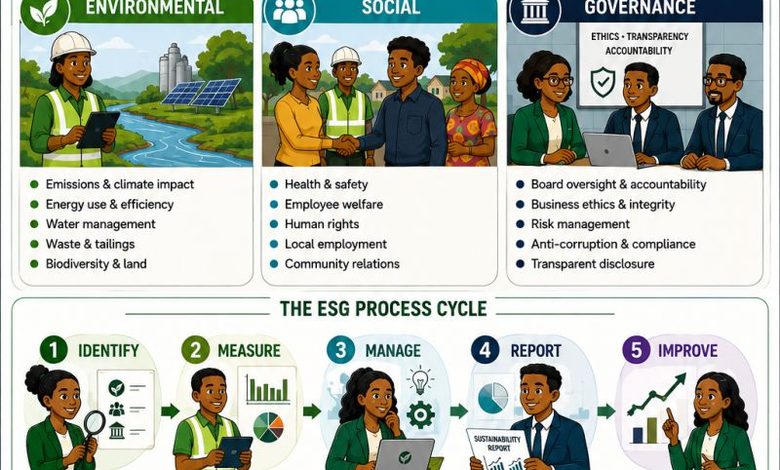
Most discussions around Environmental, Social, and Governance (ESG) fall into a predictable trap: treating it as a corporate communications exercise or a compliance box to tick.
Understanding the definition is straightforward. The friction begins when abstract commitments collide with daily operational decisions.
ESG as an Operational Engine
ESG is not a static PDF published once a year; it is an active risk-management and decision-making framework. To see how it functions on the ground, consider a mid-sized industrial manufacturer:
  Operational Inputs               ESG Management Cycle                Strategic Outputs
 ────────────────────             ──────────────────────              ───────────────────
 • Energy & Water Use  ───┐                                     ┌───> • Lower Cost of Capital
 • Safety Incidents    ───┼───>  Identify ──> Measure ──> Manage ──┼───> • Reduced Regulatory Risk
 • Labor & Diversity   ───┤        │                    │       └───> • Operational Resilience
 • Board Oversight     ───┘        └───── Report <──────┘
When embedded correctly, the data flows through five core phases:
- Identify (Materiality): Determining which risks actually impact business continuity and stakeholder value. A tech firm prioritizes data privacy and energy-efficient data centers; a mining firm prioritizes water stewardship and worker safety.
- Measure (Baseline Metrics): Establishing accurate data collection for operational footprint (e.g., Scope 1, 2, and 3 carbon emissions, turnover rates, board independence ratios).
- Manage (Operational Integration): Linking performance targets to core business incentives—such as tying executive compensation directly to safety benchmarks or emissions reduction goals.
- Report (Stakeholder Transparency): Disclosing performance metrics using structured standard methodologies for investors, regulators, and customers.
- Improve (Iterative Strategy): Adjusting supply chain choices, capital allocation, and internal policies based on performance data.
The Anatomy of Execution: Operational vs. Strategic
The difference between superficial compliance and active governance shows up across every operational layer:
| Dimension | Reactive Compliance (Reporting-Led) | Active Governance (Decision-Led) |
| Environmental (E) | Purchasing carbon offsets to neutralize reported emissions. | Redesigning production to cut energy intensity and lower operational costs. |
| Social (S) | Running annual employee satisfaction surveys without action items. | Tracking safety indicators to reduce downtime and improve retention. |
| Governance (G) | Publishing standard code-of-ethics policies on the corporate website. | Tying executive bonuses to risk management and transparent board oversight. |
The Tension Facing Organizations Today
This operational cycle reveals the central debate defining modern corporate strategy:
Is ESG primarily a tool for risk disclosure to satisfy financial markets, or a core operational discipline that reshapes how companies make capital allocation decisions?
When treated strictly as a disclosure requirement, ESG degenerates into “greenwashing” and regulatory overhead. When integrated into core management, it becomes a filter for evaluating long-term resilience, cost structures, and risk exposure.
Coming Up in Part 3
If every organization measures these factors differently, comparing performance across sectors becomes challenging. In Part 3, we will break down the primary global ESG frameworks including GRI, SASB, ISSB, and TCFD and examine how standardizing these metrics shapes global capital allocation.
source:


