How much waste does the world generate daily?
This rewrite transforms the data from a simple list into a compelling narrative of systemic impact. By framing waste not just as “trash” but as a global footprint, it emphasizes the scale of the challenge and the necessity of a circular economy.
The Weight of Our Footprint: Unmasking the World’s Daily Waste
Every 24 hours, the global population engages in a massive act of production and disposal. While we often only notice the trash bin in our kitchen, the true scale of our daily waste is a complex web of industrial, agricultural, and technological leftovers.
To understand the crisis, we must look beyond the household bag and see the invisible tons generated on our behalf.
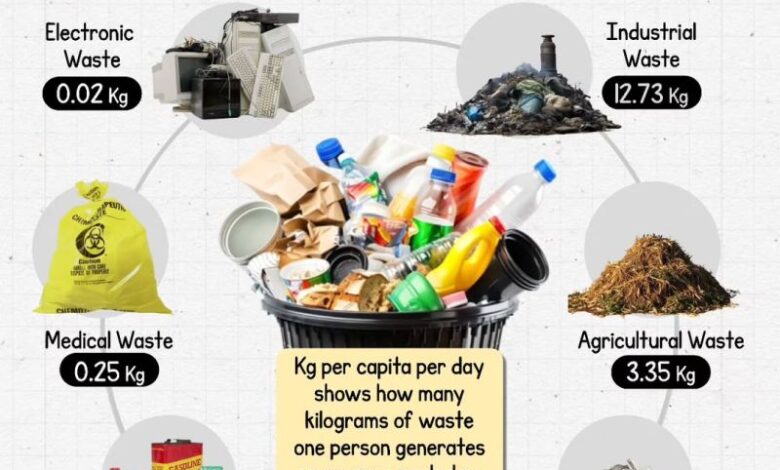
The Daily Breakdown: A Per-Person Global Average
If we took the world’s total daily waste and divided it by every individual on Earth, the “daily delivery” to our planet’s landfills and ecosystems would look like this:
| Category | Amount (per person/day) | The Hidden Story |
| Industrial Waste | 12.73 kg | The largest “invisible” stream. This represents the massive bypass of manufacturing, mining, and chemical processing required to fuel modern life. |
| Agricultural Waste | 3.35 kg | Comprising crop residues and spoiled produce, this highlights the inefficiencies in our global food supply chain. |
| Construction & Demolition | 1.68 kg | As cities expand, the debris from old buildings and new renovations has become one of the fastest-growing environmental burdens. |
| Municipal Solid Waste | 0.74 kg | This is our “visible” waste packaging, food scraps, and household items. While smaller than industrial waste, it is the hardest to manage at scale. |
| Hazardous Waste | 0.32 kg | Chemicals, batteries, and paints that pose an immediate toxic threat to soil and groundwater if not handled with precision. |
| Medical Waste | 0.25 kg | A critical stream that requires energy-intensive treatment to prevent biological contamination. |
| Electronic Waste | 0.02 kg | Smallest in weight, but highest in complexity. E-waste contains heavy metals and precious materials that are rarely recovered. |
The Staggering Reality of Accumulation
When you look at these numbers, 0.02 kg of e-waste or 0.74 kg of trash might seem manageable. However, when multiplied by 8 billion people, the daily total becomes a mountain of millions of tons that the Earth can no longer breathe under.
This is not just a management problem; it is a linear economy problem. We take, we make, and we dispo
From Awareness to Intervention: Breaking the Cycle
Understanding your footprint is the catalyst for change. Real sustainability requires a multi-tiered intervention:
- For the Individual: Move beyond “recycling” to refusing and reducing. Composting food scraps alone can drastically reduce the methane emissions of municipal waste.
- For the Industry: Shifting to a Circular Economy where products are designed to be disassembled and reused can eliminate the 12.73 kg of industrial waste at the source.
- For the Government: Infrastructure for hazardous and medical waste must be prioritized to protect the fundamental health of our environment.
Waste is essentially a design flaw. In nature, there is no such thing as “waste” every byproduct is a resource for another system. By rethinking our daily generation, we aren’t just cleaning up the planet; we are redesigning our relationship with it.
Your 0.74 kg of daily trash is part of a global conversation. By choosing sustainable packaging or repairing a gadget instead of replacing it, you are actively participating in a global deceleration of environmental decay.
source:
https://www.linkedin.com/feed/update/urn:li:activity:7446475732765290496/