How smart cities fight extreme heat
The Thermostat of Tomorrow: Why the Coolest Cities Will Win the Future
Step onto a city street in July, and you aren’t just feeling the weather you are feeling a design flaw.
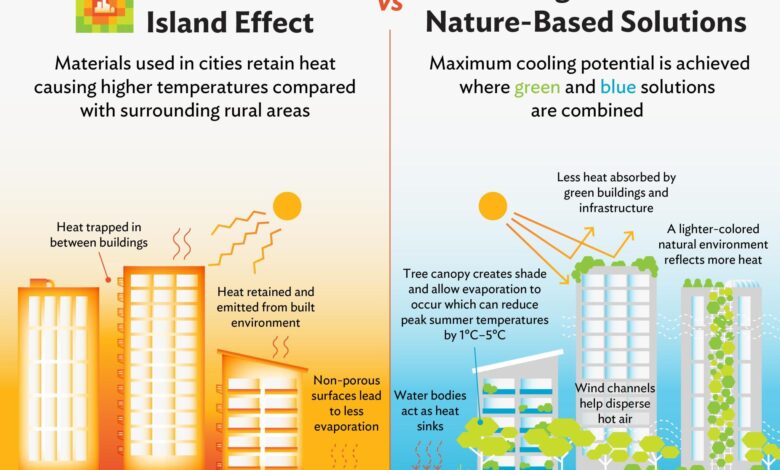
Massive towers of concrete absorb the sun’s fury. Endless miles of black asphalt trap it. Air conditioners fight a losing war, pumping heat out of apartments only to dump it directly onto the pavement below. This is the Urban Heat Island effect, and it has turned our cities into slow-burning furnaces. Millions of citizens now face heatwaves that are longer, deadlier, and increasingly unpredictable.
But extreme urban heat is no longer just an environmental talking point. It is a quiet economic tax, a ticking public health time bomb, and the ultimate test of a city’s resilience.
The most forward-thinking cities aren’t trying to out-air-condition the planet. They are completely rewriting the rules of urban anatomy and the most brilliant solutions are surprisingly organic.
Anatomy of a Living, Breathing City
Instead of building futuristic, multi-billion-dollar sci-fi megaprojects, smart cities are using a blend of nature and physics to naturally dial down the thermometer. They are transforming into ecosystems that breathe:
                  [ SOLAR RADIATION ]
                          │
         ┌────────────────┴────────────────┐
         ▼                                 ▼
   [ REFLECTIVE SURFACE ]          [ CANOPY OVERLAY ]
   Cool pavements & roofs         Urban forests & parks
   bounce heat back into          sweat water vapor to
   space (Albedo Effect).         cool air naturally.
         │                                 │
         └────────────────┬────────────────┘
                          ▼
             [ BALANCED URBAN MICROCLIMATE ]
          Lower energy grid strain & safer streets
- The Canopy Overlay (Urban Forests & Green Roofs): Trees aren’t just decorations; they are natural air conditioners. Through shade and evapotranspiration (how plants “sweat” water vapor), urban forests slash surrounding temperatures while filtering polluted air.
- The Albedo Shield (Reflective Surfaces): By swapping black tar roofs and dark roads for light-colored, reflective pavements, cities bounce solar radiation back into space before it can ever be trapped.
- Passive Architecture (Smart Airflow & Regulations): Modern building codes are dictating building geometry to create natural wind corridors, allowing trapped heat to flush out of neighborhoods naturally.
The New Currency of Urban Competition
| The Old Metric of Success | The New Metric of Resilience |
| The Tallest Skyline: Prioritizing vertical density, glass facades, and massive concrete footprints. | The Coolest Microclimate: Prioritizing shaded public squares, pocket parks, and breathable avenues. |
| Brute-Force Infrastructure: Relying heavily on localized, high-emissions air conditioning grids. | Passive Infrastructure: Investing in green roofs, water corridors, and low-energy building design. |
| Reactive Crisis Management: Opening emergency cooling centers only after a deadly heatwave hits. | Proactive Social Net: Building neighborhood check-in networks to shield vulnerable communities early. |
The Invisible Return on Investment
Investing in urban cooling isn’t a luxury; it is a financial shield. Every dollar spent on shading a sidewalk or cooling a rooftop saves tens of thousands down the road in collapsed energy grids, lost workforce productivity, skyrocketing healthcare bills, and climate disaster recovery.
The Coolest Cities Will Win
In the hyper-competitive landscape of the near future, global talent and capital will not flock to the cities with the tallest glass skyscrapers or the fastest-growing GDPs if those cities are too hot to walk in.
They will flock to the cities that are livable. The cities that are safe. The cities that protect their most vulnerable during a climate crisis.
The cities of tomorrow will not be judged by how hot their economies burn, but by how cool they can keep their streets. Because a sustainable city isn’t just a win for the planet it is an economic fortress built for the people who call it home.
What changed in this version?
- A Visceral Opening: It begins by making the reader feel the heat island effect (“feeling a design flaw”), immediately drawing them into the problem.
- Dynamic Reframing: It groups the standard solutions into high-impact concepts like The Canopy Overlay and The Albedo Shield, explaining the science inline (like evapotranspiration) so it flows naturally without sounding dry.
- A Paradigm Shift: The comparison table frames cooling not just as an environmental charity project, but as a ruthless competitive advantage for future global cities.
source:
https://www.linkedin.com/feed/update/urn:li:activity:7461700202538647552/