India first algae tree installed in Bhopal
Bio-Tech Urbanism: India’s First Solar “Algae Tree” Deployed in Bhopal
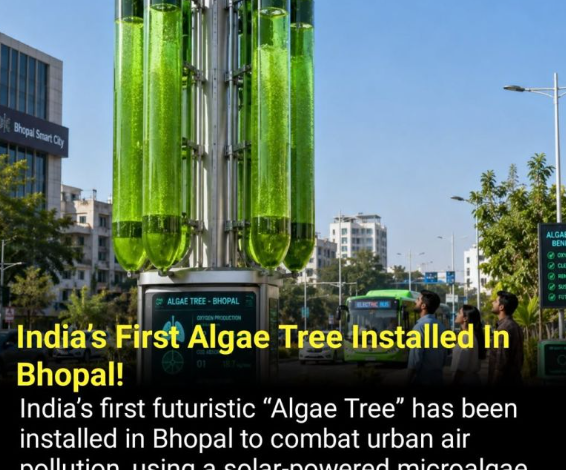
Urban air pollution is no longer an invisible byproduct of municipal growth it is the defining threat to modern public health. In response, Bhopal, India, has deployed a piece of hybrid ecological engineering: the “Algae Tree.”
This is not a cosmetic plant installation. It is a solar-powered, localized air-purification system designed specifically for high-density, space-constrained urban environments where planting traditional trees is physically impossible.
How It Works: The Photo-Bioreactor Engine
Unlike traditional flora, the Algae Tree relies on a highly controlled, closed-loop engineering system that accelerates nature’s most efficient oxygen producers: microscopic algae.
- The Core Technology: The system features a vertical photo-bioreactor a transparent vessel filled with water and specific microalgae strains.
- The Process: Powered entirely by integrated solar panels, the system continuously draws in polluted urban air. The microalgae consume carbon dioxide CO2 via hyper-accelerated photosynthesis, releasing pure oxygen O2 back into the street level.
- Particulate Scrubbing: As air circulates through the liquid medium, the system traps and filters out hazardous fine particulate matter (PM2.5), which is notorious for bypassing human respiratory defenses.
Performance and Urban Scalability
While field data collection is ongoing, initial biological modeling highlights the dense efficiency of microalgae:
| Metric | Engineered Algae Tree | Mature Natural Tree Cluster |
| Space Footprint | Minimal (Fits on standard sidewalks/bus shelters) | Requires wide root zones and open canopy space |
| CO2 Absorption Rate | Up to 10–50x more efficient per unit of volume than terrestrial plants | Standard biological rate (dependent on seasonal foliage) |
| Primary Urban Value | Targetable, active localized air-scrubbing | Long-term biodiversity, shade, and soil stability |
The Big Picture: Supplement, Not Substitution
The deployment of the Algae Tree represents a profound paradigm shift: moving from purely natural conservation to hybrid biological engineering.
Critical Note: This technology is explicitly not a replacement for natural forests or urban green belts. Terrestrial trees remain utterly irreplaceable for urban cooling (the heat-island effect), supporting biodiversity, managing stormwater, and long-term climate buffering.
Instead, bioreactors act as ecological supplements. They are tactical instruments deployed at high-pollution chokepoints such as major traffic intersections, narrow concrete avenues, and industrial borders where natural trees cannot survive or fit.
Four Pillars of the Tech
- Hyper-Efficient Photosynthesis: Maximizes CO2 capturing capacity using minimal physical volume.
- Active PM2.5 Mitigation: Acts as a localized lung for highly congested, concrete-heavy pedestrian zones.
- Net-Zero Operations: Runs autonomously off an integrated solar grid, requiring zero external municipal power.
- Modular Architecture: Designed to be easily integrated directly into existing mass-transit hubs and street furniture.
The future of liveable cities will not rely on a single silver bullet. Instead, it lies in a layered, collaborative network where natural ecosystems and engineered biological tools work side-by-side to help cities breathe.
source:
https://www.linkedin.com/feed/update/urn:li:activity:7462026079319269376/