Turning plastic waste into blooming streets
Upcycling Plastic Waste into Urban Infrastructure: The Case for Recycled Flower Barriers
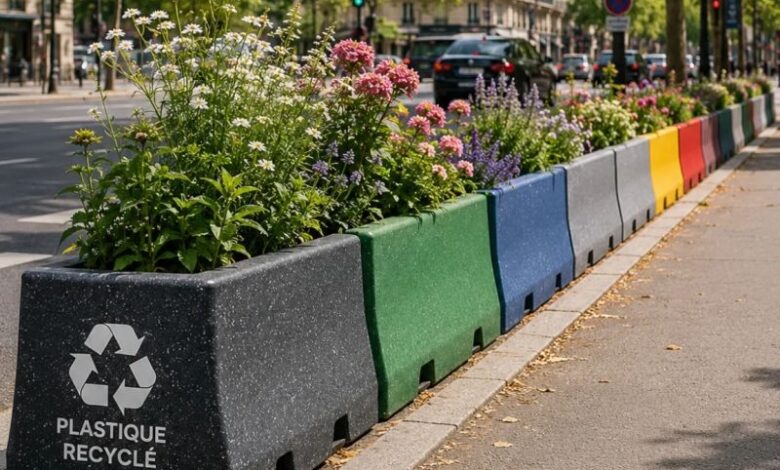
Urban street design is experiencing a structural pivot away from single-use material pathways (Take-Make-Waste) toward functional, high-value upcycling. In cities across France, municipalities are replacing concrete curb extensions and single-use metal barriers with recycled plastic flower barriers and planter modules.
These structures act as dual-purpose infrastructure: diverting post-consumer polymers from landfills while establishing protective green corridors for cyclists, pedestrians, and urban flora.
1. Material Mechanics and Environmental Resilience
Traditional street furniture made from concrete or untreated metals incurs high maintenance costs due to corrosion, weather degradation, and thermal expansion. Upcycled plastic barriers typically synthesized from High-Density Polyethylene (HDPE) and Polypropylene (PP) derived from post-consumer packaging offer distinct material advantages for outdoor municipal applications:
| Performance Metric | Virgin Concrete / Metal Infrastructure | Upcycled Polymer Barrier Modules |
| Corrosion & UV Resistance | Prone to rust, salt degradation, and freeze-thaw cracking | Inherently hydrophobic; rot-proof and UV-stabilized |
| Impact Absorption | Rigid; causes higher vehicle/bicycle damage upon impact | Moderate elasticity; absorbs kinetic energy effectively |
| Material Lifecycle | High embodied energy; energy-intensive recycling | 100% recyclable at end-of-life (Closed-Loop) |
| Maintenance Profile | Requires periodic repainting and structural sealing | Low maintenance; resistance to chemical weathering |
2. Integrated Urban Functions: Safety, Ecology, and Cooling
Rather than acting as single-purpose physical obstructions, recycled planter barriers deliver three key urban ecosystem services simultaneously:
                  [Upcycled Plastic Barrier Planter]
                                   │
      ┌────────────────────────────┼────────────────────────────┐
      ▼                            ▼                            ▼
[Traffic Safety]          [Urban Greening]           [Circular Economy]
Physical separation for   Soil retention & plant     High-value diverted plastic;
cycle lanes & walkways.   root protection.           replaces virgin materials.
- Protected Active Transportation: By lining cycle lanes and pedestrian plazas with heavy, soil-filled planter modules, cities create physical, visually distinct barriers that prevent vehicular encroachment into bike lanes.
- Microclimate & Micro-Biodiversity: Integrating vegetation directly into traffic barriers creates localized stepping-stone habitats for urban pollinators while mitigating ground-level radiative heat.
- Aesthetic Humanization: Replacing stark industrial barriers with living plant barriers improves urban livability and pedestrian comfort.
3. Structural Alignment with Circular Economy Principles
Deploying recycled plastic into long-life public infrastructure shifts the material lifecycle curve. Instead of downcycling plastic into low-grade disposable goods, this municipal strategy represents upcycling: converting short-lived packaging (used for minutes) into durable urban infrastructure engineered to last for decades.
[Linear Supply Chain]
Packaging Resin ──► Short-Term Use ──► Landfill / Incineration (Value Lost)

[Upcycled Infrastructure Pathway]
Post-Consumer Plastic ──► Pelleting & Compounding ──► Heavy Street Furniture ──► Decades of Service
By embedding recycled material standards directly into public procurement policies, municipalities create predictable demand for recycled resins stabilizing the economics of municipal waste management and accelerating the transition to resource-efficient cities.
source:
https://www.linkedin.com/posts/circulareconomy-recycling-plasticwaste-share-7487391201638178816-0-HC