
Understanding reactive CO₂
Revolutionizing Carbon: The Promise of Reactive CO₂ Capture
The world is at a critical juncture in the fight against climate change. To keep global warming in check and achieve net-zero emissions, we need to drastically cut down on greenhouse gases, especially carbon dioxide (CO2). This challenge requires a radical shift in how we produce and consume energy, moving away from fossil fuels and towards a sustainable, circular carbon economy.
The Challenge with Traditional Carbon Capture
Shifting from petroleum to captured CO2 could eliminate a staggering 3.5 gigatons of emissions annually. But current carbon capture methods, like Carbon Capture and Storage (CCS), are often expensive and energy-intensive. They require capturing high-purity CO2 before it can be used, which is both complex and costly. Because CO2 sources vary widely in concentration and location, a single solution just won’t work.
The Power of Reactive Capture
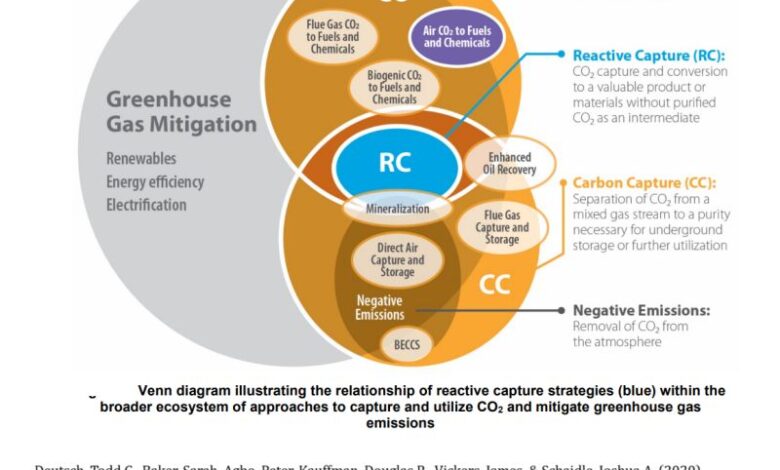
Enter Reactive Capture (RC), a game-changing technology that combines CO2 capture and conversion into a single, streamlined process. Unlike traditional methods, RC doesn’t require a costly, energy-intensive step to purify the CO2. Instead, it directly converts the gas from a waste stream into a valuable product. This integrated approach dramatically cuts power consumption and costs.
Think of it this way: instead of separating out all the CO2 first and then shipping it off to be processed, RC captures the carbon and instantly transforms it on-site. This makes it more efficient and cost-effective, with the added benefit of making it easier to transport the recycled carbon in its new chemical form rather than as a gas.
Driving a Sustainable Future
The goal of developing Reactive Capture isn’t just to be more efficient; it’s to create a more sustainable and equitable world. RC technologies have the potential to drive both environmental benefits and economic growth. By fostering cross-sector partnerships and collaboration, we can move closer to a circular carbon economy where emissions are not just reduced but are seen as a resource. The future is one where carbon is not a waste product, but a valuable building block for a cleaner, greener world.
source:


