Unlocking India’s Circular Waste Economy Potential for Sustainability
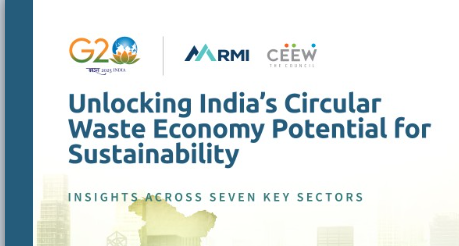
Excited to share the release of a crucial report, “Unlocking India’s Circular Waste Economy Potential for Sustainability” developed collaboratively by WRI India, RMI, and CEEW, this report offers invaluable insights into how India can transition to a circular economy across seven key sectors: solar, battery, steel, construction, agriculture, wastewater, and organic waste.
This aligns perfectly with the G20’s focus on sustainable growth and resource efficiency.
Here are the main takeaways:
1️⃣ The report highlights the environmental and economic risks of the current linear “take-make-dispose” model, emphasizing resource scarcity, waste generation, and associated pollution. Specific sector analyses reveal challenges like low material recovery rates in battery recycling, limited scrap utilization in steel production, and the environmental impact of agricultural waste burning.
2️⃣ Transitioning to a circular economy presents significant opportunities for India. This includes reduced material costs and import dependency, long-term profitability through resource recovery and second-life applications (especially for batteries), job creation across various value chains, and reduced carbon emissions.
3️⃣ The report offers sector-specific recommendations: promoting design for recyclability and reuse, investing in advanced recycling technologies, developing robust infrastructure for waste management and material recovery, and leveraging second-life applications.
4️⃣ Eight critical intervention points are identified to drive circularity across all sectors: clear targets for material recovery and reuse, advancement of recycling technologies, infrastructure development, traceability, improved policy frameworks, strategic investment in circularity, circular design principles, and cross-sector collaboration.
✳️ India’s inherent cultural values align with circularity principles, giving it a unique advantage. By combining traditional practices with modern technology and policy, India can become a global leader in sustainable development.
✴️ The report stresses the need for policy action. This includes robust Extended Producer Responsibility (EPR) frameworks, investment incentives, green public procurement policies, technical standards, skill development initiatives, and cross-border collaboration to harmonize regulations and facilitate trade in recycled materials. Dedicated action from municipalities and investment in R&D are also crucial for success.
Source: