
Way to capture carbon
Carbon Capture and Storage: A Key to a Net-Zero Future
Saudi Arabia, like many nations, has set its sights on a net-zero future, and a crucial pillar of its strategy is Carbon Capture and Storage (CCS). This technology offers a powerful way to tackle climate change by preventing a major greenhouse gas from ever reaching the atmosphere.
At its core, CCS is a three-step process:
- Capture: Carbon dioxide (CO2) is siphoned off from large industrial sources like power plants or factories.
- Transport: The captured CO2 is then compressed and moved, often through pipelines, to a storage site.
- Storage: Finally, the CO2 is injected deep underground into secure geological formations, where it’s trapped for centuries.
The Three Ways to Capture Carbon
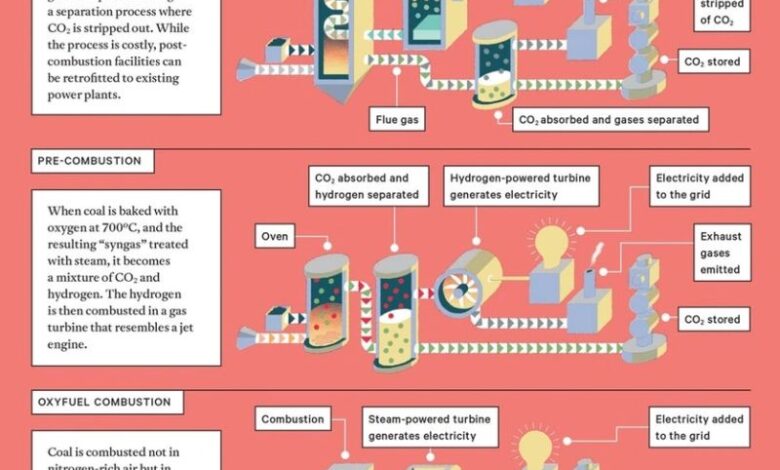
There isn’t a one-size-fits-all approach to capturing carbon; different industrial processes require different methods. Here are the three main ways this is done:
1. Pre-Combustion Capture
Imagine cleaning up a fuel source before it’s even burned. That’s the essence of pre-combustion capture. In this method, a fuel like coal or natural gas is converted into a gas rich in hydrogen and CO2. The CO2 is then separated and captured before the hydrogen is burned to generate energy. This results in a cleaner burning fuel and a concentrated stream of CO2 that’s easier to store.
2. Post-Combustion Capture
This is the most common and retrofittable method. Post-combustion capture is like installing a special scrubber on a smokestack. After a fuel has been burned, the CO2 is captured from the flue gas—the exhaust that would typically be released into the atmosphere. This is often done using chemical solvents that selectively absorb the CO2, which is then stripped out and compressed for storage.
3. Oxy-Fuel Combustion
Think of this as burning fuel in a purer environment. Instead of using air, which is mostly nitrogen, oxy-fuel combustion burns fuel in a near-pure oxygen environment. This produces a flue gas that is primarily CO2 and water vapor. Since there’s very little else in the exhaust, it’s easy to condense the water and capture a high-purity stream of CO2 for storage.
These technologies are critical for reducing emissions from hard-to-abate industries. While the challenges of cost and infrastructure are significant, the potential for CCS to create a cleaner, more sustainable future makes it a vital area of innovation and investment.


