
What makes a city hotter or cooler?
Designing Cities for a Warming World
A city can be several degrees hotter than its surrounding areas not because it receives more sunlight, but because of how the urban environment absorbs, stores, and releases heat.
As global temperatures continue to rise, the way we design cities is becoming an increasingly important part of climate adaptation. Streets, rooftops, buildings, trees, parks, and even the arrangement of urban spaces can determine whether a neighborhood feels dangerously hot or relatively comfortable.
The question is no longer simply:
How do we protect people from extreme heat?
It is also:
How do we design cities that generate less heat in the first place?
Why do some surfaces make cities hotter?
Urban areas contain large amounts of concrete, asphalt, brick, and other hard surfaces. Their thermal properties influence how much solar energy is absorbed and how quickly heat is released.
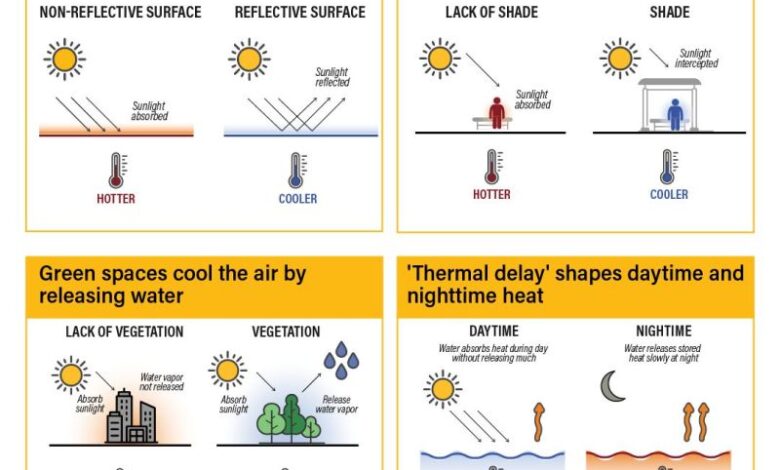
Dark-colored surfaces generally absorb more solar radiation than highly reflective surfaces. Roads and rooftops can become extremely hot under direct sunlight, turning the built environment into a large heat reservoir.
Materials with higher solar reflectance—often referred to as cool materials—can reflect more sunlight and reduce surface temperatures.
However, color is not the only factor. The thermal properties, texture, moisture content, and design of the material also influence how heat behaves.
Trees are natural cooling infrastructure
One of the most effective ways to make urban areas more comfortable is also one of the oldest: plant more trees and protect the ones that already exist.
Trees cool cities through several mechanisms.
Their canopies provide shade, preventing sunlight from directly heating roads, sidewalks, buildings, and people.
Trees also release water vapor through evapotranspiration, a natural process that transfers heat away from the surrounding environment.
But the benefits go beyond temperature.
Urban trees can support biodiversity, improve air quality, provide recreational spaces, reduce exposure to heat, and contribute to better physical and mental well-being.
This makes urban vegetation more than decoration.
It is climate infrastructure.
Shade can change how a city feels
Air temperature is only part of the human experience of heat.
A person standing under direct sunlight can feel dramatically hotter than someone standing just a few meters away under shade, even when the measured air temperature is similar.
That is why shaded sidewalks, tree-lined streets, covered public spaces, building canopies, and thoughtfully designed urban plazas can make a major difference to outdoor comfort.
For pedestrians, shade can mean the difference between a walkable street and one that people avoid during the hottest part of the day.
This is particularly important as cities encourage walking, cycling, and public transportation.
Why can cities remain hot at night?
One of the most noticeable characteristics of the urban heat island effect is that cities can remain warmer after sunset.
During the day, concrete, asphalt, and other materials absorb and store heat. After the sun goes down, they gradually release that stored energy back into the surrounding environment.
This can keep urban neighborhoods warm well into the evening and night.
The problem becomes more serious during prolonged heatwaves because buildings and infrastructure may have little opportunity to cool down between consecutive hot days.
For vulnerable populations, persistent nighttime heat can also make it more difficult for the body to recover from daytime heat exposure.
Water can also play a role
Moisture is another important part of the urban cooling equation.
Vegetated areas, healthy soils, wetlands, rain gardens, and other forms of blue-green infrastructure can use water for evapotranspiration and help moderate local temperatures.
But this requires thoughtful water management. In hot and water-stressed cities, simply adding vegetation without considering water availability may create new challenges.
The best solutions are therefore adapted to the local climate, ecology, water resources, and community needs.
Cooler cities require more than one solution
There is no single technology capable of solving urban heat.
A resilient city may need a combination of:
- More urban trees and connected green spaces
- Cooler and more energy-efficient roofs
- Heat-conscious road and pavement materials
- Shaded and walkable streets
- Rain gardens and blue-green infrastructure
- Building designs that improve natural ventilation
- Protection of existing vegetation and natural ecosystems
- Urban planning that prioritizes vulnerable communities
The most effective strategy is usually not to choose between nature and technology, but to combine them.
Designing cities that work with nature
Climate change is forcing us to rethink what urban infrastructure means.
A tree is infrastructure.
A shaded sidewalk is infrastructure.
A permeable surface is infrastructure.
A park that provides cooling, absorbs rainfall, supports biodiversity, and gives people a place to gather is also infrastructure.
When cities recognize these functions, urban nature stops being treated as an optional aesthetic feature and becomes part of climate adaptation and public health planning.
The cities of the future should not simply be designed to withstand a hotter climate.
They should be designed to create less heat, provide more shade, retain more water, and give nature space to perform the functions that cities need.
Because the coolest cities of the future may not be the ones with the most sophisticated cooling technology.
source:


