
𝗥𝗲𝗰𝗼𝗻𝗻𝗲𝗰𝘁𝗶𝗻𝗴 c𝗶𝘁𝗶𝗲𝘀, p𝗲𝗼𝗽𝗹𝗲, 𝗮𝗻𝗱 n𝗮𝘁𝘂𝗿𝗲, 𝘂𝗿𝗯𝗮𝗻 𝗱𝗲𝘀𝗶𝗴𝗻 𝗮𝘀 𝗲𝗰𝗼𝗹𝗼𝗴𝗶𝗰𝗮𝗹 𝗽𝗿𝗮𝗰𝘁𝗶𝗰𝗲
The City as a Living Biotope: Why Urban Design is No Longer Just About Infrastructure
For decades, we have treated cities as machines. We blueprint them as spatial configurations, layer them with transportation grids, and optimize them for economic output. If nature is included at all, it is usually treated as an afterthought a compensatory layer of street trees or a manicured park designed to make the concrete more palatable.
But as our urban centers confront unprecedented heat stress, rapid biodiversity loss, and deepening social vulnerability, that mechanical model is breaking down.
A profound shift is underway. The city can no longer be understood merely as a built environment. It must be read as a living biotope a complex, shared ecosystem where human and non-human actors coexist, interact, and actively shape the urban condition.
Moving Beyond “Adding Greenery”
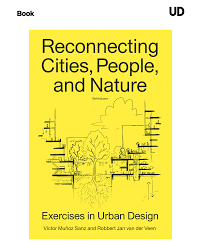
This ecological evolution is the driving force behind Reconnecting Cities, People, and Nature: Exercises in Urban Design (Birkhäuser, 2025). Authored by Víctor Muñoz Sanz and Robbert Jan Van Der Veen, with a foreword by renowned urbanist Rahul Mehrotra, the book rejects the superficial “greening” of cities. Instead, it invites architects, planners, and citizens to radically rethink the city as a deeply interconnected social and natural ecosystem.
“Urban design is not just about form, density, or mobility. It is about relationships, interdependence, and long-term ecological transformation.”
What makes this work vital is its rejection of the purely theoretical manifesto. It operates as a practical, hands-on toolkit. Through 20 meticulously crafted exercises rooted in real-world teaching and practice—and brought to life by evocative hand-drawn illustrations the authors challenge us to step away from abstract zoning maps and engage directly with the living fabric of the city.
5 Questions Forcing Us to Rethink the Drawing Board
The book acts as a conceptual mirror, forcing designers and planners to ask uncomfortable but necessary questions about the future of our professions:
- Coexisting with Micro-Climates: How can urban design actively work with living systems and natural hydrology rather than constantly trying to engineer against them?
- Designing for All Species: How do non-human actors from migratory birds to local canopy systems become legitimate stakeholders in our design processes?
- The City as a Biotope: What does it actually look like to plan a neighborhood not just for human density, but as a thriving biological habitat?
- Breaking Academic Silos: How can allied disciplines, from landscape ecology to sociology, bridge the gap to create truly resilient urban ecosystems?
- Reclaiming the Pencil: How can fieldwork, active observation, and drawing reconnect our modern spatial practices with a visceral ecological awareness?
A Manifesto for Radical Care
Ultimately, this is a call for a design practice centered on interdependence and long-term care. It reminds us that every line drawn on a map has an ecological consequence.
Whether you are a seasoned urban planner looking to break out of rigid regulatory frameworks, an educator searching for ways to inspire the next generation, or an activist fighting for better public space, these exercises offer a roadmap. It is time to stop designing around nature, and start designing as nature.
“Reconnecting Cities, People, and Nature” is available now through major booksellers and publishing platforms.


