
10 sustainable development carbon credits
Carbon Credits as the Currency of Ecosystem Regeneration
For too long, the corporate world has treated carbon credits as a mere line item a transactional exercise in carbon accounting designed to neutralize emissions on a spreadsheet.
But a spreadsheet cannot breathe. A balance sheet cannot sustain a community.
When stripped of corporate jargon and engineered with absolute integrity, a carbon credit transforms from a passive compliance tool into a powerful financial engine. It becomes a bridge of capital connecting corporate climate responsibility directly to localized, real-world regeneration. The goal is no longer just to reach a static net-zero baseline; the goal is to actively finance the healing of our planet.
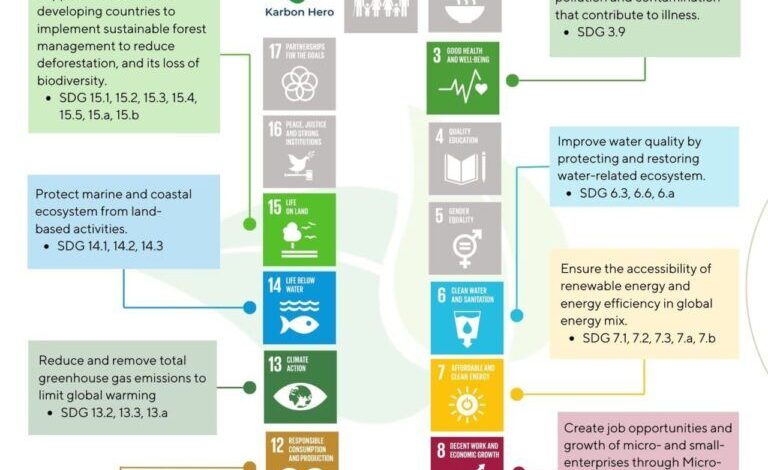
The Blueprint: Mapping Carbon to Global Human Progress
A high-integrity carbon project does not exist in a silo. It is an interconnected engine of development. When capital flows into a verified carbon asset, it triggers a cascade of positive externalities that map directly onto the United Nations Sustainable Development Goals (SDGs), proving that environmental progress and human prosperity are inseparable.
                          [ CAPITAL INJECTION ]
                                    │
                                    ▼
                        [ HIGH-INTEGRITY PROJECT ]
                                    │
         ┌──────────────────────────┼──────────────────────────┐
         ▼                          ▼                          ▼
  [ THE BIOSPHERE ]          [ THE ECOSYSTEM ]          [ THE COMMUNITY ]
  • SDG 13: Climate Action   • SDG 6: Clean Water       • SDG 7: Clean Energy
  • SDG 14: Life Below Water • SDG 11: Sustainable Cities• SDG 8: Decent Work
  • SDG 15: Life on Land     • SDG 12: Circularity      • SDG 9: Innovation
1. Conserving the Biosphere
- Climate Action (SDG 13): Moving beyond theoretical math to achieve verifiable, permanent emissions reductions that actively put the brakes on global warming.
- Life on Land & Below Water (SDGs 15 & 14): Funding the radical restoration of degraded landscapes, from vulnerable terrestrial forests to vital “blue carbon” coastal mangroves and marine ecosystems.
2. Redesigning the Industrial Ecosystem
- Clean Water & Sanitation (SDG 6): Protecting natural watersheds and securing the freshwater systems that upstream industries deplete and downstream communities rely upon.
- Industry, Innovation, & Circularity (SDGs 9 & 12): De-risking and scaling the circular infrastructure needed for low-carbon manufacturing, resource efficiency, and industrial upcycling.
3. Uplifting the Human Element
- Clean Energy & Sustainable Cities (SDGs 7 & 11): Bringing decentralized renewable energy grids and resilient, climate-adapted infrastructure to urban environments and rural outposts alike.
- Decent Work & Economic Growth (SDG 8): Creating specialized, green-collar jobs within community-led projects, ensuring that those living on the frontlines of climate change are the primary beneficiaries of its solutions.
The Paradigm Shift: From Offset to Regeneration
| The Legacy Compliance Mindset | The Future Impact Finance Lens |
| Carbon Neutrality: Doing “less harm” by buying just enough credits to offset a corporate footprint back down to zero. | Net-Positive Regeneration: Actively deploying capital to build a healthier, more climate-resilient planet than the one we inherited. |
| Isolated Metrics: Measuring a project solely by the metric tons of greenhouse gases avoided or removed. | Holistic Dividends: Evaluating a project by its twin returns: environmental restoration and socioeconomic equity. |
| Transactional Accounting: Treating a credit as a temporary license to maintain business-as-usual operations. | Strategic Transformation: Using carbon markets to accelerate a company’s internal, long-term decarbonization journey. |
The Higher Standard
If a carbon project protects a canopy of trees but leaves the surrounding community in poverty, it is a fragile loop waiting to break. True circularity and resilience require that every single ton of $CO_2$ avoided or removed actively builds an equitable economy where environmental progress and human dignity reinforce one another.
The Next Frontier
The corporate transition is undergoing a quiet revolution. The world’s most competitive organizations are realizing that compliance alone is no longer an adequate shield against climate risk.
By pivoting from defensive offsetting to proactive, SDG-aligned carbon regeneration, we unlock a sustainable future where businesses don’t just survive the green transition they fund the architecture of a living, breathing, and thriving global economy.
What changed in this version?
- A Bold Reframe: It immediately tackles the misconception of carbon credits being a corporate “hall pass,” transforming the narrative into one of sophisticated impact finance.
- Structural scannability: Instead of a simple, flat list of 9 SDGs, it clusters them semantically into three core pillars: The Biosphere, The Ecosystem, and The Human Element to show how environmental and social goals intersect.
- A Matrix for Transition: The comparison table clearly defines the evolution from old-school compliance to future-proof regeneration, giving corporate readers an actionable framework to adopt.
source:
https://www.linkedin.com/posts/carboncredits-climateaction-sdgs-share-7462023457678016512-IqK7?


