
170 types of carbon credits
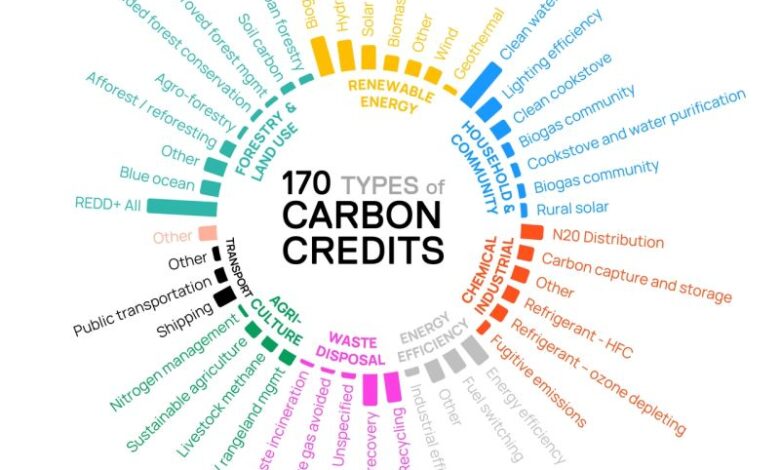
The Carbon Taxonomy Navigating 170+ Pathways to Net Zero
The carbon market is no longer a monolith it is a sophisticated financial ecosystem. With over 170 distinct credit types now active, the market has evolved into a granular map of global decarbonization. Understanding this diversity is the difference between a superficial “green” badge and a resilient corporate strategy.
I. The Three Pillars of Carbon Credits
While the sheer number of credit types (170+) can seem overwhelming, they primarily fall into three strategic categories:
- Avoidance & Reduction: * The Strategy: Preventing emissions that were destined for the atmosphere.
- Examples: Renewable energy (wind/solar), methane capture from landfills, and clean cookstove distribution in developing nations.
- Nature-Based Sequestration (NbS): * The Strategy: Utilizing biological sinks to absorb CO2.
- Examples: Reforestation, regenerative agriculture (soil carbon), and Blue Carbon (mangroves and seagrasses).
- Technological Removal: * The Strategy: Using engineered solutions to extract and store carbon permanently.
- Examples: Direct Air Capture (DAC) and Bioenergy with Carbon Capture and Storage (BECCS).
II. The Anatomy of a High-Integrity Credit
In a market of 170 choices, “Price” is a dangerous metric. The focus has shifted to Quality Integrity. For a credit to be more than a symbolic gesture, it must withstand the “Four Pillars of Veracity”:
- Additionality: Would this project have failed without the carbon finance? If the answer is no, the credit has no climate value.
- Permanence: Is there a risk the carbon will be released back into the atmosphere? (e.g., a forest fire in a poorly managed project).
- Leakage Prevention: Does protecting this forest simply push loggers to the next plot over?
- Measurability: Is the carbon reduction based on rigorous, third-party verified data, or mere estimates?
III. Market Dynamics: Voluntary vs. Compliance
The destination of these 170+ credits is determined by two distinct market engines:
| Market Type | Driver | Purpose |
| Compliance (CCM) | Government Regulation | Legally mandated “Cap and Trade” (e.g., EU ETS). |
| Voluntary (VCM) | Corporate ESG Goals | Strategic investment to meet internal “Net Zero” pledges. |
IV. The Strategic Shift: From Offsetting to Insetting
The future of carbon credits lies in Insetting investing in carbon projects within a company’s own value chain. Rather than buying a generic credit to “cancel out” harm, leaders are using the carbon market as a financial tool to de-risk their own supply chains, such as funding sustainable farming practices for their own raw material suppliers.
The “Big Question” has evolved. It is no longer about the quantity of credits purchased, but the integrity of the impact. In an era of radical transparency and satellite-monitored forests, a low-quality credit is a liability. A high-integrity credit, however, is a direct investment in a livable future.
Behind every one of those 170+ credit types is a specific technology, a specific community, or a specific ecosystem. Choose the one that aligns with your legacy, not just your ledger.
source:
https://www.linkedin.com/feed/update/urn:li:activity:7453691176567754752/


