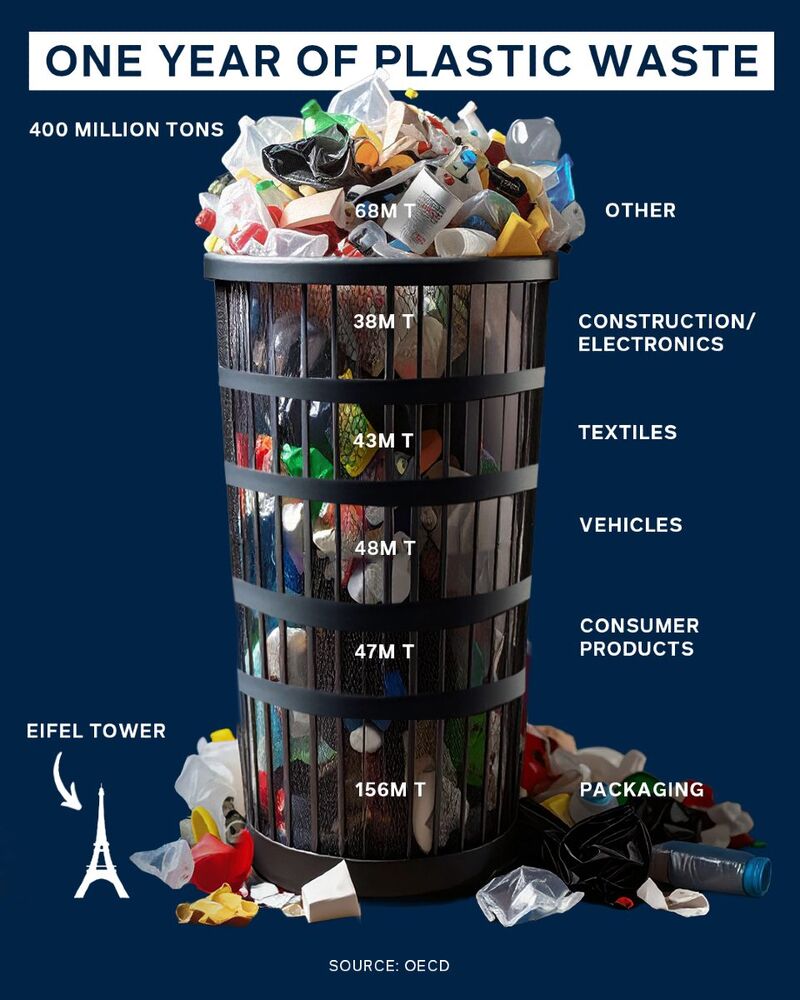
400 Million Tons. One Global Problem
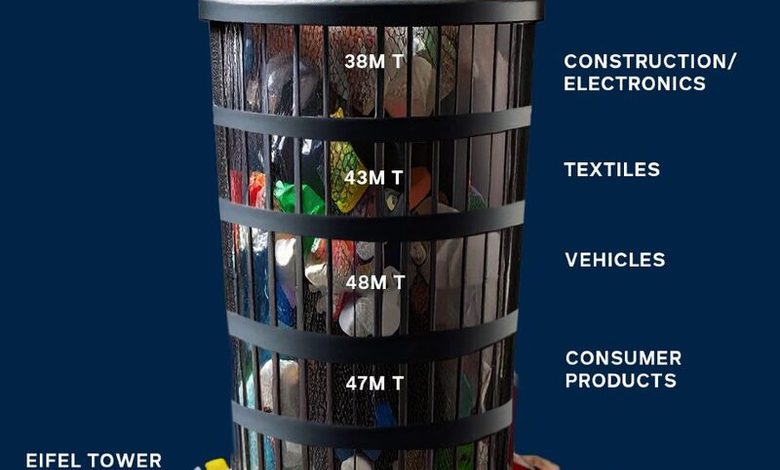
400 Million Tons. One Global Problem.
Imagine throwing away enough plastic every year to fill an enormous mountain of waste.
The numbers in this visual reveal where the challenge is concentrated:
📦 Packaging alone accounts for the largest share.
🛍️ Consumer products add millions more tons.
🚗 Vehicles, textiles, construction and electronics contribute significantly.
♻️ And a substantial volume falls into other applications.
The real problem isn’t simply how much plastic is produced.
It is what happens after we use it.
Too much plastic is designed for minutes of convenience but remains in the environment for far longer.
A circular economy changes the question:
❌ How much plastic can be produced and consumed?
➡️ How much value can be retained after its first use?
That means designing products for reuse, reducing unnecessary packaging, improving collection systems, scaling recycling technologies and creating markets for recycled materials.
Plastic waste is not just a waste-management problem.
It is a design, business and systems problem.
And solving it requires moving from a linear mindset—
Take → Make → Waste
—to a circular one:
Design → Use → Recover → Reuse.
The opportunity isn’t to manage waste better.
It’s to create less waste in the first place.