
The Active City
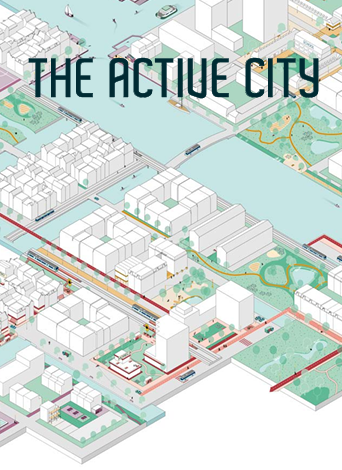
Amsterdam wants to be an active city, a city that encourages people to be physically active. A city with plenty of space for cyclists and pedestrians, a city where everybody – young and old – can enjoy sports, play and relaxation. In the active city, physical activity is a natural part of everyday life. This book describes what the active city looks like. It offers inspiration and design tools for city planners, designers and other professionals who work every day to improve the city.
WHY THE ACTIVE CITY?
The advantages of an active city are manifold. The city becomes healthier, more attractive, more liveable, and more economically vital. Healthier because of the clean (or cleaner) air and reduced noise pollution. Healthier also because inhabitants are enticed to get more physical exercise. That is badly needed, because being physically active (or choosing to be) is not easy or obvious for every inhabitant. Many people do not get enough exercise and do not reach the Dutch norms for sufficient physical activity and exercise.1 Luckily we see a decline, but many inhabitants are still overweight and suffer from obesity.2 Sufficient exercise has a positive impact on wellbeing and helps to combat depression, cardiovascular disorders and dementia.3 Especially inhabitants with a low socio-economic status, as expressed by work and education levels (SES) fail to reach the exercise norm.4 Unfortunately, such people also belong to those groups whose life expectancy is significantly lower. And the number of years that such people feel healthy is also much lower than it is among people with a high SES.
source :
https://www.urhahn.com/wp-content/uploads/The-Active-City-2017-10-10-lowres.pdf


