The world has passed “peak air pollution”
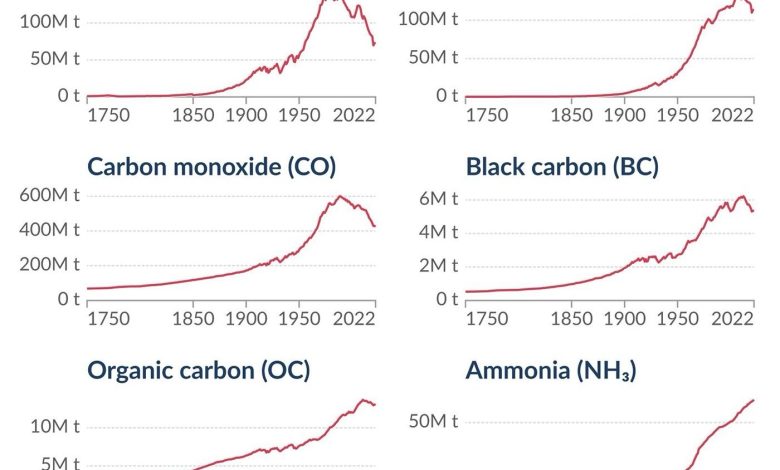
Air pollution has long been a pressing global issue, but data from Voroni and Our World in Data reveals a promising shift: the world has surpassed “Peak Air Pollution” for most major pollutants—except ammonia (NH₃). By analyzing trends from 1750 to 2022, we can see how regulatory efforts, technological advancements, and cleaner energy transitions have significantly reduced harmful emissions, while some challenges remain.
A Look at Declining Pollutants
1. Sulfur Dioxide (SO₂) and Nitrogen Oxides (NOₓ)
Once dominant contributors to acid rain and respiratory diseases, SO₂ and NOₓ emissions peaked between 1950 and 2022. Industrialization and fossil fuel combustion drove their rapid rise, but stringent environmental regulations and cleaner technologies led to a substantial decline.
- Measured on a 0–100 million tonnes (Mt) scale, their reductions have been pivotal in improving air quality and public health worldwide.
- The adoption of low-sulfur fuels, catalytic converters, and emissions controls played a crucial role.
2. Carbon Monoxide (CO)
This toxic gas, mainly from incomplete combustion in vehicles and industries, reached its peak in the mid-20th century. However, thanks to cleaner energy, fuel efficiency improvements, and emission regulations, CO levels have dropped dramatically:
- From ~600 Mt at its peak to under 200 Mt by 2022.
- This decline has contributed to a safer urban environment, reducing carbon monoxide poisoning risks.
3. Black Carbon (BC) & Organic Carbon (OC)
Both pollutants, originating from biomass burning and fossil fuel use, have seen notable reductions:
- BC, measured on a 0–6 Mt scale, has fallen to ~2 Mt.
- OC, on a 0–10 Mt scale, has dropped to ~5 Mt.
- These reductions are linked to improved combustion technologies and cleaner energy policies.
The Exception: Ammonia (NH₃) – A Rising Concern
Unlike other pollutants, ammonia emissions have not yet peaked. Derived mainly from agriculture—fertilizers and livestock waste, NH₃ levels have consistently increased from near zero in 1750 to ~50 Mt by 2022.
- While ammonia doesn’t have the same direct health impact as SO₂ or CO, it plays a significant role in forming fine particulate matter (PM₂.₅), contributing to smog and poor air quality.
- The rise in emissions highlights the need for sustainable farming practices and innovative solutions to mitigate agricultural pollution.
A Mixed Outlook: Progress and Future Challenges
The sharp decline in SO₂, NOₓ, CO, BC, and OC demonstrates the effectiveness of regulations, cleaner technologies, and public awareness. However, the continuous rise in ammonia emissions underscores the complexity of tackling air pollution—especially in agriculture, where policies and solutions are still evolving.
This data-driven insight tells a story of progress and ongoing challenges:
✔️ Technological advancements have reduced emissions from energy and industry.
✔️ Policy interventions have improved urban air quality.
⚠️ Agricultural pollution remains an unsolved issue, requiring new strategies for sustainable growth.
The fight against air pollution is far from over, but history shows that with the right actions, cleaner air is achievable.
source :