Nature-based solutions technical handbook factsheets
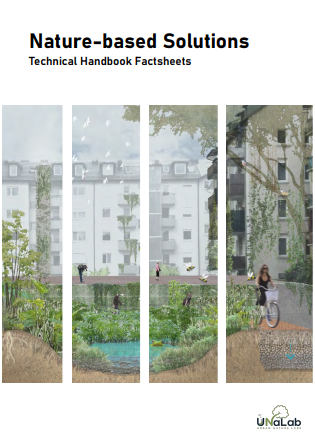
The following Nature-based Solutions (NBS) Factsheets were originally developed for UNaLab’s Nature
Based Solutions Technical Handbook. The original version of the handbook was created at the beginning
of the UNaLab project in 2018 by University of Stuttgart’s Institute for Landscape Planning and Ecology
(STU, ILPÖ) in an iterative process together with the University of Aveiro (UAV), the Technical Research
Centre of Finland (VTT), Fraunhofer (FHG), and the front-runner cities of Eindhoven, Genova, and Tampere
[1]. Its main objective was to provide front-runner cities with accurate information about potentially
applicable NBS to support climate and water resilience, and therefore facilitate informed decision making
during the NBS co-creation process.
Since the publication of the first version of the NBS Technical Handbook in 2018, the European
Commission (EC) has adopted a more robust definition of NBS with a greater emphasis on biodiversity.
The EC currently defines NBS as follows:
“Nature-based solutions to societal challenges are solutions that are inspired and
supported by nature, which are cost-effective, simultaneously provide environmental, social
and economic benefits and help build resilience. Such solutions bring more, and more diverse,
nature and natural features and processes into cities, landscapes and seascapes, through
locally adapted, resource-efficient and systematic interventions. Nature-based solutions must
therefore benefit biodiversity and support the delivery of a range of ecosystem services” [2].
The NBS Technical Handbook was periodically updated throughout the UNaLab project as the field of NBS
and the project itself progressed. Rather than offer an exhaustive catalogue and summaries of all existing
NBS, the NBS Technical Handbook Factsheets aim to provide inspiration and easily digestible information
directed towards practitioners. Because of this focus on practitioners, the NBS Factsheets were originally
organized according to planning and construction terminology. However, since the publication of the first
version of the NBS Technical Handbook in 2018, a unified classification system for NBS has been adopted
by the European Commission [3], and is used in other recent UNaLab documents. Therefore, the following
NBS Factsheets are now organized following this unified classification system.
According to this new classification system, there are three main types of NBS that are categorized by
function and increasing level of ecosystem intervention, with Type 1 involving the least intervention, and
Type 3 the greatest amount of ecosystem intervention [3]. All NBS described in the Technical Handbook
Factsheets are Type 3: Highly intensive ecosystem management or the creation of new ecosystems.
Type 3 NBS are further subdivided into seven main categories: Green space, trees and shrubs, soil
conservation and quality management, blue-green space establishment or restoration, green built
environment, natural or semi-natural water storage and transport structures, and infiltration, filtration
and biofiltration structures. Six of these categories are represented in the NBS Technical Handbook
Factsheets and are organized into the following chapters:
01 Green space
02 Trees and shrubs
03 Soil conservation and quality management
04 Green built environment
05 Natural or semi-natural water storage and transport structures
06 Infiltration, filtration and biofiltration structures
source :