Carbon footprint
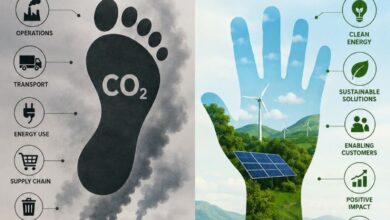
In the global effort to combat climate change, the concept of a “carbon footprint” has become a crucial metric. It represents the total amount of greenhouse gas (GHG) emissions caused directly and indirectly by an individual, organization, event, or product, expressed as carbon dioxide equivalent (CO2e). Understanding and managing your carbon footprint is the first step towards meaningful climate action.
The GHG Protocol: Your Guide to Emission Scopes
To provide a standardized framework for measuring and reporting GHG emissions, the GHG Protocol was established. It is the most widely used international accounting tool for government and business leaders to understand, quantify, and manage greenhouse gas emissions. The Protocol categorizes emissions into distinct “scopes” to help organizations identify where emissions originate and where reduction opportunities lie.
- Scope 1 Emissions (Direct Emissions): These are emissions that come directly from sources owned or controlled by your organization. Think of the fuel burned in your company vehicles, emissions from manufacturing processes, or the natural gas used to heat your buildings. These are the emissions you have the most direct control over.
- Scope 2 Emissions (Indirect Emissions from Purchased Energy): These emissions result from the generation of electricity, heating, or cooling that your organization purchases and consumes. Even though the emissions occur at the power plant or utility, they are a direct consequence of your energy consumption. Switching to renewable energy sources for your purchased electricity is a prime example of a Scope 2 reduction strategy.
- Scope 3 Emissions (Other Indirect Emissions): This is often the largest and most complex category, encompassing all other indirect emissions that occur in your organization’s value chain, both upstream and downstream. This can include a wide array of activities such as:
- Upstream: Emissions from the production of purchased goods and services, business travel, employee commuting, waste generated in operations, and transportation and distribution of materials.
- Downstream: Emissions from the use of sold products, end-of-life treatment of sold products, and franchises. Managing Scope 3 emissions often requires collaboration with suppliers, customers, and other partners in your value chain.
Beyond the Official Scopes: The Concept of Scope 4 – Avoided Emissions
While not yet officially recognized by the GHG Protocol, Scope 4 – Emissions Avoided is an emerging and increasingly important concept in corporate sustainability discussions. This refers to the GHG reductions that occur outside a product’s lifecycle or value chain, but as a direct result of using that product or service.
For example, a company producing highly efficient LED light bulbs might claim Scope 4 emissions avoided because their product helps consumers significantly reduce their electricity consumption and thus their Scope 2 emissions. Similarly, a software company offering a solution that optimizes logistics could claim avoided emissions due to reduced fuel consumption by their clients.
While challenging to quantify and verify, Scope 4 offers a way for businesses to highlight the positive climate impact of their innovative products and services, showcasing their contribution to a broader transition to a low-carbon economy.
Why Does Your Carbon Footprint Matter?
Understanding and actively working to reduce your carbon footprint is no longer just a corporate social responsibility initiative; it’s a strategic imperative. In the face of escalating climate change, businesses have a powerful role to play in driving sustainability. By taking measurable steps to reduce emissions across all scopes, organizations can:
- Mitigate Climate Risks: Reduce exposure to future carbon taxes, regulatory changes, and physical climate impacts.
- Enhance Brand Reputation: Attract environmentally conscious consumers, investors, and talent.
- Improve Operational Efficiency: Often, emission reduction strategies lead to cost savings through energy efficiency and waste reduction.
- Innovate and Gain Competitive Advantage: Develop new sustainable products and services that meet evolving market demands.
- Contribute to a Sustainable Future: Play a vital role in the global effort to limit warming and build a more resilient planet.
By embracing the GHG Protocol and actively working to minimize their carbon footprint, businesses can contribute significantly to a more sustainable future, benefiting both their operations and the planet.
source: