Movement how to take back our streets and transform our lives
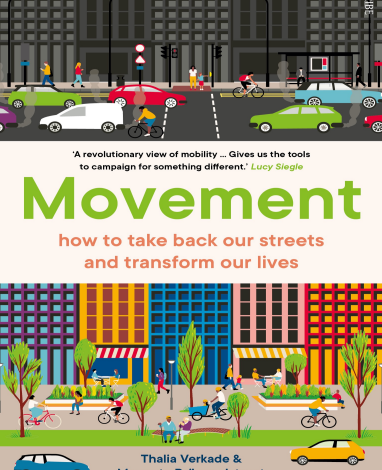
This book is about our streets and why we take it for granted that they are designed first and foremost for movement from A to B, rather than incorporating other uses that could benefit our communities in different ways. I’m Thalia, a journalist based in Rotterdam, in the Netherlands, and I had never asked myself this question before I started writing this book. For me, the street was just a place outside my front door that I walked, cycled, or drove through on my way to somewhere else. The road markings, lanes,
boxes, and traffic lights were necessary to ensure people’s safety; I didn’t think much more about them. What I did think about, while waiting at a red light yet again, was why things couldn’t be faster and more efficient.
Then I met Marco, the ‘Cycling Professor’, a specialist in urban mobility who’d led a very different life to me, and who, as a social scientist, asked different questions. Such as: why do we accept that public space is unsafe and we need road markings and a highway code to make it safe? And: have our streets become through roads precisely because people view them as the exclusive domain of fast-moving traffic and design them accordingly? And: is this why people increasingly behave like mechanical moving parts in a
traffic system instead of living, thinking human beings?
It was this clash between our implicit world views that sparked this book, a three-year shared journey of discovery into the possibilities of our streets. We’ve investigated and questioned the choices and mechanisms underpinning how these public spaces are designed, and looked at how they
could be different, and we’d like to invite you to come along for the ride.
Just one significant caveat: read this book and you may well find that you can never look at the street outside your front door in the same light again. We can’t, and many people who’ve read our book in Dutch have told us they’ve had the same experience.
And now there’s an English edition. This has made us reflect on the relevance of our story in an international context. Almost everywhere, streets are designed on the basis that those who can travel at the highest speed, in the chunkiest vehicles, take precedence. And that includes in the Netherlands.
You may be surprised to learn this, as we have the reputation of being a cyclist’s paradise, with 37,000 kilometres (nearly 23,000 miles) of cycle paths, many of them segregated. We’ve also developed bike traffic lights, rain sensors that reduce cyclists’ waiting times at traffic lights in wet weather,
bike-friendly speed bumps, roundabouts with priority for cyclists, bike parking garages, bike highways (segregated cycle paths for fast-moving commuters), and bike streets (streets where cyclists have priority over motorists for once). Sounds great, right?
Yet we in the Netherlands are also coming to understand the limitations of our solutions. Our infrastructure, designed for cyclists alongside motorists, has led to a situation in which everyone can now get from A to B with maximum speed and efficiency. Cyclists can ride at full tilt, just like motorists, each traffic category in its own segregated channel. But has this made our streets safer? Studies suggest not in the Netherlands, a higher proportion of people are killed in traffic accidents than in the UK,
1 , 2 and in 2019 every sixth victim was a cyclist killed in a collision with somebody driving a car, lorry, or van. Aside from this, what about people who want to move at a leisurely pace? What about children playing outside their homes? What about the street as a place to meet neighbours; a place with shade,
plants, water; a place of belonging? Assigning everyone their own fastmoving channel further reinforces the notion that streets exist to accommodate drivers or speedy cyclists, rather than as public space to be
shared by us all. We’ve also lost sight of the fact that bicycles have the advantage of enabling people to get about while also allowing the street to serve other purposes. And we’ve forgotten that getting about doesn’t have to be a chore it can also be an activity with a value of its own.