How to achieve a walking and cycling transformation in your city
Walking and cycling are the cleanest ways to get around a city, and both can have enormous benefits for health, greenhouse gas emissions, air quality, road safety and equity. Cities as diverse as Bogotá, Copenhagen, Montréal and Barcelona are leading the way in encouraging walking and cycling – and experience from cities like Seville shows how rapid that this transition can be.
To make walking and cycling attractive options cities must focus on safety, convenience, culture and comfort for people on bike and foot. This is relatively straightforward in engineering terms, but can be politically challenging due to opposition from groups that expect to be negatively impacted.
Here is the walking and cycling infrastructure that cities need; the policies, programmes and public messaging that encourage people to use them; and lessons from leading cities on how to make it work for everyone.
Secure a mandate to roll out walking and cycling – and act quickly to reap the rewards within a single political term
Poll the public. Consider polling the public on whether investment in walking and cycling infrastructure would be good for the city, particularly if active travel investment wasn’t part of the city administration’s election manifesto. The answer is commonly yes, delivering a strong mandate for immediate action.
Face opposition. Giving up road space in favour of walking and cycling usually attracts some opposition from car and taxi drivers, businesses concerned about loss of trade and delivery vehicles. Opposition typically comes from a vocal minority. Cities can raise the profile of the supportive majority, including through a positive poll and working with supportive community groups, to help win the local argument.
Move quickly. Support for walking and cycling infrastructure usually increases further once it is built and people are using it. It can also garner support for the next city election campaign.
Aim to build a network but begin with a smaller pilot if necessary. A permanent, comprehensive network is vital in order for residents to treat walking and cycling as transportation.1 Nevertheless, ‘tactical urbanism’ or ‘pop-up’ urbanism approaches (that make temporary and low-cost changes) provide a cheap way to pilot innovative ideas, refine them and implement them more widely. How to implement street transformations: A focus on pop-up and interim road safety projects provides comprehensive advice, informed by the experiences of cities around the world.
Polling residents in Seville, Spain
When the Mayor of Seville polled residents in 2006 on whether cycling infrastructure would benefit the city, 90% of respondents agreed. Seville then built an 80km network of segregated bicycle lanes in just 18 months, mostly by repurposing 5,000 on-street parking spaces. Crucially, this was done within a single mayoral political term. The cycle network was immediately popular. The number of trips taken by bike per day increased by over 11 times in just a few years, and the city is now one of the best in Europe for cycling.2 Hear from local experts who guided and tracked Seville’s transformation in How Seville became a city of cyclists.
Paris’s support for people walking and cycling
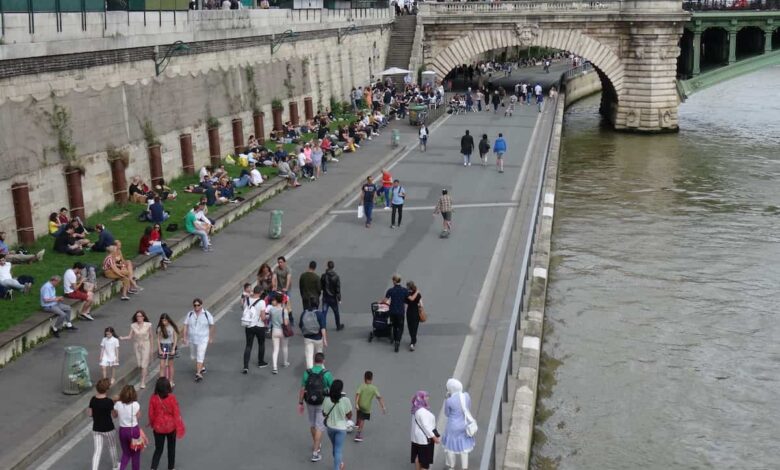
Mayor Hidalgo of Paris will ban most vehicle through-traffic crossing the city centre in 2024 to cut pollution and noise, and create space for walking and cycling. The zone’s residents, people with disabilities, public transport vehicles and those used for deliveries or services will still be allowed access, but the ban will eliminate 55% of total traffic – more than 100,000 cars – passing through the zone on average per day. The through-traffic ban was delayed to allow for an in-depth public consultation and impact study; 78% of respondents in the first consultation phase were in favour.3 Paris is also reclaiming 50% of on street parking for walking and cycling, and designing a 650km cycle network out to the city periphery. The city has already barred heavily polluting diesel cars from within the beltway, pedestrianised the Seine quayside, restricted car access on many major streets and expanded sidewalks in areas previously reserved for cars.4
Photo credit: Jeanne Menjoulet / Flickr (CC BY 2.0) – Bank of the Seine, Paris
Focus on what the city stands to gain and be flexible with the details
Positive messaging is critical to win majority support. Promote what the city and its residents and businesses will gain rather than what car users stand to lose. For example, instead of talking about shutting down streets to cars and removing parking spaces, use positive language that focuses on how this will make the local area a better place by opening streets to people, creating destinations that attract visitors, cleaning the air and tackling congestion and road danger. Cities can also emphasise the investment case, including the increased private investment, property values and retail sales associated with more walkable and bike-able streets.5, 6, 7
Janette Sadik-Khan’s advice: do bold experiments that are cheap to try out
Janette Sadik-Khan was Transportation Commissioner for New York City under the Bloomberg administration. In her TED talk she talks about the projects that have reshaped street life in five boroughs in in the city and how they became reality – including pedestrian zones in Times Square, high-performance buses and a 6,000-cycle-strong bike share.
Ensure participatory and flexible infrastructure design. At the local level, ensure that the design process for new cycling and pedestrian infrastructure is participatory. Be prepared to be flexible with the details to address concerns and maintain popular support. Usually, people who live on a street are in favour of improving walking and cycling infrastructure, and the opposition comes from those who drive through. Seek public input at the local design stage about how, not whether, to add bike lanes and other key infrastructure. Pop-up or tactical urbanism projects can help to build support.
Integrate climate adaptation into walking and cycling projects. Any investments into walking and cycling should be resilient to current and future climate scenarios, and during extreme weather events. This ideally this should be considered at the planning stage, but can be incorporated into existing infrastructure and schemes. Reducing climate change impacts on walking and cycling provides an overview of options. Street upgrade and construction projects also offer cost-effective opportunities to improve the city’s permeability to reduce flooding and expand the tree canopy to provide cooling citywide.
Walking and cycling infrastructure is relatively inexpensive
In Seville, the whole 80km network of segregated cycle lanes serving 70,000 trips each day cost €32 million. This is equivalent to building 5 or 6 kilometres of highway, and contrasts with the €800 million cost of Seville’s metro line, which serves 44,000 trips a day. However, walking and cycling infrastructure rarely generate revenue, so governments will usually need to commit their own funds to build it.
Bike-share schemes often attract private investment. A rapidly expanding number of cities have negotiated public-private partnerships with companies who pay for the bike share infrastructure in return for the advertising opportunity from naming and branding rights.
For cities in developing countries, multilateral development banks are increasingly interested in supporting cycling and pedestrian infrastructure. For example, the city of Bogotá is receiving support from the Interamerican Development Bank to plan and design its Quinto Centenario project, a new 25km-long cycle avenue that is expected to support 34,000 bicycle trips during morning commute hours.
Photo credit: Elliott Brown / Flickr (CC BY-SA 2.0) – Seville, Spain
Use the full range of infrastructure options to improve the walking and cycling experience
Grow cycling by improving equity and accessibility
Understand who is – and who is not – currently cycling in your city, and the barriers to cycling for target groups. Integrate equity considerations into cycle infrastructure, cycle hire schemes and street design. Promote cycling as a fun, safe and appealing way to move around the city for everyone.
Street space in most cities is disproportionately skewed towards motorists. Even in Barcelona, one of the most walkable cities in the world, 60% of street space is devoted to cars despite only 14% of the population using one regularly. In Copenhagen, the most bicycle-friendly city in the world, cars still have 66% of road space despite only 9% of trips being made by car.8, 9 To encourage people to travel by foot or bike, cities need to rebalance the distribution towards people walking and cycling.
Addressing this imbalance requires cities to redesign neighbourhoods and traffic systems to work in favour of people cycling and walking, and to discourage car use. This will make journeys quicker, safer and more comfortable. It will also make journeys feel safer, which is almost as important for cycling uptake.
Cities should build a combination of the following infrastructure options:
- Pedestrianised streets and widened sidewalks. To make walking an attractive option, footpaths need to be in good condition and well lit, with wide sidewalks and continuous footways, and traffic speeds and car parking kept low. For detailed guidance on how to design the built environment to maximise walking, read Pedestrians First: Tools for a Walkable City.10
- Raised, segregated and wider bike lanes. These are proven to be far more effective at encouraging cycling and improving safety (and perceived safety) than cycle lanes painted on the street. They are also harder to reverse if the next city administration takes a less favourable view of cycling. The Urban Bikeway Design Guide and Designing for all ages and abilities explain more.
- Bike hire infrastructure. This includes bikes, docking stations and vehicles to transport them. Read the Bike Share Station Siting Guide, as well as this on walkable station siting.
- Secure bike parking infrastructure. Bike parking should be visible and prominent to ensure cyclists can find it, and to make bike theft more difficult. Select racks that provide at least two points of contact with the frame to enable bikes to be locked up securely, and ensure parking doesn’t obstruct pedestrians. Also invite businesses to request or install bike parking on their premises, as Portland does.
- Traffic light signalling that prioritises people travelling by foot or bike. This allows people shorter waiting time to cross the road and helps cyclists to avoid red lights (with assumed speeds of around 20 km/h), sometimes known as the ‘green wave’. Rotterdam has installed rain sensors at intersections so that when it starts to rain the traffic lights prioritise people cycling.11
- Intersections redesigned to maximise safety for people rather than traffic speed. The Global Street Design Guide is an incredibly detailed, comprehensive and visual guide for designing streets that prioritise people walking, cycling and using public transport, including intersections as well as the points above. Designing streets for kids builds on it, focusing on the needs of children and their caregivers as pedestrians and cyclists.
These infrastructure options are technologically simple as well as quicker and cheaper to implement than alternative transportation investments. They should be coupled with schemes to incentivise walking and cycling, as described below.
Cities can maximise walking and cycling success in the longer-term by designing cities that promote walking and cycling within a comprehensive transit-oriented development strategy, as well as by pursuing ‘15-minute city’ approaches.
Walking and cycling in a 15-minute city
Adopting a 15-minute city approach means striving for an urban model that allows everyone in every neighbourhood to meet most of their daily needs within a short walk or bike ride. This means reclaiming street space from cars and developing people-centred streets and mobility to build thriving, vibrant neighbourhoods. A growing number of cities around the world are adopting the 15-minute approach and reaping local social, economic and environmental benefits. Read this for advice on designing streets for those walking and cycling as part of a wider 15-minute city strategy.
Protecting active transport mode shares in African cities
Many African cities have a large percentage of walking and – to a lesser extent – cycling transport mode shares. For example, Addis Ababa, Nairobi, Dar es Salaam and Lagos all have active mode shares of more than 40%.12 This makes them fundamentally walking and cycling cities, and maintaining these mode shares will have significant long-term benefits. However, they often lack the infrastructure and design to make it safe, comfortable and aspirational. Many of the resources linked above include examples from the region, alongside other global cities. Also read Streets for Walking and Cycling: Designing for Safety, Accessibility and Comfort in African Cities for tailored guidance for African cities.
Ensure cycling and walking networks are connected with other transport networks
Where walking and cycling infrastructure leads from and to is just as important as the types of infrastructure built. Cities need to ensure that walking and cycling networks connect with other transport networks, and with key areas of the city.
Walking and cycling are commonly used to get to and from longer-distance transit hubs, such as train stations (sometimes known as ‘last mile’ transport stages). Cities can focus on these areas and their connections to other high activity areas.
Consider the barriers that prevent people from cycling. This toolkit helps cities to tailor an action plan for quickly growing and improving cycling in the city.
In the long run, aim to turn all streets into bike and people-centred streets, rather than a sparse selection of ‘cycling network’ streets, so that the street map is the bike network map. Amsterdam’s success in implementing this approach is a key reason why it is such a fantastic city for cycling.13
Also consider partnering with neighbouring municipalities to create cycling networks that span longer distances, providing facilities for people traveling from outside the city as well as within the city boundary. Cycle Superhighways: How we built an inter-municipal network in Denmark explains how 29 Danish municipalities achieved this.
Putting walking first in Barcelona14
When Ada Colau campaigned to be Mayor of Barcelona in 2015, the city was suffering from congestion, pollution and a lack of green space. She focused her transportation policy platform on reclaiming Barcelona’s streets as enjoyable and healthy places to walk. Mayor Colau introduced the now celebrated ‘Superblock’ strategy in 2016 with the goal of reducing car and moped use by 21%. The strategy uses the city’s historic grid-based street layout and involves pedestrianising groups of three-by-three city blocks, limiting motorised access to single-lane streets around their perimeters.
Following a pilot in the area of Poblenou in 2016, by August 2021 there were six Superblocks in Barcelona. The municipality plans to eventually build 500 of them, including a super-Superblock across nine city centre blocks which was announced in November 2020, to be completed by 2030.15
Proactive and transparent communication with residents and business-owners, an emphasis on equity in the locations of the blocks, as well as investment in designing new public spaces in the intersections and streets formerly occupied by roads, have been central to the Superblock’s success. You can hear from Barcelona City Council’s mobility advisor and Barcelona residents about how the scheme works in the eight-minute video below. Vox’s five-part series also offers useful insights.https://www.youtube.com/embed/jq2yd4QgL5I?rel=0
Replicate schemes proven to incentivise walking and cycling
The main non-infrastructure programmes that have been proven to boost walking and cycling, especially when implemented in parallel with physical street improvements, are:
- Cycle-hire schemes. Bike-share schemes that allow anyone to hire a bike for short trips, either from a docking station or using dock-less bikes, have multiplied dramatically over the past decade. Many cities are now upgrading these schemes to include electric bikes, helping people to complete long or hilly journeys by bike. Bike-share and e-bike share require the infrastructure investments described above alongside a managed cycle-hire scheme. Docked bike-share schemes can be delivered by the city or in partnership with a private sector sponsor. Read the Bikeshare Planning Guide for more information. Dockless bike-share schemes are usually implemented by a private company alone and should be accompanied by regulations to define service areas and rules on where bikes can be parked. Read Optimizing Dockless Bikeshare for Cities.
- ‘Car-free street’ or ‘open-street’ days. Close down select main streets on Sundays and public holidays or more for walking, cycling and leisure. This practice was first used in Bogotá in the 1970s with its Ciclovía days and has since spread around the world. It has proved enormously popular wherever it is introduced.
- Cycling and road safety lessons. People with little experience of cycling can feel nervous about starting to travel by bike, especially when their city has not had a reputation for cycle safety in the past. Partnering with local NGOs to provide free road safety and bike maintenance lessons, often through workplaces and schools, can be a great way to help people gain the confidence to give cycling a try.
- Bike- and walk-to-work (or school) days. Organise and publicise an annual or monthly ‘bike-to-work day,’ with accompanying events, snack stations and bike maintenance services to get people out on their bikes.
- Cycle-to-work programmes. These are schemes to ease the upfront cost of purchasing a bike and related equipment, and to reduce the overall cost. The employer pays the upfront cost, which is then paid back through the employee’s monthly salary. Cycle-to-work programmes are usually arranged by national governments, so cities can lobby for their introduction if they don’t already exist. Where they do exist, cities can raise awareness among local employers and workers.
- ‘School streets’ initiatives. These schemes restrict pass-through vehicle traffic at drop-off and pick-up times, and can encourage school journeys to be taken on foot or by bike. School streets are easy and cheap to implement, will improve road safety and air quality, and can help alleviate transport and health inequalities. Examples include Barcelona’s Protegim Les Escoles (‘Let’s protect Schools) and Active and Safe Routes to School programmes run by several Indian cities. London’s local-borough led School Streets have reduced air pollution around schools by 23%, with 18% parents driving less and 81% parents supporting the measures.16
Make the journey to school and streets close to schools a priority
Safe active trips to school support children’s physical and mental health and sociability, encourage independent and active mobility throughout their development and into adulthood, and can improve classroom behaviour. Journeys to school and drop-off are often correlate to peaks in air-pollution exposure and child traffic incidents, including for children who are driven to school. Where it is common for parents to drive children to school, those journeys can account for a significant proportion of vehicles on the road at peak hours, contributing to emissions, air pollution and congestion, and are a common source of stress for children and parents alike. There is appetite for change.
For practical advice and good examples, read:
- Why the school commute should be a priority in your city’s sustainable mobility plans.
- How cities can enable safe and sustainable journeys to school.
Consider how e-scooters fit into your city’s mix
Privately-operated electric stand-up scooters, or ‘e-scooters’, are increasingly used in cities as form of urban transport. Cities have a responsibility to ensure e-scooter users are safe but should prioritise the requirements of people who walk, cycle or use public mass transit. E-Scooters and Climate Action: Contributions and potential risks, The new e-scooter generation: How cities and operators are working together for increased safety and Maximising the benefits of e-scooter deployment in cities provide guidance on managing and regulating this. The Micromobility Policy Atlas tracks policies and regulatory frameworks related to micromobility (e-bikes, shared e-scooters and e-bikes, mopeds) across the world.
Incentivise e-bikes and cargo bikes for delivering goods and services
Photo credit: acme59 / Flickr (CC BY-NC-ND 2.0)
The way that goods move around cities is changing, accelerated by the stay-at-home mandates of the COVID-19 pandemic. Cities can incentivise the use of e-bikes and cargo bikes as an affordable, clean and efficient solution for urban logistics and freight. Use of cargo bikes can also help to trigger a wider local bicycle culture, foster social enterprise, engage residents and transform public spaces.
Cities can:
- Ensure regulations and infrastructure are in place to provide access to cycle lanes and loading zones. Cities can increase parking spots for cargo bikes in popular courier zones. New York City introduced regulation that allows e-cargo bikes preferential curb-side access to loading zones usually reserved for trucks and vans.17
- Increase delivery microhubs to allow last-mile deliveries to be done by e-bikes or cargo bikes. These are urban consolidation centres located between major suburban warehouses and final delivery destinations. Cities with declining car dependency have an opportunity to repurpose underutilised car parks. Parcel lockers in public spaces in residential areas can also increase delivery density.
- Restrict polluting delivery vehicles in the city through the introductions of Low or Zero Emission Zones. These restrictions will encourage businesses to pilot e-bike and cargo bike deliveries. Cities can provide financial support to these businesses to further encourage them to make the switch.
How to enable e-cargo bike delivery on the path to zero emission freight and How cities can establish micro-logistics hubs to reduce urban freight emissions and congestion offer more detailed guidance.
Also read A Mayor’s Guide to Cargo Bikes and NACTO’s Building healthy cities in the doorstep-delivery era, which maps urban freight solutions from around the world.
Communicate the many benefits of walking and cycling to the public to promote uptake
The main reasons why residents chose to walk or cycle are:
- Quicker journey times. For trips within cities, cycling and (for shorter journeys) walking is often the fastest way to travel. This is cited as the biggest motivation for people who cycle in Copenhagen, with 56% of people cycling because of the speed.18, 19
- Exercise. The Mayor of London, Sadiq Khan, has taken a health-focused approach with his Healthy Streets for London transport planning strategy. The strategy focuses on boosting walking and cycling as a way to tackle London’s ‘inactivity crisis.’
- Low cost. Walking is free, and cycling is significantly cheaper than travel by car.
Improving access to walking and cycling also has equity benefits, and cities should involve local stakeholder groups in the design of schemes to ensure inclusive uptake. In New Orleans, United States, cycling infrastructure investments have been targeted to promote equitable access to healthy transportation options for minorities and those living in low-income neighbourhoods.20 In Cambridge, UK, improving cycling infrastructure has allowed 26% of all commutes by disabled people to be made by bike.21 Countering the overwhelmingly white and male ridership of New York City’s Citi Bike programme, the NYC Better Bike Share Partnership set up in 2015 has expanded eligibility for discounted membership to minority residents of Brooklyn’s Bedford Stuyvesant neighbourhood, resulting in a 257% membership rise in the first year alone.22
The Healthy neighbourhood explorer tool can be used to support cities in designing walking and cycling friendly cities, as well as measuring the health, economic, and climate benefits of walking and cycling. However, while broader benefits for the city, such as improved air quality and congestion, are important for building support and investment case for walking and cycling, they are less effective arguments for driving individual uptake than the personal benefits. Using language like ‘people walking and cycling’ or ‘travelling by foot or bike’ can achieve better results than ‘pedestrians and cyclists’, which may alienate or fail to resonate with residents – ‘cyclists’ often conjures an image of lycra-clad experienced riders, while car users, even if they don’t consider themselves to be ‘pedestrians’, will already walk (and perhaps cycle) sometimes.
Designing walking and cycling journeys to work for all in New Orleans
New Orleans has been working to improve cycle safety and cycling uptake for a decade. Since 2011, the city has doubled the number of bike lanes. However, by 2017 the most dangerous areas for cycling coincided with high-poverty neighbourhoods and ridership in these areas was lower.23
To address these equity concerns, New Orleans introduced a public bike scheme called BlueBikes, designed to serve locals rather than tourists. The city and partner non-profit organisations conducted extensive community engagement to determine where to locate bike stations. They launched the scheme in December 2017 with 700 bikes, installing 70 stations in a few weeks.
The city designed the scheme to be as easy as possible to sign up for and, critically, included a heavily discounted membership plan for low-income residents. Residents without bank accounts are able to pay for membership using cash. BlueBikes enjoyed significant demand in the first three years of operation – the operator racked up 680,000 rides totalling a million miles travelled.24 The scheme was paused in March 2020 due to complications with the management company changing hands, and re-launched in August 2021 with pedal-assisted electric bikes. It is now operated by a local non-profit, and sponsored by an insurer.
Source: