
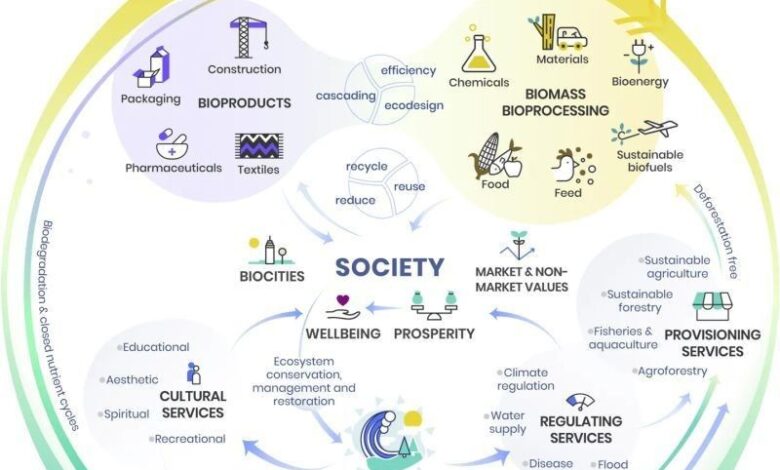
Circular bioeconomy of wellbeing
Navigating the Polycrisis: Can a Regenerative Bio-economy Chart Our Path to Survival?
Humanity stands at a perilous crossroads, facing an unprecedented convergence of environmental catastrophes. We are not just confronting a single crisis, but a “Triple Planetary Crisis”: rampant pollution, escalating climate change, and devastating biodiversity loss. The numbers paint a grim picture: we’ve already transgressed 7 out of 9 planetary boundaries – the safe operating limits that allow human life to thrive on Earth. To make matters worse, we are teetering on the edge of five critical climate tipping points, which, if crossed, could unleash irreversible and catastrophic ecosystem changes.
The stark reality is underscored by the World Economic Forum (WEF), which identifies extreme weather events and significant changes to Earth’s systems as the most severe long-term hazards confronting humanity. Adding to this urgency, the United Nations Environment Programme’s (UNEP) COP28 report issues a dire warning: surpassing the 1.5°C global warming threshold is becoming increasingly likely, threatening truly catastrophic consequences. This is our polycrisis, an intertwined web of challenges aggravated by our pervasive waste management issues and an entrenched over-reliance on fossil fuels.
The Bio-economy Emerges: A Beacon of Hope?
Amidst this daunting landscape, a powerful concept has emerged as a potential lifeline: the bio-economy. Championed by a growing chorus of experts, the bio-economy offers a transformative vision. It advocates for leveraging renewable natural resources (primarily biomass) to produce not only energy, materials, and food, but also valuable byproducts extracted from waste. This innovative approach holds immense promise for mitigating various global disasters by decoupling economic growth from resource depletion and environmental degradation.
Consider some of the compelling bio-economy-based solutions already gaining traction:
- Bioplastics (packaging): Offering sustainable alternatives to fossil fuel-derived plastics, reducing pollution and carbon footprint.
- Biofuels (especially bioethanol for mobility solutions): Providing cleaner energy for transportation, lessening our dependence on fossil fuels.
- Biochar (for soil rejuvenation and carbon sequestration): A powerful tool for improving soil health, enhancing agricultural productivity, and locking away atmospheric carbon.
- Biobased fibres (for textiles and accessories): Creating sustainable materials for fashion and other industries, moving away from synthetic, petrochemical-based options.
- Biobased materials (feedstock, construction, furniture, cosmetics): Expanding the use of renewable resources across diverse sectors, fostering circularity.
Countries are already recognizing this potential. India’s Biotechnology for Economy, Environment, and Employment (BioE3) policy has been instrumental in accelerating the growth of its bio-economy industry. In a bold declaration, India’s Union Minister, Dr. Jitendra Singh, recently asserted that the bio-economy is poised to drive the next industrial revolution.
The Path Forward: Towards a Regenerative, Circular Bio-economy
However, the journey towards a bio-based future is not without its complexities. The nascent bio-economy industry, despite its promise, is currently plagued with controversies. These can range from concerns about land use competition with food production to the sustainability of sourcing raw biomass.
This underscores a critical imperative: we must not merely shift from one extractive model to another. To truly unlock the transformative potential of the bio-economy for inclusive and equitable progress, our focus must squarely be on developing a regenerative, circular bio-economy. This means designing systems that not only utilize renewable resources but also minimize waste, maximize resource efficiency, and actively regenerate ecological systems, ensuring a truly sustainable future for all.
The urgency of our current polycrisis demands nothing less than this holistic, forward-thinking approach. The bio-economy, guided by principles of regeneration and circularity, could indeed be the key to charting a new, safer course for humanity.
source:


