Circular economy
The 6.9% Illusion: Why Our Economy is Still a Straight Line
The pursuit of a Circular Economy a system where waste is eliminated and resources are kept in use is the defining economic challenge of our time. Yet, the stark data from the Circle Economy’s 2025 Circularity Gap Report reveals a devastating truth: we’re barely inching forward.
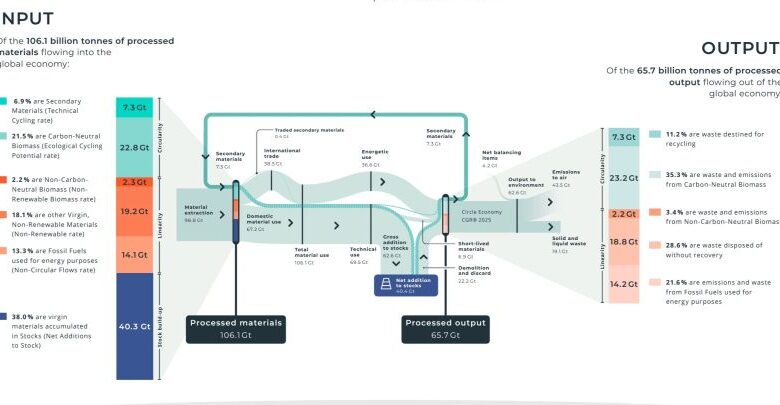
Only a meager 6.9% of global material inputs are cycled back into the economy.
That single digit is the smoking gun, proving that the vast majority of our industrial systems are still trapped in the destructive, linear model of take-make-waste. We are not operating in a circle; we are rushing down a dangerously straight line.
The Staggering Scale of Waste
Every year, an astronomical 106.1 billion tonnes of processed materials flood the global system. Here is the breakdown of why this inflow is so utterly unsustainable:
- The Recycling Myth: Despite decades of awareness campaigns, the reality is bleak. Only 7.3 Gigatonnes (Gt) of materials are actually secondary (recycled) inputs. This tiny fraction highlights our overwhelming dependency on virgin resources.
- The Inert Blockade: A massive 40.4 Gt of materials are instantly locked away into long-term infrastructure buildings, roads, and utilities that will not be available for reuse for decades, if ever.
- The Great Escape: The single largest flow is out of the system. An incomprehensible over 65.7 Gt of materials flow back out annually as waste or emissions. We are simply discarding more than half of everything we process.
The Failure to Recover
The output side of the equation confirms the industrial tragedy: our waste management is fundamentally broken:
- Disposal Dominates: A crushing 28.6% of materials are simply discarded dumped into landfills or incinerated, with no chance of ever being recovered or reused.
- Recycling as an Afterthought: True recycling accounts for only 11.2% of the material output. This proves that recycling, in its current form, is a small, overwhelmed band-aid on a hemorrhaging system.
The 6.9% figure is not just a metric; it’s a global indictment. It shows that our economy is built on a foundation of planned obsolescence and deliberate waste. We are extracting resources at a breakneck speed, only to rapidly turn them into permanent waste.
Moving to a truly circular world requires more than just better bins; it demands a radical, immediate redesign of our products, our business models, and our infrastructure. We must stop the linear flow before it drowns us in waste and depletes the last of our resources.
source: