The waste sector contributes up to 20% of global methane emissions
The Hidden Threat: Why Waste Management is the Next Frontier in Climate Mitigation
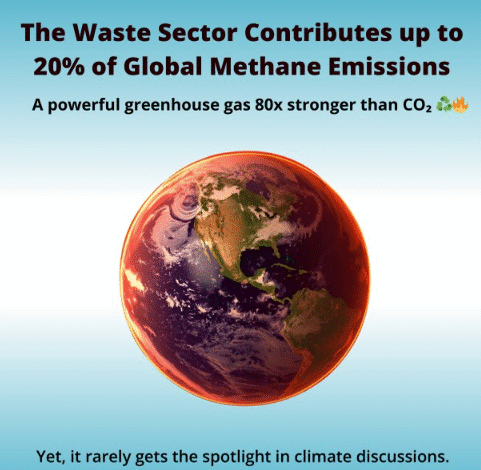
While global climate dialogues often center on tailpipes and power plants, the most potent and rapidly growing source of short-term warming is quietly bubbling up from our landfills: methane ($\text{CH}_4$) from waste. The waste sector is a crucial, yet frequently overlooked, climate challenge, contributing up to 20% of global methane emissions.1 This isn’t just a sanitation problem; it’s a profound global warming issue that demands immediate strategic attention.
Methane: The Overlooked Greenhouse Gas
Methane is a fierce, short-lived climate pollutant. Over a 20 year period, it is over 80 times more potent at trapping heat than carbon dioxide CO2. When we ignore waste management, we are actively fueling the current acceleration of global heating.
Here is the harsh reality of why poor waste management is a direct amplifier of the climate crisis:
- The Methane Machine (Organic Decay): The anaerobic decomposition of organic waste (food scraps, yard trimmings) in open dumps and unmanaged landfills is the single largest driver of CH4 from the sector.
- Carbon Release (Plastic Burning): Burning plastic waste, often practiced in communities lacking formal collection, directly releases CO2 and a cocktail of persistent, toxic pollutants into the atmosphere.
- Embodied Carbon Loss: Every item we throw away carries an “embodied carbon footprint” the energy and emissions spent mining, manufacturing, transporting, and selling that product. When we fail to recycle or reuse, we permanently lose the opportunity to avoid emissions associated with creating new materials from virgin resources.
- The Indonesian Crisis Point: In contexts like Indonesia, where more than 40% of waste still ends up in open dumps, the sector’s contribution to national GHG emissions is significant and drastically under-addressed. These open dumps become uncontrolled biogenerators of methane.
The Paradigm Shift: From Afterthought to Accelerator
Treating waste management merely as a local operational service is a relic of the linear economy. Viewing it as a climate priority unlocks immediate, measurable Greenhouse Gas (GHG) reductions and drives us toward the circular economy.
The most effective climate action in the waste sector is not complicated; it is fundamentally about eliminating the sources of methane:
- Source Reduction: Drastically reducing the amount of organic waste that reaches landfills.
- Diversion and Valorization: Implementing widespread composting and anaerobic digestion to capture methane (for energy) or turn organic waste into soil enhancers.7
- Material Recovery: Achieving high recycling and reuse rates to maximize embodied carbon savings.
When organizations and governments shift their focus to treating waste as a resource that must be managed for climate mitigation, we unlock one of the fastest pathways to curb global warming in the near term. That crucial shift from operational afterthought to climate strategy must begin today.
source: