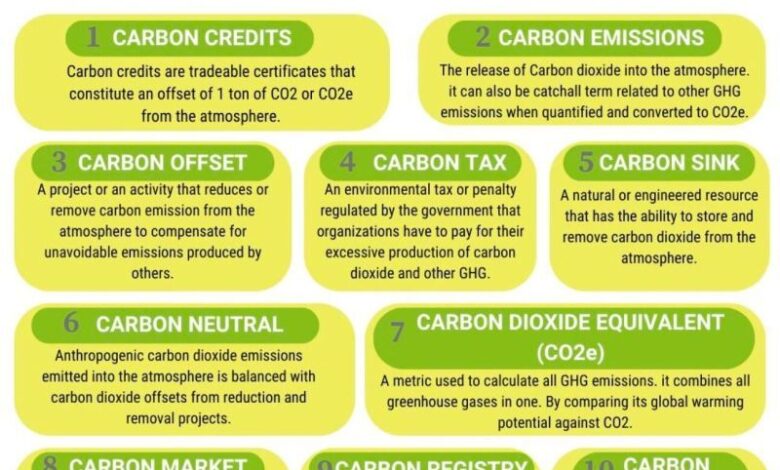
10 basic carbon terms you need to know
Mastering the Language of Net Zero: Your Guide to Strategic Climate Leadership
The race to achieve Net Zero emissions by 2050 is the defining economic and operational challenge of our era. Yet, without a precise, shared vocabulary, corporate strategies stall, investments misfire, and public trust erodes.
Clarity is not optional it is the foundation of credible climate action and strategic decision-making.
This is your essential toolkit 10 terms that define the global transition and separate genuine pioneers from passive participants.
The 10 Non-Negotiable Terms of the Net Zero Transition
Understanding these concepts is the first step toward building a robust and accountable Net Zero plan:
| Term | Strategic Definition & Impact | Contextual Example |
| Carbon Emissions | The raw output of Greenhouse Gases (GHGs) across Scopes 1, 2, and 3. Strategy begins here you can’t manage what you don’t measure. | Tailpipe exhaust (Scope 1) vs. purchased electricity (Scope 2) vs. supply chain transport (Scope 3). |
| CO₂ Equivalent CO2e | The standard metric for comparing all GHGs (Methane, N2O, F-gases, etc.) based on their Global Warming Potential. | Methane is roughly 28x more potent than CO₂ over 100 years, so 1 ton of methane = 28 tons of CO₂. |
| Carbon Accounting | The rigorous, auditable process of measuring, verifying, and reporting your complete CO2e footprint. | Mandated by regulators (like the SEC or EU’s CSRD) to ensure transparency for investors and stakeholders. |
| Carbon Neutral | A first-step designation achieved when residual emissions are balanced by equivalent offsets. Crucially, this is NOT Net Zero. | A company offsets 100% of its reported emissions by purchasing credits from a certified project. |
| Carbon Offset | Projects (e.g., reforestation, renewable energy) that reduce or remove a unit of CO2e to counterbalance emissions elsewhere. | Often a temporary, transitional tool; increasingly scrutinized for its additionality and permanence. |
| Carbon Credits | Verified units representing 1 ton of CO2e that has been avoided or removed, traded across carbon markets. | Used by companies to fulfill compliance obligations or to meet voluntary offsetting goals. |
| Carbon Market | The infrastructure (compliant or voluntary) where Carbon Credits are bought and sold, establishing a financial price for carbon. | The EU Emissions Trading System (ETS) is the world’s largest compliance market. |
| Carbon Registry | Independent platforms that track, verify, and publicly certify the issuance and retirement of carbon credits to ensure unique ownership and avoid double-counting. | Verra and Gold Standard are trusted entities for validating credit quality and integrity. |
| Carbon Sink | Natural systems (forests, oceans, soil) or engineered technologies (Direct Air Capture) that absorb and permanently store CO₂. | Critical to achieving true Net Zero these are the mechanisms that actively remove hard to abate residual emissions. |
| Carbon Tax | A government-imposed fee on CO2e emissions, designed to put an explicit price on pollution and drive behavioral change and investment in clean technologies. | Creates a powerful economic signal that makes polluting activities more expensive than cleaner alternatives. |
Beyond Definitions: The Net Zero Imperative
Net Zero is the strategic endpoint: the point at which an entity minimizes its absolute emissions to near zero, and any remaining, residual emissions are neutralized by permanent Carbon Sinks.
- The Transition: The journey demands radical decarbonization (reducing absolute emissions) first, before relying on offsets.
- The Mandate: Investors, consumers, and regulators are demanding verifiable, science-aligned pathways, not just promises. Your credibility hinges on using this vocabulary precisely.
Net Zero is not a marketing term; it is an engineering, financial, and moral commitment.
source: