Mexician scientist cactus biodegradable that breaks like a fallen dissolves in about 7 days
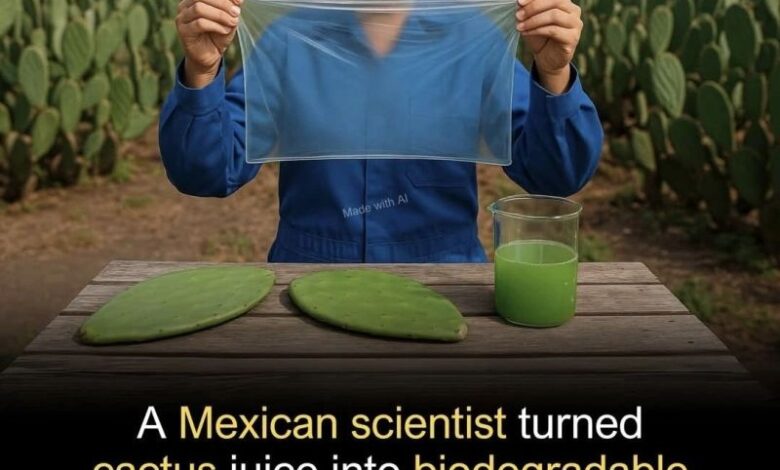
The Nopal Revolution: Engineering Biodegradable “Plastic” from Mexican Cactus
While the world struggles with a plastic crisis that lasts for centuries, Mexican researcher Sandra Pascoe Ortiz has looked toward the desert for a solution. By harnessing the Nopal cactus (Opuntia ficus-indica), she has developed a bio-polymer that mirrors the utility of plastic but returns to the earth in record time.
The Science of Synthesis: From Juice to Polymer
The transformation of a prickly cactus into a flexible packaging material is a precise biochemical process. Unlike synthetic plastics derived from crude oil, this material uses the natural sugars and gums (mucilage) found in the cactus.
- Extraction: The juice is pressed from the cactus leaves (cladodes).
- Formulation: The juice is mixed with a proprietary blend of non-toxic additives, including glycerin and natural waxes, to improve its structural integrity.
- Lamination: The liquid mixture is poured into thin sheets and dried, resulting in a material that has the appearance and feel of traditional plastic.
Rapid Decomposition: A Seven-Day Life Cycle
The most revolutionary aspect of cactus plastic is its “end-of-life” efficiency. Conventional plastics (PET or HDPE) take up to 500 years to break down.1 In contrast, this bio-material offers three modes of disposal:
- Water Solubility: If placed in a glass of water, the material will dissolve completely in about one week.
- Composability: In soil, it decomposes just like a fallen leaf, typically vanishing within a month.2
- Safety: Because the ingredients are 100% organic and food-grade, the material is safe if accidentally ingested by wildlife or marine creatures.
Comparison: Synthetic vs. Cactus Biopolymer
| Feature | Conventional Plastic | Cactus Biopolymer |
| Base Material | Petroleum / Fossil Fuels | Nopal Cactus Juice |
| Carbon Footprint | High (Extraction & Refining) | Carbon Neutral (Cactus absorbs $CO_2$) |
| Ocean Longevity | Centuries (Microplastic risk) | ~7 to 30 Days |
| Toxicity | Contains Phthalates/BPA | Edible and Non-toxic |
Strategic Advantages for Global Cities
The Nopal cactus is an incredibly resilient crop that thrives in arid conditions where nothing else grows.3 This makes it a low-impact raw material that doesn’t compete with food crops for fertile land or water resources. For cities aiming for “Zero Waste” targets, this material could replace
The Path Forward
While currently in the prototype and small-batch production phase, the goal is to scale this technology for industrial use. By blending indigenous botanical knowledge with modern polymer science, Mexico is providing a blueprint for a future where our waste doesn’t outlive our grandchildren.
source: