A natural fit renewable energy and sustainable land management
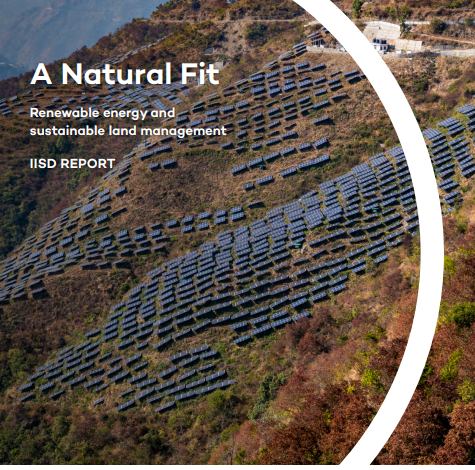
As the world transitions to renewable energy to achieve its climate goals, attention must be given to the land-energy nexus. Renewable energy technologies solar, wind, bioenergy, hydropower, and geothermal interact with land systems in complex ways, influencing land integrity, ecosystem services, and socio-economic outcomes. How can we transition rapidly to renewable energy systems, which are vital for limiting global warming, without undermining land health, ecosystem functions, and the rights and livelihoods of people depending on these lands? This primer explores challenges and opportunities associated with the transition to renewable energy and examines approaches to ensure that the expansion of renewable energy installations supports sustainable land management (SLM) and sustainable land-use systems, improves local livelihoods, and drives progress toward the objectives of the Rio Conventions and Sustainable Development Goals (SDGs).
The world is set to decarbonise rapidly. To avoid catastrophic climate change impacts, the world must rapidly transition away from fossil fuels toward renewable energy sources. The Intergovernmental Panel on Climate Change (IPCC) highlights that climate mitigation options, including solar and wind power, are becoming increasingly cost effective and accepted by the public. The global clean energy transition is gathering speed. In 2024, renewables accounted for 29.9% of global electricity generation, 46% of total installed power capacity, and over 90% of newly added capacity. Solar power increased by a record 29%, continuing the trend of doubling global solar capacity every 3 years. The expansion of renewable energy
will further accelerate as key sectors like industry and transport electrify to reduce their greenhouse gas emissions and increase the share of electricity in total energy consumption from 25% in 2023 to 55% in 2050 to achieve the target of the Paris Agreement on Climate Change to limit global warming to 1.5 °C above pre-industrial levels.
Renewable energy sources are key to power development. The rapid expansion of renewable energy is fuelled by a continuing decline in costs. The average levelised cost of electricity, a measure of the lifetime cost per unit of energy produced, for solar power, for example, has declined by approximately 85%–90% since 2010, making it one of the cheapest sources of electricity in many locations by 2024.5 At the same time, the cost of enabling technologies like battery storage and grid management technology is also decreasing, opening opportunities for integrated renewable systems that combine intermittent solar and wind energy with stable renewable sources like geothermal and bioenergy. The scalability of these systems makes them a potentially viable solution to connect the 666 million people who still
lack access to electricity to the grid and provide clean alternatives to the 2.1 billion people who still rely on traditional biomass for cooking.
On average, renewable energies require more land than fossil fuels. Some renewable energy systems, including solar and wind power, have higher land-use intensity of energy(LUIE) (a measure of the land footprint required to produce 1 terawatt-hour of electricity per year [ha/TWh/y]) than fossil-fuelled generation. The higher land footprint has raised concerns that the prospect of a rapid clean energy transition could have adverse impacts on land quality and compete with other land uses, such as food production, biodiversity conservation, carbon sequestration, and livelihoods.
source:
https://www.iisd.org/publications/report/renewable-energy-land-management