Vertical argree lo
Breathing Walls: How Microalgae Panels are Re-Engineering Urban Air
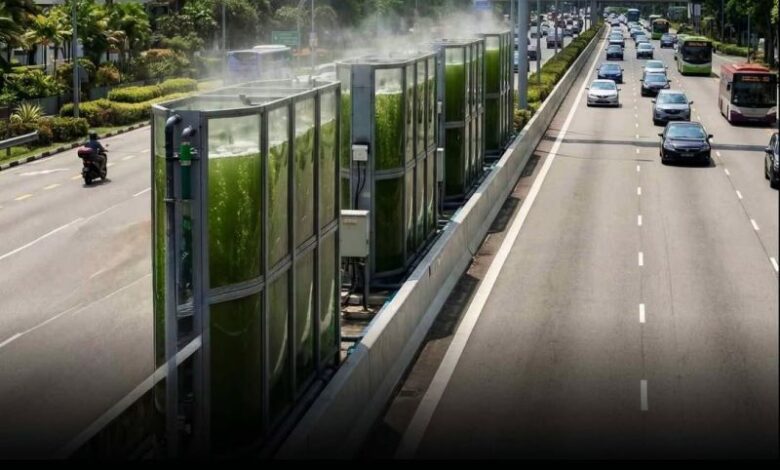
Urban highways are the “exhaust pipes” of our modern cities, acting as concentrated corridors for CO2, nitrogen oxides (NOx), and particulate matter. To neutralize this, Singapore is pioneering a shift from static concrete to bioreactive infrastructure: Vertical Algae Panels.
This isn’t just landscaping; it is high-performance biological engineering designed to turn highways into massive, living filters.
1. The Biological Engine: Why Algae?
Microalgae are nature’s most efficient carbon-capture machines. While trees are vital, microalgae can be up to 10 to 50 times more efficient at absorbing CO2 than terrestrial plants per unit of surface area.
- Photosynthetic Speed: Algae grow at an exponential rate, doubling their biomass in as little as 24 hours under optimal conditions.
- Space Optimization: In land-scarce cities like Singapore, planting a forest along a highway is impossible. A vertical panel provides the same carbon-scrubbing power of several mature trees while occupying only a fraction of the footprint.
2. How the Bioreactor Works
These panels function as “closed-loop photobioreactors.” Integrated into highway sound barriers and building facades, the process follows a sophisticated cycle:
- Capture: Ambient air, thick with vehicle emissions, is pumped into the water-filled panels.
- Conversion: Using sunlight and the high concentration of CO2 from traffic, the algae perform rapid photosynthesis.
- Oxygenation: Pure oxygen is released back into the roadside micro-environment.
- Filtration: The panels also trap particulate matter (PM2.5), preventing it from drifting into nearby residential zones.
3. Beyond Air Quality: The Multi-Layered Benefits
The integration of algae panels creates a “triple-win” for urban planners:
- Thermal Regulation: Through evaporative cooling and shading, these living walls mitigate the Urban Heat Island (UHI) effect, cooling the concrete surfaces of highways that otherwise bake in the sun.
- Acoustic Insulation: The liquid and biomass within the panels act as a natural dampener, absorbing high-frequency tire and engine noise more effectively than hollow plastic barriers.
- Circular Economy: This is where the technology shines. The excess algae the “waste” of the system is harvested and converted into:
- Biofuels: Powering the very transport systems that created the emissions.
- Nutrient-rich Fertilizers: For urban farming initiatives.
- Bioplastics: Creating carbon-neutral packaging.
4. Comparison: Traditional Greenery vs. Algae Panels
| Feature | Roadside Trees | Algae Panels |
| Space Required | High (Root systems/canopy) | Minimal (Vertical/Flat) |
| Growth Rate | Years to reach maturity | Days to reach peak efficiency |
| CO2 Absorption | Standard | Ultra-High (10-50x) |
| Maintenance | Trimming/Soil management | Fluid circulation/Automated harvesting |
| End Use | Aesthetic/Shade | Biomass for Fuel/Fertilizer |
The Future of the “Living City”
As we move toward COP 30 and beyond, the definition of a “smart city” is evolving. It is no longer just about sensors and data, but about biological integration. Singapore’s exploration of algae panels suggests a future where our infrastructure is not just “less bad” for the environment, but actively regenerative.
By turning the gray scars of our highways into vibrant, green lungs, cities can finally begin to breathe again.