
Roadmap to sustainability
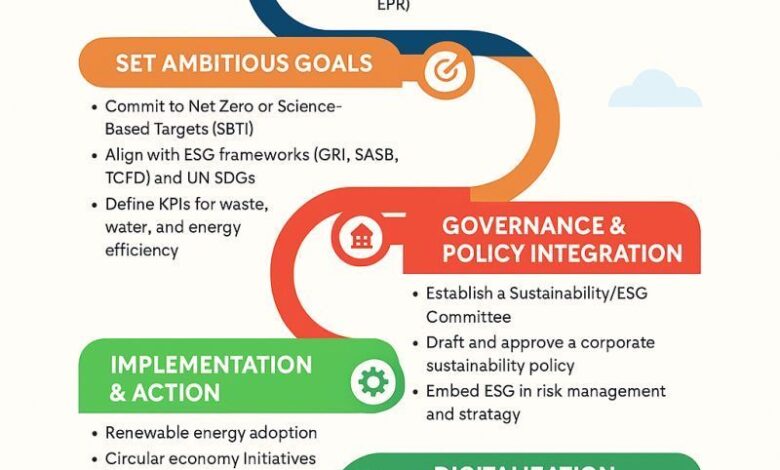
Building a roadmap from Strategy to Impact isn’t about checking boxes; it’s about a fundamental re-engineering of how a corporation breathes, consumes, and creates value. Here is the blueprint for moving beyond ambition into hard-coded resilience.
Phase 1: The Audit of Truth (Baselines & Compliance)
You cannot manage what you do not measure. The journey begins with a brutal, data-driven assessment of your current environmental debt.
- The Emission Triad: Identifying the footprint across Scope 1 (direct), 2 (indirect energy), and the often-elusive Scope 3 (entire value chain).
- Resource Auditing: A deep dive into the “Metabolism of the Firm” how much water is cycled, how much energy is bled, and how much waste is truly recovered.
- The Regulatory Shield: Mapping current operations against a tightening web of global ESG obligations to identify immediate legal and financial risks.
Phase 2: Decoupling Growth from Impact (Goals & KPIs)
Once the baseline is established, the organization must set “North Star” targets that are grounded in science, not just PR.
- Science-Based Targets (SBTi): Moving beyond vague “Net Zero” claims toward rigorous, time-bound emissions reductions aligned with the 1.5o pathway.
- The KPI Dashboard: Translating the UN Sustainable Development Goals (SDGs) into granular corporate metrics energy intensity per unit, circularity rates, and water neutrality milestones.
Phase 3: Structural Integration (Governance & Policy)
Sustainability fails when it lives in a silo. It must be woven into the fiduciary DNA of the company.
- The ESG Committee: Elevating sustainability to board-level oversight, ensuring that environmental risks are treated with the same gravity as financial audits.
- Risk Management 2.0: Embedding climate scenarios into every merger, acquisition, and capital expenditure decision. If a project doesn’t survive a “Climate Stress Test,” it doesn’t get funded.
Phase 4: The Circular Execution (Implementation)
This is where the “Paper Strategy” hits the “Factory Floor.”
- Energy Sovereignty: Transitioning from fossil-fuel dependency to on-site renewables (like PLTS) and Power Purchase Agreements (PPAs).
- The 10R’s of Circularity: Moving from a “Take-Make-Waste” model to a closed-loop system where waste becomes a secondary raw material.
- Supply Chain De-Risking: Transitioning to Responsible Sourcing, where suppliers are held to the same ESG rigors as the parent organization.
Phase 5: The Digital Twin (Monitoring & Evolution)
Impact is only as credible as the data that proves it.
- Digitalization: Deploying real-time ESG data platforms to replace manual spreadsheets. This allows for Automated Compliance Reporting and proactive intervention before a KPI is missed.
- Radical Transparency: Using data to maintain accountability with investors, regulators, and the public, turning “Impact” into a competitive advantage in the capital markets.
Sustainability transformation is a marathon, not a sprint but the starting gun has already fired. A clear roadmap doesn’t just “save the planet”; it builds a future-proof business that is leaner, smarter, and more attractive to modern capital.


