
Top plastic waste generating countries
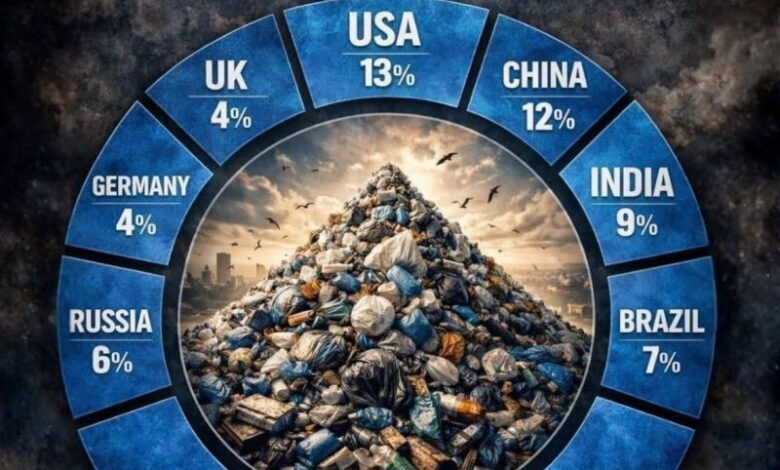
1. The Heavyweights: A Tale of Two Realities
The rankings reveal a startling divide between high-income consumption and high-population production.
The Consumption Leader: United States (~42M tonnes)
While China and India have massive populations, the U.S. leads the world in waste generation per person. This is driven by a “disposable-first” culture and a sophisticated retail supply chain that wraps almost every consumer good in polymers.
- The Hidden Factor: A significant portion of U.S. plastic waste is exported to other nations, meaning its “footprint” often lands on shores thousands of miles away.
The Production Giants: China & India (~56M tonnes combined)
As these economies have modernized, their plastic footprint has exploded. However, both nations have recently pivoted toward aggressive policy shifts:
- China’s “National Sword” Policy: In 2018, China stopped accepting the world’s plastic trash, forcing Western nations to rethink their own recycling failures.
- India’s Single-Use Ban: India has implemented some of the world’s strictest bans on specific single-use plastics to protect its fragile urban drainage systems.
2. The Efficiency Gap: Generation vs. Management
Total tonnage only tells half the story. The real environmental “danger zone” occurs where high waste generation meets low waste management infrastructure.
| Country | Mismanaged Waste Risk | Primary Infrastructure Challenge |
| Indonesia | High | Archipelago geography makes centralized collection difficult. |
| Brazil | Medium | High reliance on informal waste pickers (Catadores) for recycling. |
| Germany | Low | High generation, but world-leading incineration and recycling rates. |
3. The “Invisible” Impact: Microplastics & Air
We often focus on the plastic we can see the bottles in the river or the bags on the street. But the “Other 120+ Million Tonnes” from the rest of the world contribute to a more insidious problem: Atmospheric Plastic.
- The Breakdown: Plastic doesn’t biodegrade; it photodegrades into microscopic particles.
- The Cycle: These particles are now light enough to be carried by wind. Microplastics have been found in the snow of the Pyrenees and the rain over the Rocky Mountains. We aren’t just swimming in plastic; we are breathing it.
4. The Path Forward: From “Recycling” to “Redesign”
The data makes one thing clear: We cannot recycle our way out of 350+ million tonnes of waste. The infrastructure simply doesn’t exist to handle the volume.
The shift must move toward Upstream Solutions:
- Extended Producer Responsibility (EPR): Forcing companies to pay for the “end-of-life” of their packaging.
- The Treaty Move: The UN is currently negotiating a Global Plastic Treaty a legally binding agreement to end plastic pollution, focusing on the full lifecycle of plastic rather than just the litter.
“The future of our planet depends on what we choose to do today.”
The numbers are a warning, but they are also a blueprint for where the intervention needs to happen. By targeting the top-generating industries and nations with circular technology, we can turn the tide on the “Plastic Age.”
source:


