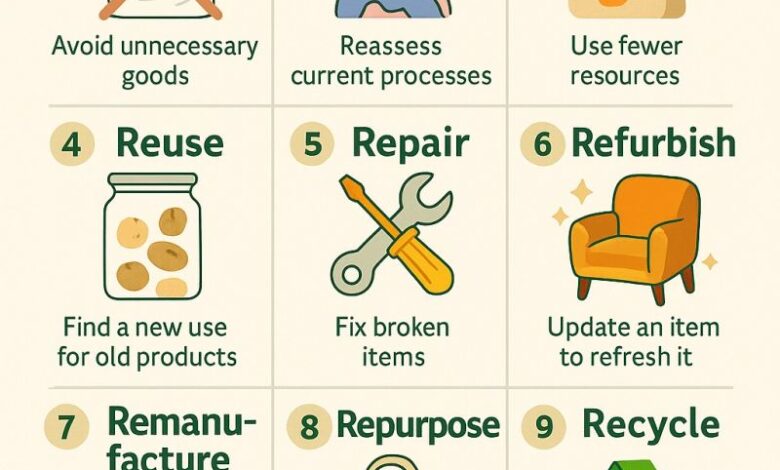
9Rs of circularity
Re-engineering Value in a Resource-Finite World
The traditional “Linear Economy” (Take–Make–Waste) is no longer a viable business model it is a systemic risk. As resource scarcity accelerates and regulatory pressures mount, the global economy is undergoing a fundamental pivot toward Circular Design Thinking. The goal is a total decoupling of economic growth from environmental degradation.
At the core of this revolution is the 9Rs Hierarchy, a strategic roadmap designed to eliminate the very concept of “waste” through intelligent system design.
1. The Power of Prevention (The “High-Value” Tier)
The most effective way to manage waste is to never create it. The top of the hierarchy focuses on smarter design and consumption.
- R0 | Refuse: Eliminating non-essential materials and processes at the source. It is the ultimate form of efficiency—using zero resources to achieve an outcome.
- R1 | Rethink: Questioning the delivery model. Why sell a product when you can sell a service? (e.g., “Lighting as a Service” instead of selling bulbs).
- R2 | Reduce: Engineering for minimalism. Achieving the same utility with a fraction of the raw material and energy input.
2. Life-Cycle Extension (The “Value Retention” Tier)
Once a product enters the economy, the strategic goal is to keep it at its highest utility for as long as possible.
- R3 | Reuse: Facilitating a second life for products through robust design and sharing economies.
- R4 | Repair: Defeating “planned obsolescence” by designing for modularity and ease of maintenance.
- R5 | Refurbish: Restoring aesthetic and functional quality to bring products back to contemporary standards.
- R6 | Remanufacture: Industrial-scale restoration where components are tested and reassembled to original specifications, often with the same warranty as new goods.
3. Material Recovery (The “Last Resort” Tier)
When a product reaches its terminal state, we pivot from preserving the object to preserving the molecules.
- R7 | Repurpose: Shifting an object into a different functional domain (e.g., turning old shipping containers into modular housing).
- R8 | Recycle: The final safety net. Processing materials to create raw inputs for new products.
The Strategic Insight: While recycling is vital, it is the least efficient R. It requires high energy input and often results in “downcycling.” The true economic gains are found in the higher tiers (Refuse through Remanufacture).
4. Circularity as a Competitive Moat
For modern enterprises and governments, adopting the 9Rs is no longer a matter of CSR (Corporate Social Responsibility) it is a Supply Chain Security strategy.
| Strategy | Traditional Model | Circular Advantage |
| Material Sourcing | Volatile Commodity Markets | Predictable “Urban Mining” & Loops |
| Product Design | Linear / Disposable | Modular / Upgradable |
| Revenue Model | One-time Transaction | Recurring Service & Relationship |
| Regulation | Compliance Burden | Early Adoption of Carbon/Waste Taxes |
Designing Out the End
The future economy will not be judged by its throughput, but by its circularity ratio. By treating the 9Rs as a hierarchy of strategic choices, we can transform cities from “waste generators” into “resource hubs.”
Circularity is the only path to a resilient, regenerative future. It is time to stop managing waste and start designing it out of existence.
source: