R-strategies for circular business models
Shifting from a Linear Drain to a Circular Economic Engine
For generations, economic growth has been inextricably linked to the creation of waste. But that paradigm is crumbling. The future of resilient, innovative, and profitable business lies not in extraction and disposal, but in circular thinking a radical approach where resources are perpetually valued, reused, and regenerated.
The 9R Framework is more than just a sustainability checklist; it is the definitive blueprint for a waste-free economy. By systematically redefining how products are designed, produced, and consumed, the 9Rs offer a comprehensive strategic roadmap for resilience and long-term competitiveness.
The Hierarchy of Value: A Strategy for Every “R”
The 9R framework establishes a clear hierarchy, prioritizing actions that keep products and materials at their highest possible value for the longest possible time.
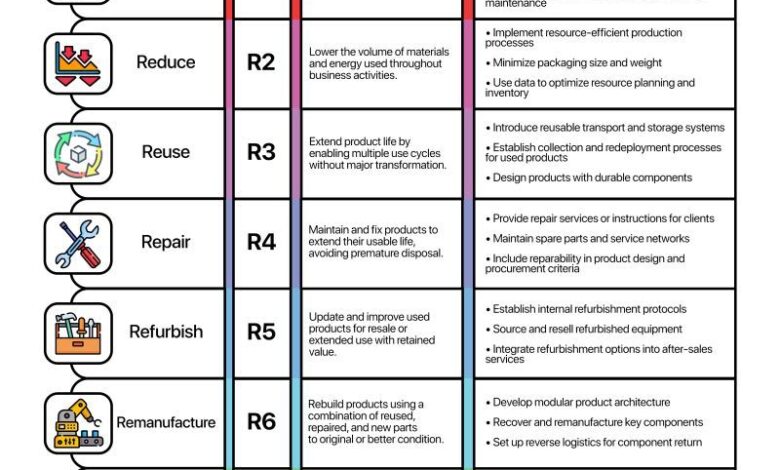
| The R Strategy | Action and Imperative | Economic Impact |
| 1. Refuse (Eliminate) | Stop it before it starts. Design out low-value, wasteful products or materials from the system entirely. | Risk Mitigation: Cuts future waste processing costs and avoids regulatory penalties. |
| 2. Rethink (Innovate) | Change the business model. Shift from selling goods to selling performance (e.g., Product-as-a-Service, leasing). | Resilience: Decouples revenue from resource consumption, fostering customer loyalty and recurring revenue streams. |
| 3. Reduce (Optimize) | Use less, perform better. Optimize production, packaging, and logistics to dramatically decrease virgin resource use. | Efficiency: Reduces input costs and improves margins. |
| 4. Reuse (Share) | Extend the product’s life. Implement sharing platforms, rental services, or deposit schemes to keep products in circulation. | Value Extension: Monetizes the product multiple times without new manufacturing. |
| 5. Repair (Maintain) | Make durability the norm. Design products that are easy to maintain, disassemble, and fix, shifting repair from an exception to a standard service. | Customer Trust: Enhances product lifespan and customer satisfaction, challenging the planned obsolescence model. |
| 6. Refurbish (Restore) | Bring old back to new. Restore used products to a ‘like-new’ functional and aesthetic standard. | New Market Entry: Creates a secondary market channel with lower input costs and attractive pricing for value-conscious consumers. |
| 7. Remanufacture (Rebuild) | Reassemble high-value components. Disassemble complex products (e.g., engines, electronics) and rebuild core components into new products. | Strategic Sourcing: Retains the high embodied energy and material quality of components, saving significant production energy. |
| 8. Repurpose (Re-function) | Give materials a new identity. Use materials or products for a completely new function beyond their original design when their first life ends. | Waste Diversion: Converts unavoidable waste streams into new, marketable assets. |
| 9. Recover (Extract) | The last resort. Extract energy (Energy Recovery) or materials (Recycling) from waste that cannot be practically processed by the other 8Rs. | Resource Security: Minimizes reliance on primary resource extraction and landfill capacity. |
The Future of Growth: Efficiency, Innovation, and Competitiveness
The 9R framework demonstrates that transitioning to a circular economy is not a philanthropic exercise but an economic necessity. Every action within this hierarchy drives critical business outcomes:
- Innovation: The need to Rethink and Redesign products forces breakthrough innovation in materials, disassembly, and service delivery.
- Competitiveness: Businesses that master Repair, Refurbish, and Remanufacture create secondary markets, secure material supply, and reduce vulnerability to volatile commodity prices.
- Resilience: Decoupling revenue from finite resources ensures long-term viability against resource scarcity and climate change impacts.
The 9R Revolution is a powerful mandate: to design out waste, keep products in use, and regenerate natural systems. It’s the playbook for building a robust, sustainable economic future.
source: