Turning Plastic Waste into Floating Farms
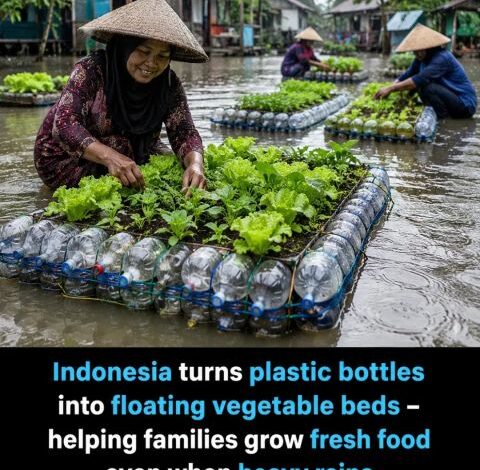
What if rising floodwaters didn’t destroy farmland… but created new growing space?
In Indonesia, communities are transforming discarded plastic bottles into floating vegetable beds—a simple yet powerful innovation that turns climate vulnerability into food resilience.
Instead of treating plastic waste as pollution, it becomes structure. Instead of abandoning flooded land, farming continues above it.
Plastic bottles are collected, cleaned, and assembled into buoyant platforms. Layers of soil and organic material are added on top, creating stable beds where vegetables can grow even when fields are underwater.
This is circular thinking in its purest form:
♻️ Waste is redesigned into agricultural infrastructure
🌊 Flood-prone land is converted into productive space
🥬 Fresh food is grown even during extreme weather
🌍 Local communities gain resilience without heavy capital systems
🌱 Sustainability becomes practical, not theoretical
The impact goes beyond farming.
It redefines how adaptation can work at the community level—using what already exists, rather than relying on complex external systems.
Plastic pollution is one of the most visible environmental challenges of our time. Flooding is one of the most destructive climate risks. This solution sits at the intersection of both—turning two problems into one regenerative loop.
It is not high-tech innovation.
It is high-impact circular design.
And it shows a critical truth:
The future of sustainability will not only be built in laboratories or large infrastructure projects. It will also emerge from simple, scalable ideas that communities can build with their own hands.
When materials are reimagined, even disaster zones can become productive ecosystems.
The question is no longer what is waste.
The question is what waste can become.