
Blue hydrogen
Navigating the Low-Carbon Fuel Transition
As the global energy sector faces immense pressure to decarbonize, Blue Hydrogen has emerged as a crucial transitional fuel. It offers a practical pathway to lower carbon emissions in heavy industries that currently rely heavily on fossil fuels, acting as a bridge toward a fully renewable energy future.
What is Blue Hydrogen & How is it Made?
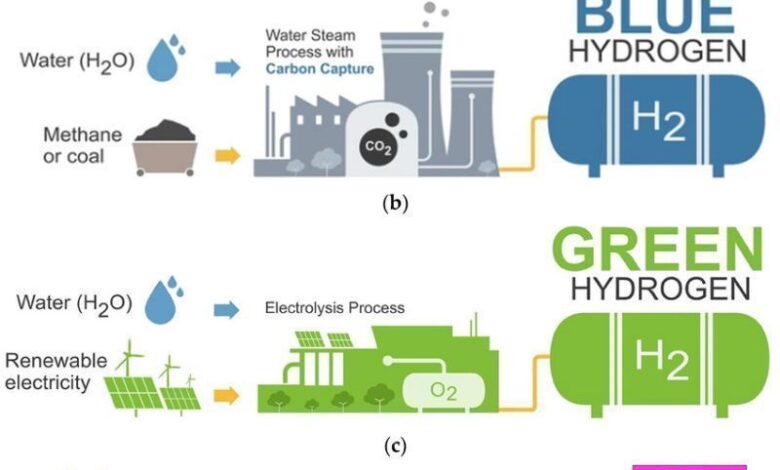
Blue hydrogen is hydrogen produced from fossil fuels—primarily natural gas—where the resulting carbon dioxide ($CO_2$) emissions are not released into the atmosphere. Instead, they are captured and permanently trapped underground using Carbon Capture and Storage (CCS) technology.
The production relies on a multi-step chemical engineering process:
                  [ Natural Gas (Methane) + Steam ]
                                  │
                                  ▼
                     [ Steam Methane Reforming ]
                                  │
                ┌─────────────────┴─────────────────┐
                ▼                                   ▼
         [ Pure Hydrogen ]                 [ Carbon Dioxide ]
                │                                   │
                ▼                                   ▼
      ( Clean Fuel Output )               ( Captured via CCS & )
                                          ( Stored Underground )
- Steam Methane Reforming (SMR): High-temperature steam ($700^\circ\text{C} – 1100^\circ\text{C}$) is combined with natural gas (methane) under pressure. This chemical reaction yields hydrogen gas and carbon dioxide as a major byproduct.
- Carbon Capture: Before the greenhouse gases escape, CCS technology intercepts and isolates the $CO_2$ byproduct.
- Sequestration: The captured carbon is compressed into a liquid-like state and injected deep into geological formations (such as depleted oil and gas reservoirs) for permanent storage, leaving behind clean hydrogen fuel.
The Hydrogen Color Spectrum: A Quick Comparison
Hydrogen is a invisible gas, but the energy industry uses a “color spectrum” to categorize how cleanly it is produced.
| Type | Production Method | Environmental Impact / Byproduct |
| Green | Electrolysis of water powered entirely by renewable energy (solar/wind). | 100% Emission-Free (Only yields water vapor). |
| Blue | Steam reforming of natural gas paired with CCS technology. | Low-Carbon (Emissions are heavily reduced/stored). |
| Grey | Traditional steam reforming of fossil fuels without carbon capture. | High-Carbon (Current industry norm; high $CO_2$ output). |
| Turquoise | Methane pyrolysis (splitting methane using thermal plasma). | Low-Emission (Yields solid carbon instead of $CO_2$ gas). |
| Pink | Water electrolysis powered by nuclear energy. | Zero-Emission (Provides a highly stable, clean supply). |
| Yellow | Water electrolysis using standard grid electricity. | Variable (Cleanliness depends on the grid’s power mix). |
| White | Naturally occurring hydrogen deposits found underground. | Minimal Impact (Directly extracted via mining/drilling). |
Core Market Drivers Accelerating Growth
The blue hydrogen sector is experiencing rapid investment and scaling due to several converging factors:
- Targeting “Hard-to-Abate” Sectors: Industries like steel, heavy-duty transport, marine shipping, and aviation cannot easily run on batteries alone. Blue hydrogen provides the high-intensity chemical energy these sectors require.
- Industrial Versatility: It serves as a seamless, low-carbon replacement raw material in oil refining, chemical manufacturing, and commercial fertilizer production.
- Infrastructure Synergy: Because blue hydrogen relies on natural gas, existing pipeline networks, supply chains, and chemical plants can be retrofitted for its production much faster than building entirely new green hydrogen setups.
- Expansion of Regional CCS Hubs: Massive investments in shared carbon storage networks are driving down the individual cost of carbon sequestration, making blue hydrogen increasingly economically viable.
- The Rise of Fuel Cell Electric Vehicles (FCEVs): Growing global demand for commercial fuel-cell trucks and heavy logistics transport is creating a massive new consumer market for low-carbon hydrogen.
While blue hydrogen is an excellent tool for immediate carbon reduction, its long-term viability will depend heavily on improving carbon capture efficiency rates (ideally above 90%) and driving down production costs to compete effectively as green hydrogen technology matures.
source:


