Plastic free starts with one choice, July calender – 31 days of ideas
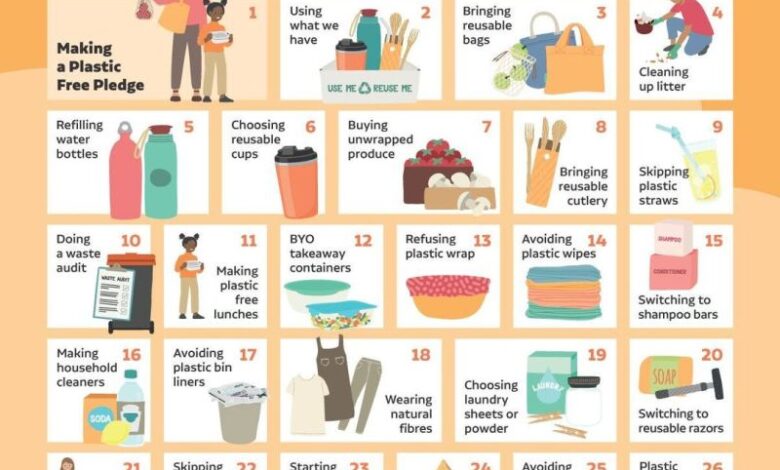
The Compound Effect of Zero-Waste: A 31-Day Systems Blueprint
“Plastic Free July” is often framed as a minor lifestyle challenge for eco-conscious citizens. In reality, it is a behavioral incubator. It highlights a critical systemic flaw: plastic pollution is not merely a waste management failure it is an upstream extraction crisis, a major driver of petrochemical greenhouse gas emissions, and a pervasive threat to global ecologies.
By systematically introducing alternative habits over a 31-day cycle, consumers don’t just change their shopping lists; they actively rewrite market demand signals.
The Lifecycle Paradox: Linear Disruption vs. Circular Resiliency
To understand why small consumer modifications matter, we must contrast the traditional linear lifecycle of single-use plastics against the compound value of reusable alternatives:
| Single-Use Plastic Artifact | Average Utility Span | Environmental Half-Life | Systemic Mitigation (The Reuse Blueprint) |
| Thin-Film Grocery Bag | 12 Minutes | 400+ Years | 1 Canvas/Tote Bag eliminates an estimated 1,500 plastic bags over its structural lifespan. |
| Polyethylene (PET) Bottle | 20 Minutes | 450+ Years | 1 Stainless Steel/Glass Vessel halts the upstream extraction of petroleum required for hundreds of virgin bottles. |
| Polypropylene Straw | 10 Minutes | 500+ Years (Breaks down into microplastics) | Absolute Refusal / Metal Alternative starves the low-margin manufacturing pipeline of demand. |
| Polystyrene Food Container | 15 Minutes | Forever (Fragmentary degradation) | BYO Substrate (Bring Your Own Container) bypasses municipal waste systems entirely. |
The Microplastic Cascade: Why Downstream Cleanups Fail
The article correctly identifies that macro-plastics do not disappear; they fragment. When left in natural environments, UV radiation and mechanical wave action downsize plastic waste into microplastics and nanoplastics (particles smaller than 5 millimeters).
[ Virgin Plastic Production ] ──> [ Short-Term Consumer Utility ]
                                              │
                                              ▼
[ Trophic Transfer in Food Web ] <── [ Microplastic Fragmentation ]
This creates a high-risk loop known as trophic transfer:
- Plastic fragments seep into marine and agricultural topsoils.
- Low-trophic organisms (plankton, earthworms) ingest the synthetic particles.
- Toxins bioaccumulate up the food chain, ultimately depositing microplastics into human lung tissue, bloodstreams, and placentas.
Because microplastics are nearly impossible to filter out of the biosphere once dispersed, upstream prevention via daily consumer friction is the only mathematically viable solution.
Behavioral Economics: Shifting the Market via Choice Architecture
Systemic change does not require immediate, flawless perfection from a small group of people; it requires imperfect, deliberate friction from millions.
When you refuse a single-use plastic item, you are participating in Choice Architecture. Retailers and multi-national consumer goods brands track inventory and velocity metrics in real-time. A sustained, collective drop in the consumption of packaged goods forces corporate procurement strategies to pivot toward circular models: reusable packaging, bulk refilling infrastructures, and localized supply chains.
The Behavioral Maxim:
Sustainability is not an identity; it is a compounding loop of micro-decisions. Your refusal of single-use substrate today is a direct economic vote against fossil-fuel extraction and long-term ecological debt.
source: