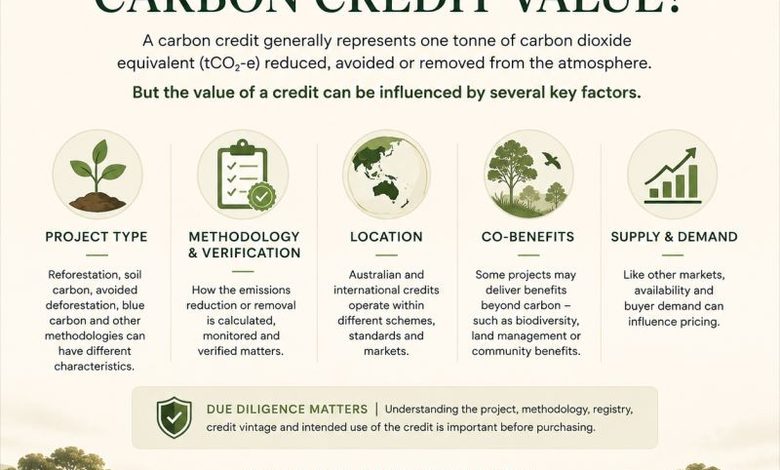
What gives a carbon credit value?
Unlocking Market Dynamics: What Truly Drives Carbon Credit Valuation?
While every carbon credit standardizes the offsetting of one metric tonne of carbon dioxide equivalent (CO2), market pricing varies wildly from under $ 2 per credit to over $ 100 .
This discrepancy exists because a carbon credit is not a homogenous commodity. It is an intricate financial instrument whose valuation reflects risk, durability, compliance utility, and broader ESG co-benefits.
Key Valuation Drivers: Beyond the Headline Price
Understanding carbon credit pricing requires evaluating six core structural criteria:
                  CARBON CREDIT VALUATION MATRIX

  [ HIGH PREMIUM ]   🔥 Removals (DACCS, Biochar, Blue Carbon)
                     🌿 High Co-Benefits (Biodiversity, Indigenous Rights)
                     📜 Strict Verification (ACCUs, Verra, Gold Standard)
                     🗓️ Recent Vintage (Within 2-3 years)

  [ BASE DISCOUNT ]  💨 Avoidance (Renewables, Landfill Gas)
                     🏭 Unverified or Legacy Methodologies
                     ⏳ Older Vintage Years
1. Removal vs. Avoidance (Project Methodology)
- Emissions Removal: Technologies or nature-based interventions that directly strip CO2 from the atmosphere (e.g., Direct Air Capture, Biochar, Reforestation, Blue Carbon) command a significant price premium due to high durability and permanence.
- Avoidance & Reduction: Projects that prevent emissions from occurring in the first place (e.g., avoided deforestation, renewable energy integration) trade at lower valuations due to saturated supply and varying baseline assumptions.
2. Integrity, Rigor & Verification Standards
The credibility of the underlying baseline methodology directly impacts asset liquidity. Credits issued under high-integrity registries with third-party auditing such as Australian Carbon Credit Units (ACCUs), Gold Standard, or Verra (VCS)—carry a premium over unverified or self-reported credits.
3. Co-Benefits & Narrative Alignment
Buyers increasingly target credits that support secondary environmental and social objectives beyond carbon abatement:
- Ecological Co-Benefits: Habitat restoration, soil health improvement, and endangered species protection.
- Socioeconomic Impact: Jobs creation, healthcare infrastructure, and First Nations/Indigenous land stewardship engagement.
4. Vintage & Regulatory Context
- Vintage Year: The year in which the emission reduction occurred. Buyers heavily favor newer vintages, while older credits face steep discounts or corporate policy exclusions.
- Compliance vs. Voluntary Markets: Credits eligible for compliance schemes (such as Australia’s Safeguard Mechanism) carry strict regulatory demand floors, yielding higher and more stable prices than purely voluntary markets.
Comparative Assessment Matrix
| Attribute | Baseline / Low-Cost Credit | High-Value Premium Credit |
| Mechanic | Avoidance / Grid Energy Shift | Permanent Sequestration / Removal |
| Governance | Unaligned / Legacy Voluntary Standards | Tier-1 Registries (e.g., ACCU, Gold Standard) |
| Co-Benefits | Carbon-only focus | Verified Biodiversity + Indigenous Inclusion |
| Buyer Motivation | Lowest-cost volume offsetting | High-integrity ESG claims & risk mitigation |
Navigating the Carbon Landscape
As corporate disclosures transition from voluntary sustainability targets toward mandatory financial reporting, due diligence in carbon procurement is critical. Evaluating project integrity, registry provenance, and methodology durability enables market participants to build resilient, defensible climate portfolios.
Carbon Credit Sales | Australia’s Environmental Marketplace
Connect with verified carbon projects, benchmark credit pricing, and navigate environmental markets with confidence.
source:
https://lnkd.in/p/exYue8Sk