Can Better Land Management Reduce Wildfire Risk? The Answer Begins Long Before the Flames
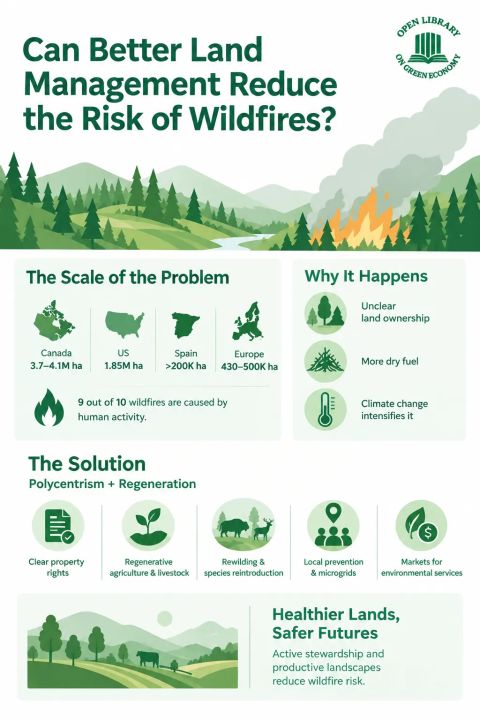
Wildfires are often treated as sudden natural disasters—events that begin with extreme heat, drought, strong winds, or an accidental spark and then rapidly grow beyond human control. But the infographic presents a broader argument: the severity of wildfire risk is also connected to the way landscapes are owned, managed, restored, and economically valued. Fire may be the visible crisis, but some of the conditions that allow fires to become destructive can accumulate quietly for years before the first flame appears.
The scale presented in the infographic illustrates how widespread the challenge has become. It cites wildfire-affected areas of approximately 3.7–4.1 million hectares in Canada, 1.85 million hectares in the United States, more than 200,000 hectares in Spain, and roughly 430,000–500,000 hectares across Europe. The infographic also states that nine out of ten wildfires are caused by human activity. These figures are presented to reinforce a central message: wildfire risk cannot be addressed only through emergency response. Prevention must become part of everyday land management.
Wildfire Risk Is Also a Land-Management Problem
A forest can appear healthy from a distance while conditions on the ground are gradually becoming more susceptible to fire. Dry vegetation can accumulate, abandoned or poorly managed land can become increasingly overgrown, and responsibilities for maintaining particular areas may be unclear. When prolonged heat and dry conditions arrive, these accumulated fuels can contribute to the spread of fire once ignition occurs.
The infographic identifies unclear land ownership as one factor contributing to the problem. This is important because effective landscape management depends on knowing who is responsible for a particular piece of land. If ownership and management responsibilities are fragmented or uncertain, preventive activities can become more difficult to coordinate.
Who clears dangerous fuel accumulation?
Who maintains access routes?
Who restores degraded areas?
Who monitors changes in vegetation?
Who invests in long-term management?
When those responsibilities are unclear, preventive management can fall between institutional boundaries.
This makes land tenure more than a legal or administrative matter. In landscapes vulnerable to wildfire, clear responsibility can become part of disaster-risk management.
Dry Fuel Can Turn a Small Ignition into a Larger Fire
Another factor highlighted in the infographic is the accumulation of dry fuel.
Wildfire needs combustible material. Dry grasses, shrubs, branches, dead vegetation, and other organic matter can provide that fuel. Under suitable conditions, greater quantities of dry material can help fire spread more rapidly or burn more intensely.
This does not mean that forests should simply be cleared of vegetation. Dead wood, leaf litter, shrubs, and other organic materials are also natural components of ecosystems and provide habitat, nutrients, and other ecological functions.
The challenge is therefore one of management rather than indiscriminate removal.
Different ecosystems require different approaches. In some landscapes, vegetation management may be appropriate. In others, grazing, agricultural activity, ecological restoration, prescribed fire where scientifically and legally appropriate, or maintaining landscape mosaics may contribute to managing fuel loads.
There is no universal formula because fire ecology differs dramatically among ecosystems.
The important principle is that wildfire prevention should consider the condition of the landscape before dangerous fire weather arrives.
Climate Change Intensifies the Challenge
The infographic also identifies climate change as an intensifying factor.
This creates an important distinction.
Climate change does not mean that every wildfire is directly “caused” by climate change. Fires require ignition, fuel, and appropriate environmental conditions. But hotter and drier conditions can influence how easily vegetation dries and how favourable conditions become for severe fire.
That means societies increasingly face two connected tasks.
The first is addressing climate change itself.
The second is adapting landscapes to a climate in which dangerous fire conditions may become more difficult to manage.
Fire suppression alone cannot accomplish either task.
A landscape that repeatedly accumulates vulnerabilities will remain vulnerable even if firefighters successfully extinguish individual fires.
Fighting Fire Is Necessary, but Prevention Starts Earlier
Firefighting will always remain essential.
Communities need trained personnel, equipment, evacuation systems, early warning, emergency communications, and rapid response capabilities.
But relying primarily on suppression means intervening after the crisis has already begun.
Better land management asks a different question:
What can be done months or years before ignition to make landscapes and communities less vulnerable when fire eventually occurs?
This shifts attention from emergency management toward risk management.
The distinction is important.
Emergency response asks how quickly a fire can be controlled.
Risk reduction asks why the landscape became so vulnerable in the first place.
A resilient wildfire strategy needs both.
Polycentrism: Wildfire Prevention Cannot Depend on One Institution
The infographic proposes “Polycentrism + Regeneration” as the foundation of its solution.
Polycentric governance recognises that complex environmental problems rarely fit neatly within the responsibility of one organisation. Wildfire risk can involve private landowners, farmers, livestock producers, forest managers, local governments, emergency agencies, environmental organisations, researchers, communities, and regional or national authorities.
A fire does not stop because it reaches an administrative boundary.
Neither should prevention.
A landscape-level approach therefore requires different actors to coordinate while retaining responsibilities appropriate to their roles.
Local knowledge can help identify vulnerable areas.
Government can establish regulation and provide coordination.
Landowners can maintain their properties.
Farmers and livestock managers can contribute to productive landscape management.
Scientists can provide ecological and climate information.
Emergency services can develop response plans.
When these elements operate as an interconnected system, wildfire prevention becomes more than the responsibility of firefighters.
Clear Property Rights Can Support Clear Responsibility
The first solution highlighted in the infographic is clear property rights.
This may sound disconnected from wildfire prevention, but it can have practical consequences. When land ownership and management responsibilities are clearly established, it becomes easier to determine who should maintain vegetation, implement restoration, participate in prevention programmes, or comply with land-management requirements.
Clarity can also support longer-term investment.
A person or community with secure rights and predictable responsibilities may have stronger incentives to improve land condition because the benefits of restoration and productive management can accumulate over time.
However, clarity should not simply mean assigning ownership on paper. Effective governance must also consider customary rights, community use, ecological responsibilities, and the wider effects of management decisions across the landscape.
Fire moves across property boundaries, so even clearly owned land still requires cooperation.
Regenerative Agriculture and Livestock Can Be Part of the Landscape
The infographic also proposes regenerative agriculture and livestock as part of the solution.
This introduces an interesting perspective: productive land does not necessarily have to be separated completely from wildfire prevention.
Appropriately managed agricultural and grazing systems can potentially help maintain active landscapes rather than allowing some areas to become abandoned and heavily overgrown. Livestock grazing, for example, can influence vegetation structure in certain environments, although its effectiveness and ecological impacts depend strongly on stocking levels, timing, vegetation type, climate, and local ecosystem conditions.
Regenerative approaches can also seek to improve soil condition, vegetation diversity, water retention, and overall ecosystem function.
The important word is management.
Poorly managed agriculture can degrade landscapes.
Poorly managed grazing can damage ecosystems.
But carefully designed productive land uses may become part of a broader landscape strategy in appropriate locations.
This moves the conversation beyond a simplistic choice between “nature” and “production.”
Healthy landscapes can sometimes be ecological and productive simultaneously.
Rewilding and Species Reintroduction Add Another Dimension
Another solution shown in the infographic is rewilding and species reintroduction.
Rewilding generally seeks to restore ecological processes rather than simply recreate the visual appearance of nature. In some landscapes, restoring native herbivores or other ecological relationships may influence vegetation structure and landscape dynamics.
However, this approach must be highly context-specific.
Species cannot simply be introduced because they might consume vegetation. Their ecological role, habitat requirements, population dynamics, interactions with agriculture, human-wildlife conflict, and conservation implications all need careful assessment.
The larger lesson is valuable: ecosystems themselves can contribute to landscape management when ecological processes are restored appropriately.
Instead of managing every hectare solely through machinery and human intervention, some landscapes may benefit from recovering natural processes that historically shaped vegetation.
Local Prevention and Microgrids Can Strengthen Community Resilience
The infographic also highlights local prevention and microgrids.
This expands the discussion from forest management into community resilience.
Wildfires can disrupt electricity infrastructure, damage transmission systems, force evacuations, and interrupt essential services. Communities therefore need to think not only about preventing fires but also about maintaining critical functions when disasters occur.
Local energy systems and microgrids can potentially provide resilience for critical facilities when wider electricity networks are disrupted, depending on their design and operating capability.
Meanwhile, local prevention can include preparedness planning, vegetation management around settlements, communication systems, evacuation planning, monitoring, and community education.
This illustrates an important principle:
wildfire resilience is not only about protecting forests from fire; it is also about protecting communities when fire occurs.
Environmental Services Need Economic Value
Perhaps one of the most interesting solutions in the infographic is the creation of markets for environmental services.
Land management costs money.
Restoring ecosystems costs money.
Maintaining vegetation costs money.
Monitoring landscapes costs money.
Yet many of the benefits generated by healthy landscapes—cleaner water, carbon storage, biodiversity, reduced erosion, improved soil, recreational value, and potentially reduced disaster risk—are not always directly compensated through conventional markets.
This can create a mismatch.
Society benefits from well-managed land, but individual landowners may bear much of the cost of maintaining it.
Payments or markets for ecosystem services attempt to address this problem by recognising some of those environmental benefits economically.
If carefully designed, such mechanisms can create incentives for landowners and communities to maintain landscapes in ways that generate broader public benefits.
The key challenge is ensuring that environmental outcomes are genuine, measurable, durable, and socially fair.
Healthy Landscapes Are Not Landscapes Without Fire
There is an important ecological nuance when discussing wildfire prevention.
Not every fire is inherently destructive.
Fire is a natural ecological process in some ecosystems, and certain species and landscapes have evolved with periodic burning. Completely suppressing every fire over long periods can, in some contexts, alter ecological conditions and contribute to fuel accumulation.
The objective should therefore not necessarily be a world in which no vegetation ever burns.
The objective is to reduce the probability that fire becomes catastrophic for ecosystems and communities.
That requires understanding local fire ecology rather than applying the same strategy everywhere.
A tropical peatland, Mediterranean shrubland, boreal forest, grassland, and temperate woodland cannot be managed identically.
Restoration Must Be Designed for the Landscape
The word regeneration is central to the infographic’s proposed solution.
Regeneration means more than planting trees after a wildfire.
A burned landscape may require different responses depending on the severity of the fire and the ecosystem involved.
Some ecosystems can regenerate naturally.
Some require erosion control.
Some may need invasive-species management.
Some need hydrological restoration.
Some require assisted regeneration.
And some severely degraded areas may require active revegetation.
Automatically planting large numbers of trees after every wildfire can therefore be inappropriate.
Restoration should begin by asking what ecological processes have been damaged and what intervention—if any—is needed to help them recover.
The Best Time to Reduce Wildfire Risk Is Before Fire Season
One of the strongest lessons that can be drawn from the infographic is that wildfire prevention should not begin when smoke appears on the horizon.
It begins years earlier.
With land-use planning.
With clear responsibilities.
With healthy soils.
With appropriately managed vegetation.
With functioning rural economies.
With ecological restoration.
With community preparedness.
With monitoring.
With climate adaptation.
And with cooperation between neighbouring landowners and institutions.
Firefighters are the last line of defence.
Land management is part of the first.
Healthier Lands Can Create Safer Futures
The final message of the infographic is simple: active stewardship and productive landscapes can reduce wildfire risk.
The deeper meaning is that abandoned, fragmented, poorly governed, or increasingly dry landscapes can accumulate vulnerability over time. When extreme weather and ignition eventually coincide, the consequences may become far more severe.
Better land management cannot eliminate wildfire.
Nor can it prevent every extreme fire under severe weather conditions.
But it can influence the conditions through which fire moves across a landscape and the resilience of communities exposed to it.
This is why wildfire policy should extend beyond firefighting budgets and emergency equipment. It should also include agriculture, forestry, biodiversity, land tenure, rural development, energy resilience, climate adaptation, and ecosystem restoration.
The most important question is therefore not simply:
“How do we extinguish the next wildfire?”
It is:
“What kind of landscape do we want the next wildfire to encounter?”
A neglected landscape overloaded with vulnerability—or a diverse, actively managed, ecologically functioning landscape with communities prepared for fire?
The answer will determine not whether fires occur, but increasingly how destructive they become.
Source: Can Better Land Management Reduce the Risk of Wildfires?, Open Library on Green Economy (as shown in the supplied infographic).