Climate change isn’t one crisis
Climate change isn’t one crisis.
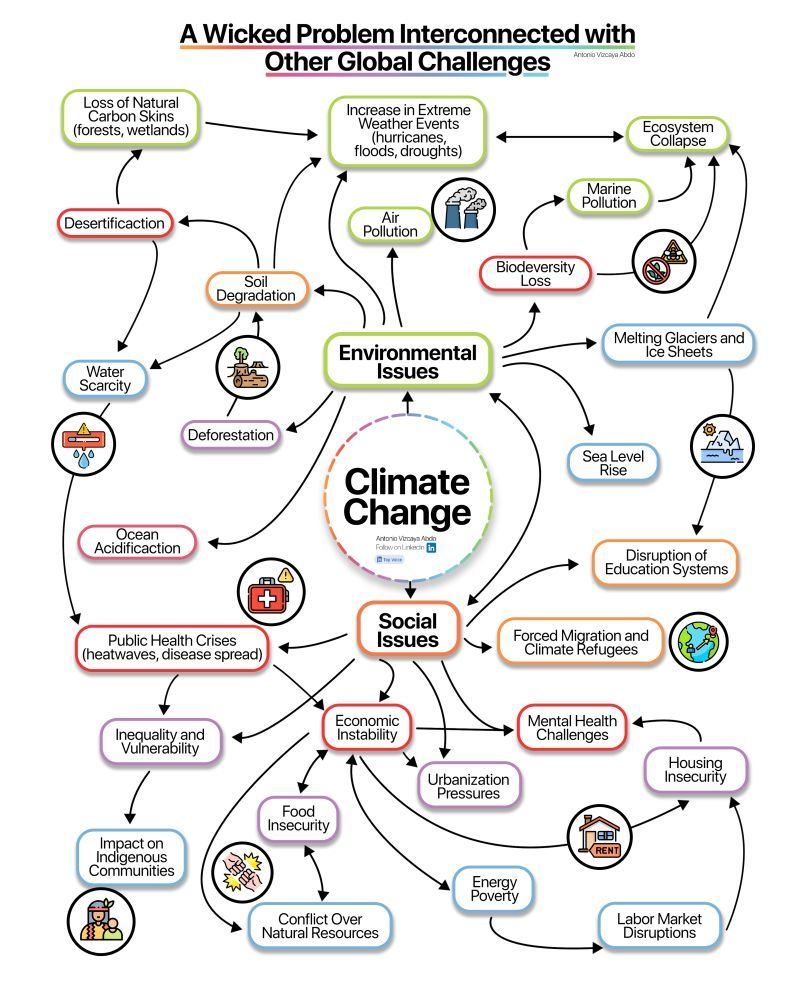
It’s a chain reaction, and most of us only see one link.
Planners Horst Rittel and Melvin Webber coined the term wicked problem in 1973 for challenges with no definitive formulation and no stopping rule, where every problem is a symptom of another.
Climate change fits that definition: the IPCC says its impacts are cascading across sectors and regions, and 3.3-3.6 billion people live in contexts highly vulnerable to it.
At the London Interdisciplinary School, we spent our time tackling complex and wicked problems, and it taught me to follow the chain past the environment to where it lands on people.
The World Bank projects up to 216 million people could move within their own countries by 2050, driven by water scarcity, falling crop productivity and sea-level rise, and says concerted action could cut that by as much as 80%.
↳ Environment feeds society. Drought, flooding and water scarcity don’t stay environmental. The IPCC finds risks to health and food production worsen when sudden crop losses from heat and drought combine with lost labour productivity.
↳ Vulnerability decides who pays. Vulnerability is higher where poverty, governance challenges and limited access to basic services combine, so the same shock hits some communities far harder than others.
↳ Impacts cross borders. Weather extremes ripple through supply chains, markets and natural resource flows, so a flood or drought in one region can become a price, jobs or displacement issue in another.
The challenge is that the problem is connected while our institutions aren’t: energy, health, housing and nature sit in separate departments, budgets and reporting frameworks, so a fix in one can miss, or even worsen, the others.
Which link in this chain do you think gets the least attention?
Graphic: Antonio Vizcaya Abdo